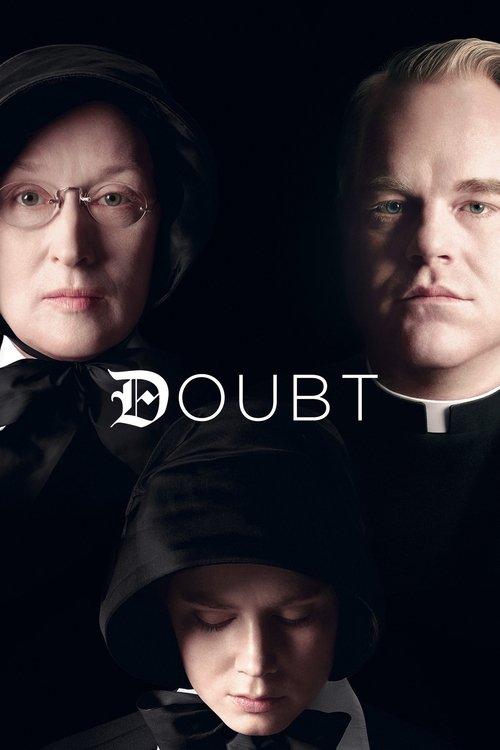
Doubt (2008)
Directed by John Patrick Shanley
No — Doubt is not especially woke, scoring 26 out of 100 on our wokeness meter.
Doubt arrives from 2008, a year when prestige cinema still believed a Pulitzer-winning play, four actors of the first rank, and a Bronx parish could carry a moral argument without a single explosion.
Consciousness Markers
Donald's race is explicitly discussed as making him vulnerable to being singled out, and Mrs. Miller's scene confronts the brutal realities of being Black in 1964, engaging race as a genuine narrative concern.
Features Viola Davis and a Black child actor as the school's only Black student, but the diversity is period-appropriate to a 1964 Bronx setting rather than modern inclusive casting for its own sake.
Donald's sexuality is revealed as a plot point when his mother admits he is gay and fears his father's violence, but it is treated as a tragic 1964 reality rather than a celebratory theme.
Sister Aloysius and Sister James challenge a male priest's authority within a patriarchal institution, offering a feminist reading, though the film's focus is moral ambiguity rather than gender politics.
The film is dialogue-heavy with homilies and moral arguments, but its sermonizing concerns faith, certainty, and doubt rather than modern social justice messaging.
Flynn's advocacy for a working-class congregation and community engagement gestures at class dynamics, but the film offers no anti-capitalist critique.
No environmental or climate themes appear anywhere in the film.
No body positivity themes are present.
No neurodivergence themes are present.
The film is a fictional parable set in 1964 and makes no attempt to revise or reinterpret historical events.
Why it received this score
Doubt arrives from 2008, a year when prestige cinema still believed a Pulitzer-winning play, four actors of the first rank, and a Bronx parish could carry a moral argument without a single explosion. John Patrick Shanley adapts his own stage work and directs with the patience of a man who trusts dialogue. The result is a film about certainty, and the ruin it visits upon the people who hold it. Sister Aloysius accuses Father Flynn of something the screenplay never confirms. That refusal to resolve is the entire engine.
The picture is period-appropriate in its demographics. Donald Miller is the school's only Black student, a fact the film treats as a source of vulnerability in 1964 rather than an occasion for modern self-congratulation. Viola Davis, in a single scene, explains what it means for her son to be Black, gay, and at the mercy of a violent father, and she does it without a shred of uplift. The scene is devastating and it is not a lecture. Sister Aloysius and Sister James do push against a male cleric's authority inside a patriarchal institution, which invites a feminist reading, though the film's interest lies in doubt, not in gender. Flynn's sympathy for his working-class congregation gestures at class, briefly, and then thinks better of it.
The film's absences are instructive. There is no environmental sermon, no body-positive subplot, no neurodivergent arc, no attempt to rewrite the historical record. Its sermonizing is confined to homilies about gossip and faith, which is a different register entirely from the social messaging of a later era. The cast is superb. The screenplay is merciless. And the whole enterprise sits at a comfortable distance from the cultural preoccupations that would arrive a decade later. A sober, well-made film about the impossibility of knowing. Score it as such.
Analysis generated by our Consciousness Algorithm


Synopsis
In 1964 Bronx, two Catholic school nuns question the new priest's ambiguous relationship with a troubled African-American student.
Questions about Doubt
Is Doubt woke?
No — Doubt is not especially woke, scoring 26 out of 100 on our wokeness meter. That earns it a verdict of Based.
Does Doubt have any woke elements?
4 of the 10 markers register at 30 or above, led by Racial Consciousness (40), Feminist Agenda (30) and LGBTQ+ Themes (30). On Racial Consciousness: Donald's race is explicitly discussed as making him vulnerable to being singled out, and Mrs.
How does Doubt compare to other 2008 movies?
It ranks #23 of the 212 films from 2008 we've scored; their average is 12. The wokest is Milk (68).
How is the Woke Score calculated?
An AI-assisted process researches the film and its reception, scores it 0–100 on ten markers, then combines those into one 0–100 Woke Score. It measures a specific set of 2020s cultural themes, not film quality.