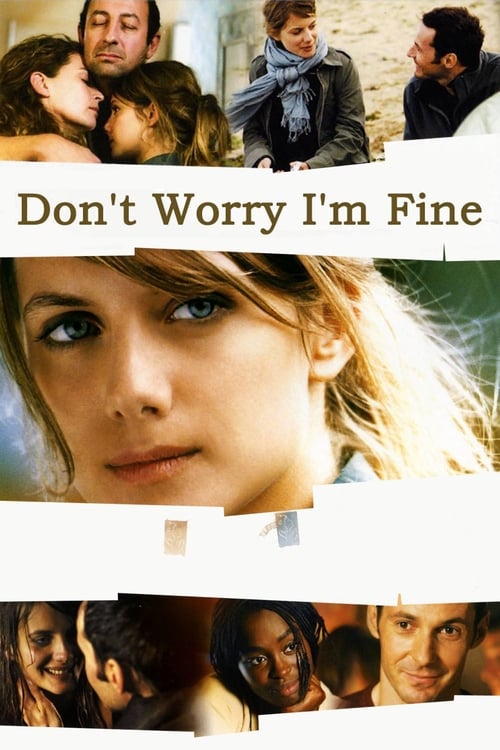
Don't Worry, I'm Fine (2006)
Directed by Philippe Lioret
No — Don't Worry, I'm Fine is not woke, scoring 6 out of 100 on our wokeness meter.
The French drama Don't Worry, I'm Fine arrives from 2006 with the quiet confidence of a film that has no interest in addressing anyone's politics.
Consciousness Markers
The cast is diverse in origin, but the narrative focus remains strictly on intimate family drama rather than challenging systemic representation.
Lili is a strong, emotionally complex protagonist navigating intense familial pressure, but the film does not employ a modern, explicit feminist agenda.
As a quiet, character-driven drama, it lacks the didactic, overtly political pronouncements characteristic of high lecture energy cinema.
The film contains no explicit or implied LGBTQ+ themes or characters.
The film is set in France and does not engage with racial dynamics or issues.
There is no reference to environmentalism or climate change within the plot or setting.
The conflict is purely personal and familial, showing no critique of economic structures or wealth disparity.
Lili's struggle with anorexia is depicted as a symptom of grief and mental illness, not as a commentary on body image or positivity.
The film does not feature characters with diagnosed neurodivergence.
The plot revolves around a personal family secret and a fictionalized event, not a revision of established historical facts.
Why it received this score
The French drama Don't Worry, I'm Fine arrives from 2006 with the quiet confidence of a film that has no interest in addressing anyone's politics. Philippe Lioret follows Lili, a nineteen-year-old whose twin brother vanishes after a fight with their father, and who stops eating as grief tightens its grip. The novel by Olivier Adam supplies a family secret, a forged correspondence, and a slow unraveling that lands closer to heartbreak than to sermon. Mélanie Laurent carries it all with a weariness that feels earned.
For our purposes, the film registers as a near-total absence of the cultural markers we are obliged to tally. The cast includes performers of varied origins, and Aïssa Maïga appears as Lili's friend, yet the narrative keeps its gaze fixed on one family's private devastation. No systemic argument is made about who gets to be represented. Lili herself is a fierce and complicated young woman navigating enormous pressure, which earns a modest nod toward feminist sensibility, though the film never organizes her suffering into a thesis. Her disorder is treated as a symptom of loss and mental anguish, not as a statement about bodies or beauty standards.
There is no environmental lament, no critique of capital, no engagement with race as a social force, no neurodivergent character, no rewriting of history, and no romance that bends toward anything other than its own melancholy. The film lectures nobody. It sits with a girl who cannot accept that her brother is gone, and lets the audience do the difficult work of feeling it. As vintages go, this one is dry, restrained, and entirely uninterested in winning our approval.
Analysis generated by our Consciousness Algorithm

Synopsis
A 19-year-old searches for her twin brother after he runs away from home, following a fight with their father.
Questions about Don't Worry, I'm Fine
Is Don't Worry, I'm Fine woke?
No — Don't Worry, I'm Fine is not woke, scoring 6 out of 100 on our wokeness meter. That earns it a verdict of Ultra Based.
Does Don't Worry, I'm Fine have any woke elements?
Very few. None of the 10 markers reaches 30, the level where a marker counts as present; the highest is Representation Casting at 15.
How does Don't Worry, I'm Fine compare to other 2006 movies?
It ranks #121 of the 211 films from 2006 we've scored; their average is 11. The wokest is An Inconvenient Truth (92).
How is the Woke Score calculated?
An AI-assisted process researches the film and its reception, scores it 0–100 on ten markers, then combines those into one 0–100 Woke Score. It measures a specific set of 2020s cultural themes, not film quality.