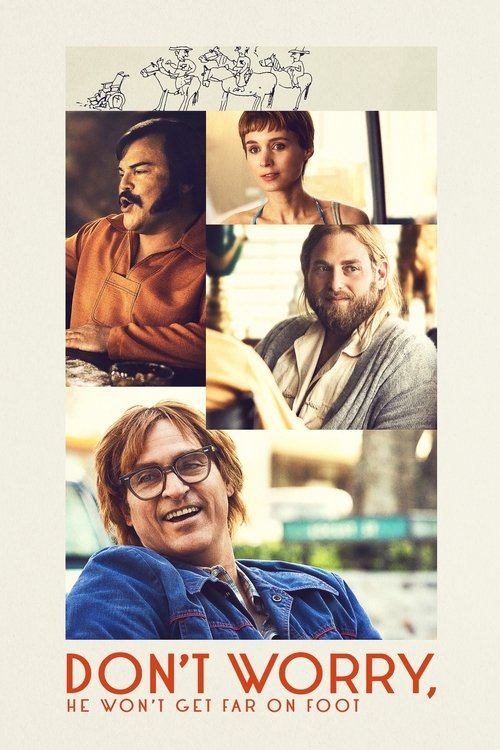
Don't Worry, He Won't Get Far on Foot (2018)
Directed by Gus Van Sant
No — Don't Worry, He Won't Get Far on Foot is not woke, scoring 16 out of 100 on our wokeness meter.
Gus Van Sant's 2018 adaptation of John Callahan's memoir arrives with a disability at its center and a curious ambivalence about what to do with it.
Consciousness Markers
The film centers on a quadriplegic protagonist and disability experience, but the lead is played by able-bodied Joaquin Phoenix, and the supporting cast is largely conventional. Disability is present as subject matter rather than as a casting-driven representation statement.
John's AA sponsor Donnie is gay and dies of AIDS, giving the film a genuine but understated queer presence. It is treated matter-of-factly rather than as an advocacy theme.
The AA twelve-step framework and recovery arc carry a gentle moral message, but the film avoids preachy direct-address or sermonizing, favoring character over thesis.
A brief beat has the Disability Resource Center denying John help due to budget cutbacks, a mild jab at underfunded social services, but the film is not structured around an economic critique.
The film engages disability and bodily limitation, but it does not advance a body-positivity message about size, appearance, or self-acceptance in the modern sense.
Rooney Mara's Annu functions primarily as a romantic interest and caregiver figure; there is no discernible feminist thesis or gendered power critique.
Race is essentially absent as a thematic concern; the story is a white Portland artist's recovery memoir with no racial commentary.
No environmental or climate content whatsoever.
Addiction and alcoholism are the film's core subject, but these are not framed as neurodivergence; no ADHD, autism, or similar framing appears.
A faithful adaptation of Callahan's own memoir; it does not revise or reinterpret historical events for ideological purposes.
Why it received this score
Gus Van Sant's 2018 adaptation of John Callahan's memoir arrives with a disability at its center and a curious ambivalence about what to do with it. The film follows a quadriplegic cartoonist through paralysis, addiction, and the slow grind of recovery, so the subject matter is undeniably present. Yet the role goes to Joaquin Phoenix, an able-bodied actor of visible commitment, and the supporting cast stays resolutely conventional. Disability registers as theme, not as a statement about who gets to stand in front of the camera.
Elsewhere the picture is even more restrained. Jonah Hill's Donnie, the AA sponsor, is gay and dies of AIDS, an inclusion handled with such matter-of-factness that it never announces itself as advocacy. Rooney Mara's Annu exists chiefly as therapist, then girlfriend, and the film shows no interest in gendered power or feminist argument. Race is absent as a concern. So is the environment, entirely. The lone glancing economic note comes when the Disability Resource Center refuses John help because of budget cutbacks, a small sigh about underfunded services, and then the film moves on.
The film settles into the twelve-step framework, treating it as a gentle moral architecture and never a sermon. John learns not to play the victim, and the camera stays on his face instead of turning to address us. There is no revisionist reworking of history here, and no attempt to recast alcoholism as neurodivergence. This is a faithful, humane, faintly old-fashioned recovery story, and it seems content to remain one. Van Sant has made a film about a man learning to draw with ruined hands, and about the ordinary decency of staying sober. The cultural weather of its moment passes overhead without landing on it.
Some viewers will want the film to argue something. It declines. That refusal is its own quiet position, and it leaves the picture sitting comfortably at the low end of the register, a memoir adaptation that trusts character over thesis and lets the era's louder conversations happen elsewhere, in other films, on other screens, in other rooms entirely.
Analysis generated by our Consciousness Algorithm

Synopsis
On the rocky path to sobriety after a life-changing accident, John Callahan discovers the healing power of art, willing his injured hands into drawing hilarious, often controversial cartoons, which bring him a new lease on life.
Questions about Don't Worry, He Won't Get Far on Foot
Is Don't Worry, He Won't Get Far on Foot woke?
No — Don't Worry, He Won't Get Far on Foot is not woke, scoring 16 out of 100 on our wokeness meter. That earns it a verdict of Ultra Based.
Does Don't Worry, He Won't Get Far on Foot have any woke elements?
1 of the 10 markers register at 30 or above, led by Representation Casting (38). On Representation Casting: The film centers on a quadriplegic protagonist and disability experience, but the lead is played by able-bodied Joaquin Phoenix, and the supporting cast is largely conventional.
How does Don't Worry, He Won't Get Far on Foot compare to other 2018 movies?
It ranks #129 of the 325 films from 2018 we've scored; their average is 20. The wokest is Return (92).
How is the Woke Score calculated?
An AI-assisted process researches the film and its reception, scores it 0–100 on ten markers, then combines those into one 0–100 Woke Score. It measures a specific set of 2020s cultural themes, not film quality.