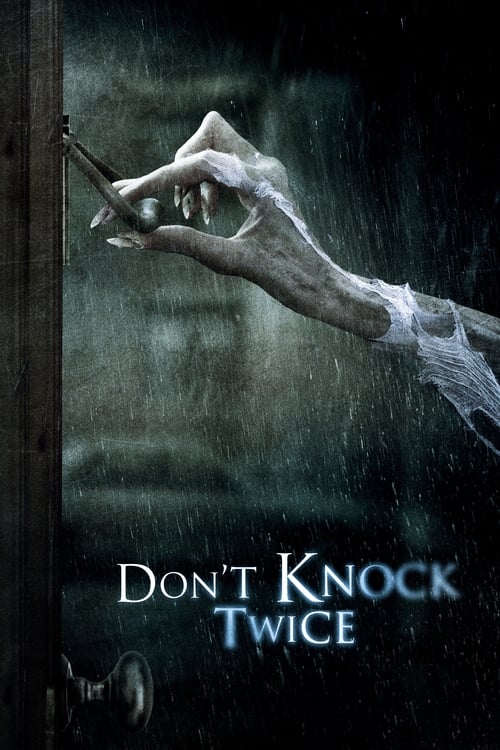
Don't Knock Twice (2017)
Directed by Caradog W. James
No — Don't Knock Twice is not woke, scoring 10 out of 100 on our wokeness meter.
Don't Knock Twice arrives from Wales by way of a folkloric photocopier, assembling its witch, its urban legend, and its estranged-mother scaffolding with the care of a furniture kit missing several screws.
Consciousness Markers
The cast includes a Black British actor (Jordan Bolger) and an Iranian actress (Pooneh Hajimohammadi) in supporting roles, but their presence is incidental and never remarked upon.
The film centers on a mother-daughter relationship and features women in the lead and antagonist roles, but this is standard horror construction rather than a feminist statement.
No LGBTQ+ characters, themes, or subtext appear anywhere in the film.
Race is never addressed or thematized; the film has no racial commentary whatsoever.
No environmental or climate themes are present.
The film contains no economic critique or anti-capitalist messaging.
No body positivity themes or messaging appear in the film.
No neurodivergent characters or themes are depicted.
The film is a fictional supernatural horror with no historical subject matter to revise.
This is a straightforward jump-scare horror film with no didactic or preachy messaging.
Why it received this score
Don't Knock Twice arrives from Wales by way of a folkloric photocopier, assembling its witch, its urban legend, and its estranged-mother scaffolding with the care of a furniture kit missing several screws. Katee Sackhoff plays Jess, a sculptor and recovering addict who wants her daughter back. Lucy Boynton plays Chloe, who would prefer not. They knock twice on a door. Something unpleasant answers. The film has been here before and knows it, recycling the jump scare with the diligence of a night-shift worker punching a clock.
On the matter of social consciousness, the film is a near-vacuum, and this is not a criticism so much as an observation. Two women carry the story, and a mother-daughter bond supplies the emotional engine, which is standard horror architecture and not a manifesto. The supporting cast includes a Black British actor and an Iranian actress, both of whom are simply present, the film never clearing its throat about it. Race, class, the climate, the body, the mind, and the economy are all left unexamined, presumably because the demon is busy.
What remains is atmosphere, and not quite enough of it. The reviews were unkind, and the film earns some of that unkindness. The characters are sketched in pencil and the third act collapses into a cave. Yet there is a modest pleasure in watching a horror film with no ambitions beyond the next scare. It wants to frighten you and then end. In an era of cinema that frequently wants to instruct you as well, the absence of a sermon registers as a small, accidental courtesy.
Analysis generated by our Consciousness Algorithm


Synopsis
A mother desperate to reconnect with her troubled daughter becomes embroiled in the urban legend of a demonic witch.
Questions about Don't Knock Twice
Is Don't Knock Twice woke?
No — Don't Knock Twice is not woke, scoring 10 out of 100 on our wokeness meter. That earns it a verdict of Ultra Based.
Does Don't Knock Twice have any woke elements?
Very few. None of the 10 markers reaches 30, the level where a marker counts as present; the highest is Representation Casting at 18.
How does Don't Knock Twice compare to other 2017 movies?
It ranks #162 of the 309 films from 2017 we've scored; their average is 19. The wokest is I Am Not Your Negro (92).
How is the Woke Score calculated?
An AI-assisted process researches the film and its reception, scores it 0–100 on ten markers, then combines those into one 0–100 Woke Score. It measures a specific set of 2020s cultural themes, not film quality.