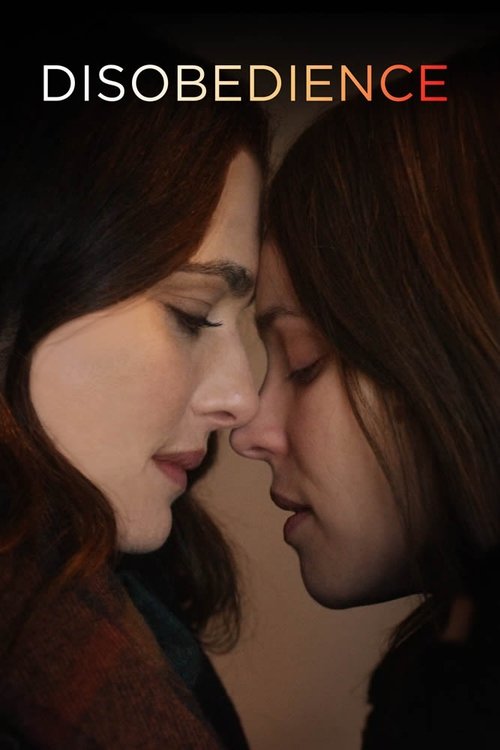
Disobedience (2018)
Directed by Sebastián Lelio
Yes — Disobedience is woke, scoring 60 out of 100 on our wokeness meter.
Sebastián Lelio's Disobedience opens with a sermon and closes with a kiss, which is a tidy summary of its concerns.
Consciousness Markers
The film's central romance is between two women, exploring their sexuality within a repressive religious context.
Centers on women's autonomy, critiquing patriarchal religious expectations and arranged marriage, with Esti demanding freedom from her husband.
Features a central same-sex relationship and a predominantly Jewish cast portraying an Orthodox community, though the leads are white and the film does not foreground racial diversity.
Critics noted the film 'never preaches or judges,' presenting its themes with emotional nuance rather than didacticism.
No engagement with racial politics or systemic racism; the focus is on religious and sexual identity.
No environmental themes.
No economic critique or class struggle.
No body positivity themes.
No neurodivergence themes.
A contemporary story, not a historical revision.
Why it received this score
Sebastián Lelio's Disobedience opens with a sermon and closes with a kiss, which is a tidy summary of its concerns. Ronit, a New York photographer played by Rachel Weisz, returns to the Orthodox Jewish enclave of North London to bury a father who never quite forgave her. She finds her childhood friend Esti, played by Rachel McAdams, installed as the wife of the late rabbi's chosen successor. Dovid, played by Alessandro Nivola, is the third point of a triangle the script declines to resolve cheaply. The old attraction resumes with a deliberateness that borders on the liturgical. Lelio photographs the reunion in muted tones and lets long silences do the arguing.
The romantic core here is between two women, and the film takes that seriously without turning it into a seminar. Esti's confession that she has only ever been drawn to women arrives quietly, and her later request for freedom from her husband lands as an act of self-possession, not a slogan. The critique of arranged marriage and patriarchal expectation runs through the whole thing, though the film is careful to grant Dovid his dignity. The casting is largely Jewish, which lends the community its texture. The two leads remain, of course, white movie stars.
Where the film earns its restraint is in what it refuses. There is no racial argument, no economic argument, no environmental lament, no celebration of bodies, no diagnosis of neurodivergence, no reworking of the historical record. It is a contemporary story about faith, desire, and the cost of both. Reviewers noted that it never preaches, and that is accurate. The film sits in its own melancholy and declines to instruct us. For a picture built on transgression, it is remarkably unwilling to raise its voice. We file it accordingly, with a weary nod and a fresh pot of tea.
{"thematic_tags": ["book_adaptation"]}
Analysis generated by our Consciousness Algorithm


Synopsis
New York photographer Ronit flies to London after learning about the death of her estranged father. Ronit is returning to the same Orthodox Jewish community that shunned her decades earlier for her childhood attraction to Esti, a female friend. Their fortuitous and happy reunion soon reignites their burning passion as the two women explore the boundaries of faith and sexuality.
Questions about Disobedience
Is Disobedience woke?
Yes — Disobedience is woke, scoring 60 out of 100 on our wokeness meter. That earns it a verdict of Woke.
What makes Disobedience woke?
3 of the 10 markers register at 30 or above, led by LGBTQ+ Themes (95), Feminist Agenda (75) and Representation Casting (50). On LGBTQ+ Themes: The film's central romance is between two women, exploring their sexuality within a repressive religious context.
How does Disobedience compare to other 2018 movies?
It ranks #21 of the 325 films from 2018 we've scored; their average is 20. The wokest is Return (92).
How is the Woke Score calculated?
An AI-assisted process researches the film and its reception, scores it 0–100 on ten markers, then combines those into one 0–100 Woke Score. It measures a specific set of 2020s cultural themes, not film quality.