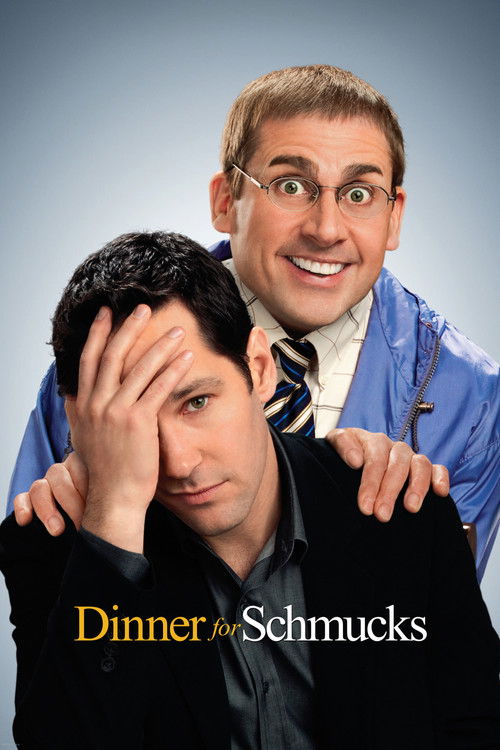
Dinner for Schmucks (2010)
Directed by Jay Roach
No — Dinner for Schmucks is not woke, scoring 13 out of 100 on our wokeness meter.
Jay Roach's 2010 comedy arrives with the mild ambition of adapting a French farce about executives who gather monthly to mock a guest of honor, and it lands squarely in the middle of its era.
Consciousness Markers
The executives who mock the less fortunate for sport are the villains, and the ending has the firm going bankrupt and branded 'Wall Street's Biggest Loser' — a mild eat-the-rich comeuppance, though framed as personal cruelty rather than systemic critique.
Julie lectures Tim about the immorality of the dinner, and Tim delivers a climactic rebuke to his boss defending Barry — a clear moral lesson about not mocking people, though delivered with comedic rather than preachy energy.
Predominantly white ensemble led by Paul Rudd and Steve Carell, with Larry Wilmore in a minor supporting role; no conscious diversity casting effort.
Julie objects to the dinner's cruelty and serves as a moral compass, but this is humanist decency rather than a feminist agenda; Darla is a comic grotesque.
Barry reads as socially oblivious and obsessive (taxidermy dioramas), but the film frames him as a 'schmuck' to be pitied rather than offering any neurodivergence-affirming lens.
No LGBTQ+ characters, themes, or subtext anywhere in the film.
No engagement with race or racial themes; the film's social commentary is entirely about class and corporate cruelty.
No environmental or climate content whatsoever.
No body positivity messaging; physical appearance is largely played for mockery.
No historical revisionism; the film is a contemporary corporate comedy.
Why it received this score
Jay Roach's 2010 comedy arrives with the mild ambition of adapting a French farce about executives who gather monthly to mock a guest of honor, and it lands squarely in the middle of its era. The ensemble is overwhelmingly white and comfortable, led by Paul Rudd as a rising executive and Steve Carell as the taxidermist who builds dioramas from stuffed mice. Larry Wilmore appears in a supporting role and the film moves on without comment. There is no queer presence of any kind, no engagement with race, and no interest in the climate. The camera treats human bodies as material for punchlines, and physical appearance is mocked with the enthusiasm of a schoolyard. Barry's social obliviousness and obsessive hobby are offered as comedy to be pitied. The film has no vocabulary for affirming any of it.
Julie, the fiancee, objects to the dinner's cruelty and functions as the story's conscience. Her objection is decency, not doctrine. The film's social criticism is aimed at class and corporate behavior instead. The executives who treat human beings as collectible curiosities are the villains, and the epilogue, delivered through Barry's mouse dioramas, sees the firm bankrupt and branded Wall Street's biggest loser. It is a comeuppance, mild and personal, never a systemic argument.
The film does carry a moral. Julie lectures Tim about the dinner, and Tim eventually rebukes his boss in front of the room. The lesson is that mocking people is wrong. It is delivered with slapstick, a burning mansion, and a lost finger, which keeps the sermon from settling in. The result is a comedy that wants credit for kindness while still selling the joke. Two decades on, it reads as a period piece about a specific corporate smugness, and nothing more.
Analysis generated by our Consciousness Algorithm


Synopsis
Rising executive Tim Conrad works for a boss who hosts a monthly dinner in which the guest who brings the biggest buffoon gets a career-boost. Tim plans on not attending until he meets Barry, a man who builds dioramas using stuffed mice. Barry's blundering but good intentions send Tim's life into a downward spiral, threatening a major business deal and possibly scuttling Tim's engagement to his fiancee.
Questions about Dinner for Schmucks
Is Dinner for Schmucks woke?
No — Dinner for Schmucks is not woke, scoring 13 out of 100 on our wokeness meter. That earns it a verdict of Ultra Based.
Does Dinner for Schmucks have any woke elements?
Very few. None of the 10 markers reaches 30, the level where a marker counts as present; the highest is Eat the Rich at 25.
How does Dinner for Schmucks compare to other 2010 movies?
It ranks #63 of the 238 films from 2010 we've scored; their average is 11. The wokest is My Name Is Khan (84).
How is the Woke Score calculated?
An AI-assisted process researches the film and its reception, scores it 0–100 on ten markers, then combines those into one 0–100 Woke Score. It measures a specific set of 2020s cultural themes, not film quality.