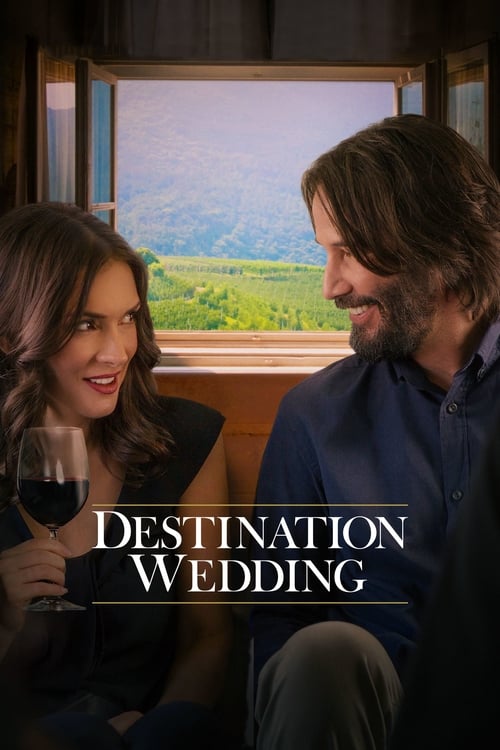
Destination Wedding (2018)
Directed by Victor Levin
No — Destination Wedding is not woke, scoring 2 out of 100 on our wokeness meter.
Victor Levin's Destination Wedding deposits Winona Ryder and Keanu Reeves at a Paso Robles inn for a weekend of nuptials and lets them bicker for eighty-six minutes.
Consciousness Markers
The dialogue is relentless and opinionated, but its bile is misanthropic and personal rather than a social-issue sermon; there is no didactic messaging.
The cast is led by two white stars (Winona Ryder, Keanu Reeves) with a uniformly white supporting ensemble; no meaningful diverse representation is present or commented upon.
There are no LGBTQ+ characters, relationships, or themes anywhere in the film.
Lindsay is a professional prosecutor, but the film offers no feminist thesis or gendered critique; her profession is merely a detail used for banter.
Race is entirely absent as a subject; the film concerns two white misanthropes and their families.
No environmental or climate themes appear at any point.
The characters snipe at each other's jobs (marketing, prosecution) but the film advances no anti-capitalist argument or class critique.
Mutual compliments about physical appearance occur, but this is romantic banter, not a body-positivity message.
No neurodivergent characters or themes are present.
The film makes no historical claims and revises nothing.
Why it received this score
Victor Levin's Destination Wedding deposits Winona Ryder and Keanu Reeves at a Paso Robles inn for a weekend of nuptials and lets them bicker for eighty-six minutes. They play Lindsay, a prosecutor, and Frank, a marketing man, two misanthropes who discover they share a former partner, a contempt for the assembled guests, and a talent for articulate complaint. The camera rarely leaves their faces. There is no third act crowd to win over, no town to save, no lesson waiting at the altar.
On the matter of contemporary social consciousness, the film is a vacuum. The cast is white and the film never notices. Racial identity, queerness, climate anxiety, class resentment, body image, neurodivergence: each is absent, not suppressed but simply unconsidered, as though the screenplay were written in a sealed room in 1994. Lindsay's job as a prosecutor supplies banter about prosecutorial discretion and nothing else. The characters sneer at each other's careers, yet the sneering is personal, never structural. Nobody is eating the rich here. They are merely eating each other, slowly, over appetizers.
The one faint pulse is the dialogue itself, which arrives in ratatat bursts of opinion and refuses to stop. It is relentless, but its bile is aimed at siblings, exes, and wedding guests, not at society. Think of it as sermonizing with no sermon, aggression without a cause. Reviews divided accordingly, with some finding the sourness bracing and others finding it a chore. The cultural ledger stays near empty, and no viewer will exit with a new vocabulary for injustice. Two movie stars insult one another with evident pleasure, which, for a certain temperament, is its own modest endowment.
Analysis generated by our Consciousness Algorithm


Synopsis
Frank and Lindsay—two emotionally-broken strangers—meet on the way to a destination wedding. Over the course of the weekend and against all odds, they find themselves drawn together even though they are initially repulsed by one another.
Questions about Destination Wedding
Is Destination Wedding woke?
No — Destination Wedding is not woke, scoring 2 out of 100 on our wokeness meter. That earns it a verdict of Ultra Based.
Does Destination Wedding have any woke elements?
Very few. None of the 10 markers reaches 30, the level where a marker counts as present; the highest is Lecture Energy at 5.
How does Destination Wedding compare to other 2018 movies?
It ranks #287 of the 325 films from 2018 we've scored; their average is 20. The wokest is Return (92).
How is the Woke Score calculated?
An AI-assisted process researches the film and its reception, scores it 0–100 on ten markers, then combines those into one 0–100 Woke Score. It measures a specific set of 2020s cultural themes, not film quality.