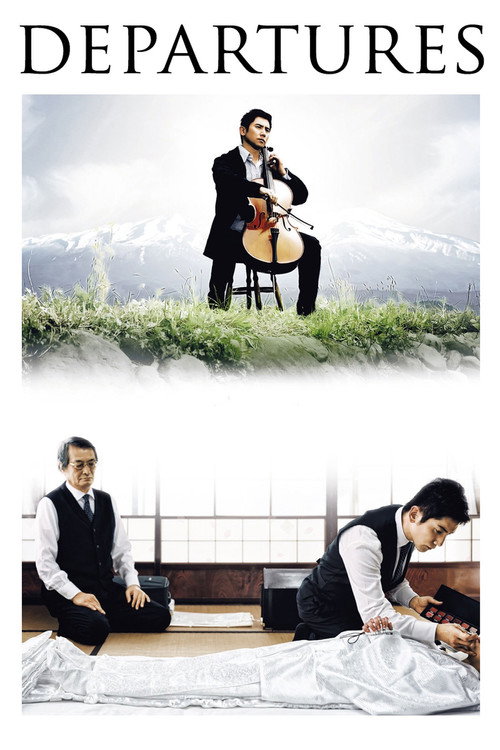
Departures (2008)
Directed by Yojiro Takita
No — Departures is not woke, scoring 2 out of 100 on our wokeness meter.
Departures arrives with the quiet authority of an Academy Award for Best Foreign Language Film and the reputation of a Japanese domestic drama that made grown men weep into their funeral programs.
Consciousness Markers
The cast is entirely Japanese, which is the natural and unremarkable default for a Japanese domestic drama; there is no deliberate diversity casting or commentary on representation.
No LGBTQ+ characters, themes, or subtext appear anywhere in the film.
The wife Mika is written in a traditional domestic register, leaving and returning pregnant and urging her husband toward a 'respectable' job; the film has no feminist agenda.
The film's social-ostracism theme concerns the historical Japanese stigma against death-workers (burakumin-adjacent taboo), which is an organic cultural element of the story, not modern racial-consciousness messaging.
No environmental or climate themes are present.
The protagonist's layoff from an orchestra is a plot device, not a critique of capitalism; the film is a humanist meditation on death and dignity.
The film deals reverently with corpses and encoffining ritual, but this is about death and dignity, not body-positivity messaging.
No neurodivergent characters or themes are depicted.
The film is a contemporary fictional drama with no historical revisionism.
The film is sentimental and humanistic but never preachy in a modern social-justice register; its emotional appeals are about family and mortality, not ideology.
Why it received this score
Departures arrives with the quiet authority of an Academy Award for Best Foreign Language Film and the reputation of a Japanese domestic drama that made grown men weep into their funeral programs. A cellist loses his orchestra job, returns to Yamagata with his wife, and takes work as a nōkanshi, preparing the dead for encoffining. The film treats this ritual with reverence and a certain comic tenderness. It is a story about mortality, fathers, small towns, and the shame that clings to those who handle the dead. It is not a story about contemporary social reform.
The social ostracism Daigo faces is real within the film's cultural setting. The taboo against death workers has deep historical roots in Japan, and the screenplay uses it as organic texture. No character pauses to deliver a lecture on representation. The wife, Mika, leaves and returns pregnant, urging her husband toward a respectable job; the resolution comes through ritual and reconciliation, not a feminist awakening. The film has no interest in the contemporary crusades. It does not sermonize about identity, ecology, economics, or the body. Its emotional appeals are familial and mortal. They are not ideological.
Adapted loosely from Shinmon Aoki's memoir Coffinman, the film sands off the source's Buddhist metaphysics in favor of a humanist arc. That choice annoyed the author, which is perhaps the most political thing about it. Otherwise, Departures is content to show a man learning to wash a body with care. It never scolds. It never demands that we examine our complicity. It simply asks us to sit with grief and a cello score. In the current cultural climate, such a film feels almost extraterrestrial. It has no modern progressive pulse. It is a warm, sad, beautifully acted null set.
Analysis generated by our Consciousness Algorithm


Synopsis
Daigo, a cellist, is laid off from his orchestra and moves with his wife back to his small hometown where the living is cheaper. Thinking he’s applying for a job at a travel agency he finds he’s being interviewed for work with departures of a more permanent nature – as an undertaker’s assistant.
Questions about Departures
Is Departures woke?
No — Departures is not woke, scoring 2 out of 100 on our wokeness meter. That earns it a verdict of Ultra Based.
Does Departures have any woke elements?
No. All 10 markers score zero.
How does Departures compare to other 2008 movies?
It ranks #168 of the 212 films from 2008 we've scored; their average is 12. The wokest is Milk (68).
How is the Woke Score calculated?
An AI-assisted process researches the film and its reception, scores it 0–100 on ten markers, then combines those into one 0–100 Woke Score. It measures a specific set of 2020s cultural themes, not film quality.