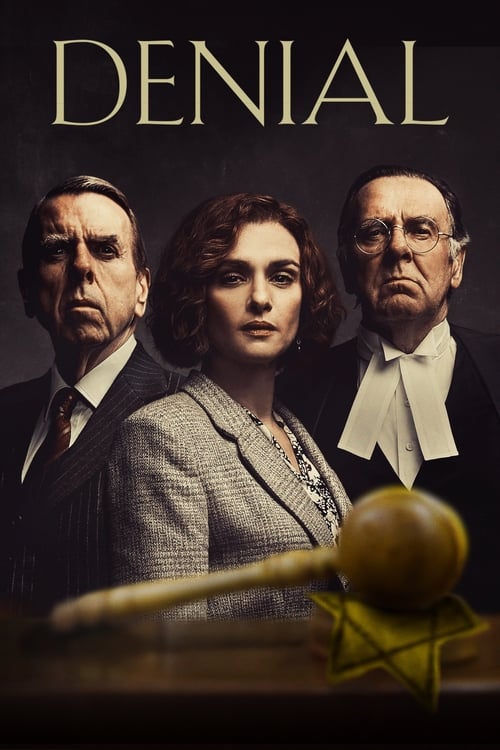
Denial (2016)
Directed by Mick Jackson
No — Denial is not woke, scoring 0 out of 100 on our wokeness meter.
Denial arrives with the solemn bearing of a film that knows it is about something important, and it is.
Consciousness Markers
The cast is entirely white and does not feature any notable diverse or inclusive casting choices.
There are no LGBTQ+ themes or characters in the film.
While the protagonist is a woman, the film does not advance a feminist agenda or critique patriarchal structures.
The film deals with antisemitism and Holocaust denial, but it does not engage with modern racial consciousness or systemic racism against people of color.
There is no climate change or environmental theme in the film.
The film does not critique capitalism or wealth inequality.
There is no body positivity or body image theme in the film.
There is no exploration of neurodivergence or mental health in a modern social justice context.
The film actively defends historical truth against Holocaust denial, making it anti-revisionist rather than revisionist.
The film is a serious courtroom drama about historical truth, not a preachy lecture on modern progressive social issues.
Why it received this score
Denial arrives with the solemn bearing of a film that knows it is about something important, and it is. Deborah Lipstadt, played by Rachel Weisz with a permanent expression of affronted rectitude, is sued in a British court by David Irving for calling him a Holocaust denier. The burden of proof falls on her. The film follows the case with a procedural patience that borders on the liturgical, touring Auschwitz, subpoenaing diaries, and letting Tom Wilkinson's barrister deliver a cross-examination that functions as the film's real climax. It is a courtroom drama of the old school, and it is entirely sincere.
Which leaves us with the curious task of classification. The cast is uniformly white. There is no romantic subplot, no marginalized identity treated as a theme, no environmental lament, no critique of the wealthy, no meditation on body image, and no engagement with neurodivergence. The villain is an antisemite, and the film's position is that he is simply wrong, which is not a revisionist gesture but its opposite. Lipstadt is a woman of formidable intelligence, yet the film never pauses to interrogate the structures that surround her. She is a scholar who happens to be a woman, and the screenplay treats that as unremarkable, which is presumably the point.
The result is a film that is morally serious and culturally inert. It argues for historical truth with the tools of a well-made television movie, and it never turns to the audience to instruct them on how to vote, what to consume, or whom to apologize to. There is something almost restful about that. The film has no agenda beyond the verdict, and the verdict, in this case, is correct. We file it accordingly, with a certain quiet gratitude, and move on to the next screening.
Analysis generated by our Consciousness Algorithm


Synopsis
Acclaimed writer and historian Deborah E. Lipstadt must battle for historical truth to prove the Holocaust actually occurred when David Irving, a renowned denier, sues her for libel.
Questions about Denial
Is Denial woke?
No — Denial is not woke, scoring 0 out of 100 on our wokeness meter. That earns it a verdict of Ultra Based.
Does Denial have any woke elements?
No. All 10 markers score zero.
How does Denial compare to other 2016 movies?
It ranks #264 of the 285 films from 2016 we've scored; their average is 16. The wokest is 13th (92).
How is the Woke Score calculated?
An AI-assisted process researches the film and its reception, scores it 0–100 on ten markers, then combines those into one 0–100 Woke Score. It measures a specific set of 2020s cultural themes, not film quality.