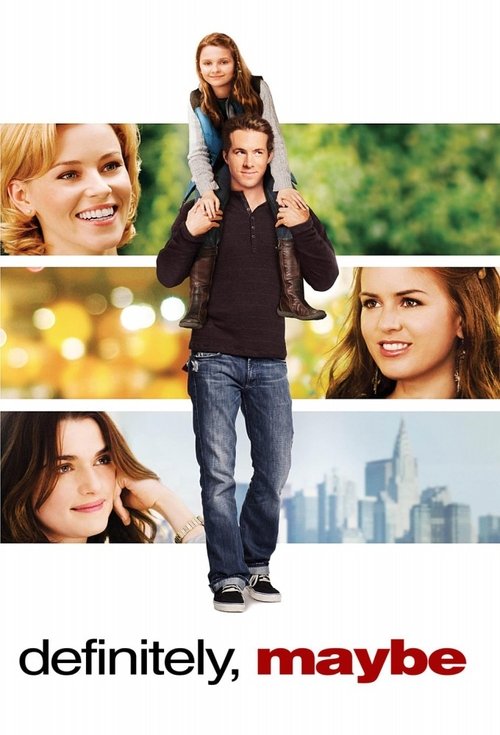
Definitely, Maybe (2008)
Directed by Adam Brooks
No — Definitely, Maybe is not woke, scoring 11 out of 100 on our wokeness meter.
Definitely, Maybe arrives from 2008, a year when the romantic comedy still believed in itself, and it proceeds with a sincerity its own marketing likely undersold.
Consciousness Markers
Summer (Rachel Weisz) is revealed to have had a brief affair with Emily (Elizabeth Banks), Will's college sweetheart, a same-sex relationship treated matter-of-factly rather than as a plot lecture. It is a genuine but minor and non-foregrounded element.
The cast is overwhelmingly white, with Derek Luke as Will's friend and business partner Russell being the most prominent non-white role, plus a minor turn by Sakina Jaffrey. These characters exist naturally without commentary, typical of 2008 studio casting.
The framing device centers a precocious 10-year-old daughter driving the narrative and features several distinct women, but the film remains a conventional rom-com about a man's romantic history. No explicit feminist thesis is advanced.
A light, charming romantic comedy that prioritizes sincerity and wit over preaching. It contains no didactic messaging or moralizing.
Set against the 1992 Clinton campaign, the film engages politics but not racial themes; Derek Luke's character is present without any racial commentary. No racial consciousness agenda is present.
No environmental or climate themes appear anywhere in the film.
Will works in advertising and political consulting, but the film offers no critique of capitalism or wealth. No eat-the-rich sentiment.
No body positivity themes or messaging are present.
No neurodivergence themes or neurodivergent characters are depicted.
The film is a fictional romance; its use of the Clinton campaign as backdrop is not historical revisionism.
Why it received this score
Definitely, Maybe arrives from 2008, a year when the romantic comedy still believed in itself, and it proceeds with a sincerity its own marketing likely undersold. Ryan Reynolds plays Will Hayes, a divorced father recounting his romantic history to his ten-year-old daughter, who must guess which of three women became her mother. The conceit is sturdy, borrowed from the How I Met Your Mother playbook with a detour through High Fidelity, and it carries the film further than its modest ambitions might suggest.
The film's social consciousness registers as a faint pulse. Its casting follows the standard 2008 studio arrangement, overwhelmingly white, with Derek Luke as Will's friend and business partner occupying the most visible non-white role, present without commentary. Summer, played by Rachel Weisz, is revealed to have had a brief affair with Emily, Will's college sweetheart, a detail the film treats as ordinary fact instead of a teaching moment. That is the sum of its progressive content, and it is handled with a shrug. The framing device grants a ten-year-old girl unusual narrative authority, and the women in Will's life are drawn with more specificity than the genre typically permits, but the engine remains a man's romantic inventory.
On the matters that dominate contemporary cultural accounting, the film is silent. No environmental theme. No critique of wealth, despite a protagonist who works in advertising and political consulting. No body positivity, no neurodivergence, no revisionist history. The Clinton campaign serves as wallpaper, not argument. Its lecturing instinct is minimal, and the film prefers wit to sermonizing. This is a pleasant, well-acted romance that never mistakes itself for a civics lesson. In the taxonomy of cultural instruction, it earns its small marks and then politely excuses itself from the table.
Analysis generated by our Consciousness Algorithm


Synopsis
When Will decides to tell his daughter the story of how he met her mother, he discovers that a second look at the past might also give him a second chance at the future.
Questions about Definitely, Maybe
Is Definitely, Maybe woke?
No — Definitely, Maybe is not woke, scoring 11 out of 100 on our wokeness meter. That earns it a verdict of Ultra Based.
Does Definitely, Maybe have any woke elements?
Very few. None of the 10 markers reaches 30, the level where a marker counts as present; the highest is LGBTQ+ Themes at 22.
How does Definitely, Maybe compare to other 2008 movies?
It ranks #83 of the 212 films from 2008 we've scored; their average is 12. The wokest is Milk (68).
How is the Woke Score calculated?
An AI-assisted process researches the film and its reception, scores it 0–100 on ten markers, then combines those into one 0–100 Woke Score. It measures a specific set of 2020s cultural themes, not film quality.