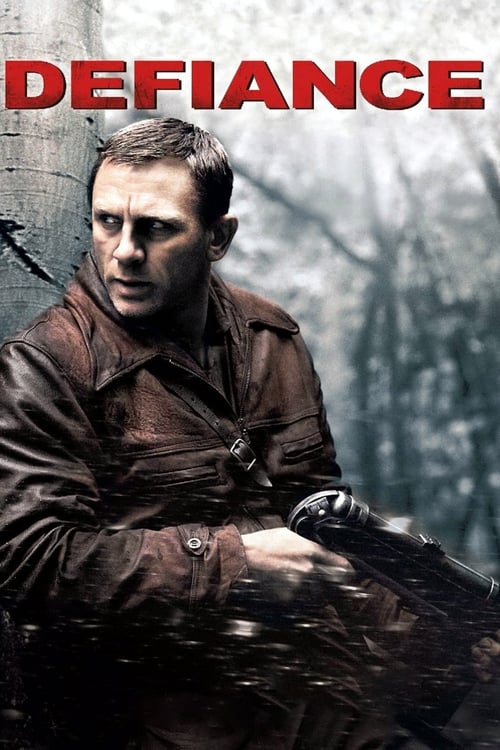
Defiance (2008)
Directed by Edward Zwick
No — Defiance is not especially woke, scoring 22 out of 100 on our wokeness meter.
Edward Zwick's Defiance carries itself like a monument, which is fitting, since it was built the way monuments are: with a straight face and a heavy hand.
Consciousness Markers
Critics noted the dialogue 'crashes down on the big themes like a blacksmith's hammer,' with heavy-handed moralizing about honor, humanity, and whether one must become a monster to fight monsters.
The film was widely criticized for historical revisionism: an anachronistic ampicillin reference, a climactic tank battle that never occurred, a more egalitarian camp than reality, and the airbrushing of Polish and NKVD context. It also deliberately overturns the 'Jewish passivity' stereotype.
A Holocaust drama about Jewish partisans naturally casts Jewish and non-Jewish actors in Jewish roles; the ethnic specificity is inherent to the subject rather than a modern diversity mandate.
Antisemitism within the Soviet partisan ranks is depicted, but this is the historical subject matter of the Holocaust rather than a modern racial-consciousness program.
Female characters exist (Lilka, Chaya) and a subplot addresses a rape survivor's pregnancy, but the film is a male-led war narrative with no feminist agenda driving it.
No LGBTQ+ characters, relationships, or themes appear anywhere in the film.
No environmental or climate themes are present.
The film is about survival and resistance, not economic critique; the epilogue even notes the brothers' postwar trucking business without irony.
No body-positivity themes or messaging.
No neurodivergence themes or characters.
Why it received this score
Edward Zwick's Defiance carries itself like a monument, which is fitting, since it was built the way monuments are: with a straight face and a heavy hand. Four Jewish brothers escape the Einsatzgruppen into the Naliboki forest, gather twelve hundred refugees, and spend two years arguing about how much of their humanity to spend on staying alive. The ethnic specificity here is inherent to the subject, not imposed from outside. Jewish actors play Jewish partisans because the story is theirs. There is nothing performative about it.
The screenplay, drawn from Nechama Tec's book, has one volume setting and it is loud. Morality is announced, then announced again. The recurring question, whether a man must become a monster to defeat monsters, is posed so often that the audience could answer it in their sleep. Women appear, and one subplot gives a rape survivor her due, but the camera belongs to the brothers and their rifles. Antisemitism within the Soviet partisan ranks earns a scene, which is history, not messaging. Nothing here concerns the climate, the body, the economy, or the wiring of the brain.
The history, however, has been rearranged. Ampicillin is prescribed two decades before its discovery. A tank battle that never occurred supplies the climax. The camp is more egalitarian than the record allows, and the Polish and Soviet context is quietly excised. This is a picture that means to overturn the myth of Jewish passivity and, in the attempt, invents a few myths of its own. The epilogue mentions a trucking business in New York without a trace of irony. Some legacies do not require a thesis.
Analysis generated by our Consciousness Algorithm


Synopsis
Based on a true story, during World War II, four Jewish brothers escape their Nazi-occupied homeland of West Belarus in Poland and join the Soviet partisans to combat the Nazis. The brothers begin the rescue of roughly 1,200 Jews still trapped in the ghettos of Poland.
Questions about Defiance
Is Defiance woke?
No — Defiance is not especially woke, scoring 22 out of 100 on our wokeness meter. That earns it a verdict of Based.
Does Defiance have any woke elements?
2 of the 10 markers register at 30 or above, led by Lecture Energy (45) and Revisionist History (40). On Lecture Energy: Critics noted the dialogue 'crashes down on the big themes like a blacksmith's hammer,' with heavy-handed moralizing about honor, humanity, and whether one must become a monster to fight monsters.
How does Defiance compare to other 2008 movies?
It ranks #28 of the 212 films from 2008 we've scored; their average is 12. The wokest is Milk (68).
How is the Woke Score calculated?
An AI-assisted process researches the film and its reception, scores it 0–100 on ten markers, then combines those into one 0–100 Woke Score. It measures a specific set of 2020s cultural themes, not film quality.