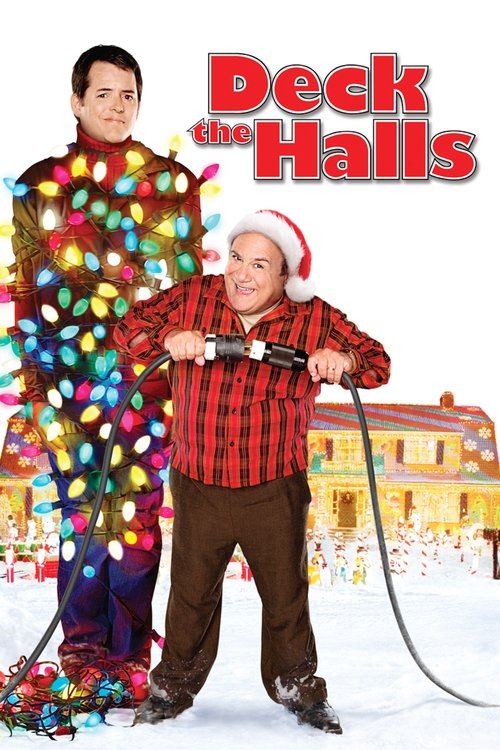
Deck the Halls (2006)
Directed by John Whitesell
No — Deck the Halls is not woke, scoring 0 out of 100 on our wokeness meter.
Deck the Halls arrives from 2006 like a fruitcake unearthed from a freezer, still wrapped in foil and radiating the faint chill of a bygone studio obligation.
Consciousness Markers
The cast is predominantly white, with minority actors in non-racialized supporting roles; the film makes no comment on or effort toward diverse representation.
No LGBTQ+ characters, themes, or subtext appear in the film.
The film features wives bonding and a scolding wife, but no feminist critique or agenda; gender roles remain traditional.
Race is not a theme, and no racial consciousness or commentary is present.
No environmental or climate themes appear; the excessive Christmas lights are played for comedy, not ecological critique.
The film includes a used-car salesman and holiday consumerism, but it does not critique capitalism or wealth inequality.
No body positivity themes or diverse body representation are present.
No neurodivergent characters or themes are present.
The film is a contemporary fictional comedy with no historical revisionism.
The film does not lecture the audience on social or political issues; it is a broad holiday comedy.
Why it received this score
Deck the Halls arrives from 2006 like a fruitcake unearthed from a freezer, still wrapped in foil and radiating the faint chill of a bygone studio obligation. The plot concerns two suburban men, an optometrist and a car salesman, who escalate a Christmas decorating feud until municipal infrastructure and marital patience are tested. The film has no interest in social instruction. It wants only to place Danny DeVito in a light-covered jumpsuit and Matthew Broderick in a series of humiliations. On that narrow contract, it delivers with the enthusiasm of a mall Santa who has been awake since October.
The cast is white, the gender roles are traditional, the humor is broad, and the moral universe extends no further than 'do not sabotage your neighbor's fuse box.' There is a used car dealership, a trophy wife, a scolding wife, and a finale built on cell phone flashlights and 'O Holy Night.' None of this is arranged toward a thesis about capitalism, climate, race, sexuality, body image, or neurological difference. The film is not hostile to such concerns. It is simply unaware of them, the way a golden retriever is unaware of mortgage rates. Its only ideological commitment is to the proposition that Christmas displays should be visible from space and that men who compete over wattage will eventually reconcile over dinner.
As a cultural document, it is nearly frictionless. It offers no lessons, no representation goals, no revisionist history, no sermon. It is a pre-2010 studio comedy that treats its audience as people who want to watch a horse drag a man into a frozen lake. That is not a compliment. It is a classification. The film's progressive quotient is so low that it functions as a control group. For the sommelier of social consciousness, this is a vintage of distilled water: clean, inert, and impossible to pair with anything except regret. It fails as art, but as a baseline, it is impeccable.
Analysis generated by our Consciousness Algorithm


Synopsis
Determined to unseat Steve Finch's reign as the town's holiday season king, Buddy Hall plasters his house with so many decorative lights that it'll be visible from space! When their wives bond, and their kids follow suit, the two men only escalate their rivalry - and their decorating.
Questions about Deck the Halls
Is Deck the Halls woke?
No — Deck the Halls is not woke, scoring 0 out of 100 on our wokeness meter. That earns it a verdict of Ultra Based.
Does Deck the Halls have any woke elements?
No. All 10 markers score zero.
How does Deck the Halls compare to other 2006 movies?
It ranks #177 of the 211 films from 2006 we've scored; their average is 11. The wokest is An Inconvenient Truth (92).
How is the Woke Score calculated?
An AI-assisted process researches the film and its reception, scores it 0–100 on ten markers, then combines those into one 0–100 Woke Score. It measures a specific set of 2020s cultural themes, not film quality.