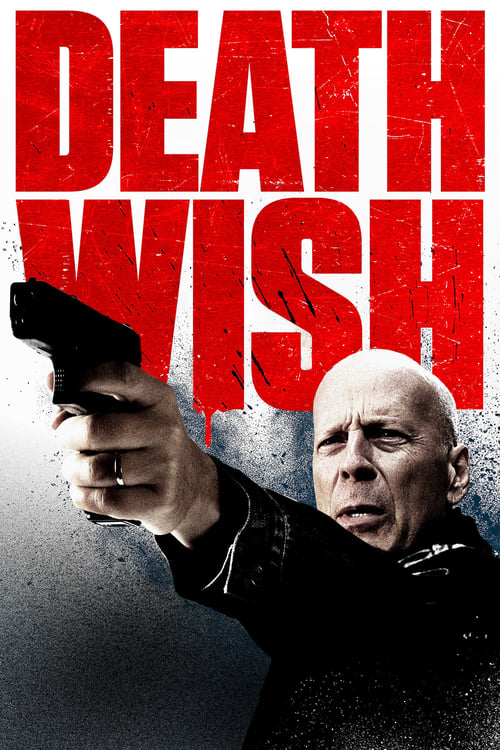
Death Wish (2018)
Directed by Eli Roth
No — Death Wish is not woke, scoring 11 out of 100 on our wokeness meter.
Death Wish arrives as the sixth entry in a franchise that began in 1974, and as the second telling of Brian Garfield's novel, which is to say it is a remake of a remake's source material.
Consciousness Markers
The cast is a standard action-thriller ensemble with a few non-white supporting players (Kimberly Elise as Detective Jackson, an uncredited Mike Epps), but diversity is incidental rather than a stated priority.
The film gestures at a gun-violence debate via news clips and divided public opinion, but critics noted it refuses to actually take a moral or political stance, making it a provocation rather than a sermon.
The film engages no racial consciousness; critics actually faulted it for depicting its criminals along racialized lines without any commentary or self-awareness.
The plot is a classic fridging narrative: a wife is killed and a daughter hospitalized purely to motivate the male protagonist's vengeance. No feminist framing whatsoever.
No LGBTQ+ characters, themes, or subtext appear anywhere in the film.
No environmental or climate themes are present.
No economic critique or anti-capitalist messaging; the film is a straightforward personal-revenge fantasy.
No body-positivity themes or messaging.
No neurodivergent characters or themes.
No historical revisionism; the film is a contemporary fictional revenge story.
Why it received this score
Death Wish arrives as the sixth entry in a franchise that began in 1974, and as the second telling of Brian Garfield's novel, which is to say it is a remake of a remake's source material. Bruce Willis plays Dr. Paul Kersey, a Chicago trauma surgeon whose wife is killed and whose daughter is left comatose after a home invasion. He then acquires a handgun, and the film proceeds with the grim efficiency of a man working through a to-do list. Eli Roth directs with a straight face and a fondness for improvised weaponry. The tone is brisk, the body count is generous, and the moral ledger is left entirely blank.
For a film released three weeks after Parkland, the cultural accounting here is remarkably thin. News broadcasts flicker across the screen showing a divided public, some calling Kersey a hero, others a menace. The film watches this debate the way a man watches traffic. It never joins it. Critics at the time faulted the picture for pandering to bloodlust while pretending to satire, and the charge holds. The criminals are drawn along familiar racial lines, and no one in the frame pauses to notice. The wife exists to be killed. The daughter exists to be hospitalized. Neither is granted a personality beyond the function she serves.
All that remains is a competent, mean-spirited revenge picture with a Golden Raspberry nomination and a B+ from audiences. It gestures toward a national argument about firearms and then walks away, content to let Willis point a finger gun at a bag thief in the final shot. There is no economic critique, no environmental conscience, no interest in identity of any kind. As a specimen of modern social consciousness, it registers as almost nothing at all. The sommelier swirls the glass, finds no vintage, and sets it down.
Analysis generated by our Consciousness Algorithm


Synopsis
A mild-mannered father is transformed into a killing machine after his family is torn apart by a violent act.
Questions about Death Wish
Is Death Wish woke?
No — Death Wish is not woke, scoring 11 out of 100 on our wokeness meter. That earns it a verdict of Ultra Based.
Does Death Wish have any woke elements?
Very few. None of the 10 markers reaches 30, the level where a marker counts as present; the highest is Representation Casting at 20.
How does Death Wish compare to other 2018 movies?
It ranks #184 of the 325 films from 2018 we've scored; their average is 20. The wokest is Return (92).
How is the Woke Score calculated?
An AI-assisted process researches the film and its reception, scores it 0–100 on ten markers, then combines those into one 0–100 Woke Score. It measures a specific set of 2020s cultural themes, not film quality.