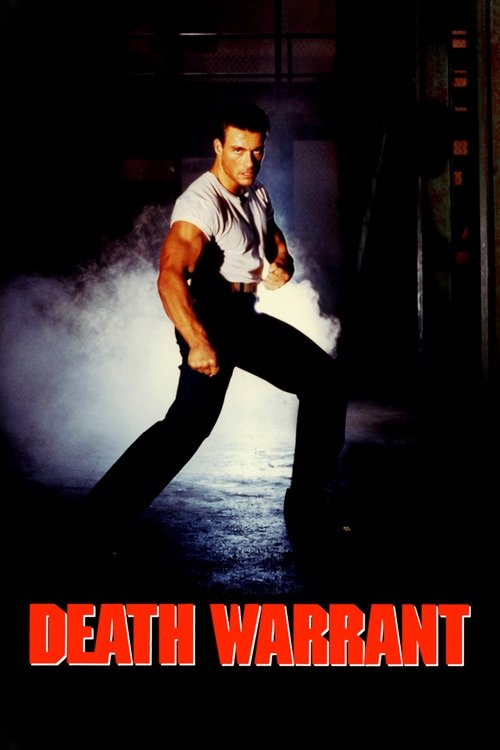
Death Warrant (1990)
Directed by Deran Sarafian
No — Death Warrant is not woke, scoring 7 out of 100 on our wokeness meter.
The year is 1990.
Consciousness Markers
The villainous attorney general runs a for-profit organ-harvesting scheme exploiting poor prisoners, offering a faint 'rich preying on the powerless' critique, though it plays as crime-thriller villainy rather than ideology.
The cast is predominantly white, though Robert Guillaume and a mixed prison population provide some natural diversity that exists without commentary.
Cynthia Gibb's attorney Amanda Beckett is a competent investigator who deciphers the conspiracy, but she functions as a standard supporting character rather than a feminist statement.
No LGBTQ+ characters or themes whatsoever in this 1990 prison action film.
The prison features a diverse inmate population, but the film makes no racial commentary; the organ-harvesting conspiracy is purely criminal and financial.
No environmental or climate themes are present.
No body-positivity themes; the film trades on conventional physical toughness and violence.
The Sandman is depicted as a psychopathic killer, which is villainous characterization, not neurodivergent representation.
A fictional crime thriller with no historical subject matter to revise.
A straightforward martial-arts action film that never pauses to deliver social or political sermons.
Why it received this score
The year is 1990. Jean-Claude Van Damme, a Quebecois Mountie, is sent into a California penitentiary to solve a string of murders, and we are asked to accept that a man with that accent and that ponytail could pass unnoticed among hardened inmates. The film does not linger on the implausibility. It has other business, namely a great deal of kicking.
On the matter of social consciousness, this is a sparse vintage. The cast is largely white, though Robert Guillaume and a mixed prison population lend a natural texture of diversity that the screenplay treats as furniture rather than thesis. Cynthia Gibb's Amanda Beckett is a capable investigator who cracks the code, which earns a modest nod toward feminist competence and nothing beyond it. The plot's engine, an attorney general harvesting organs from healthy first-time offenders and selling them for profit, gestures faintly at the wealthy feeding on the powerless. It plays as crime-thriller villainy, not ideology. No sermon follows.
The remaining markers sit at zero, and deservedly so. There is no climate anxiety in a boiler room, no body positivity in a film whose entire argument is that a man can be thrown into a furnace and walk it off. The Sandman is a psychopath, which is a plot device, not a diagnosis. When the villain finally dies, impaled on a valve stem and still talking, the movie does not pause to reflect on the carceral state. It pauses to twist his head around. Forty-six million dollars against a six million dollar budget. Sometimes the market speaks, and it says nothing at all.
The classification stands. A lean, mean, and ideologically inert specimen, best filed under violence for its own sake. It is not a film with a message. It is a film with a roundhouse kick, and it knows exactly which one it would rather deliver.
Analysis generated by our Consciousness Algorithm


Synopsis
Canadian policeman Louis Burke is assigned in a jail to investigate the murders of prisoners and jailors. While there, Louis, using his outstanding martial arts skills, is able to save his life and make himself respected in this violent world.
Questions about Death Warrant
Is Death Warrant woke?
No — Death Warrant is not woke, scoring 7 out of 100 on our wokeness meter. That earns it a verdict of Ultra Based.
Does Death Warrant have any woke elements?
Very few. None of the 10 markers reaches 30, the level where a marker counts as present; the highest is Eat the Rich at 15.
How does Death Warrant compare to other 1990 movies?
It ranks #27 of the 68 films from 1990 we've scored; their average is 9. The wokest is Nightbreed (60).
How is the Woke Score calculated?
An AI-assisted process researches the film and its reception, scores it 0–100 on ten markers, then combines those into one 0–100 Woke Score. It measures a specific set of 2020s cultural themes, not film quality.