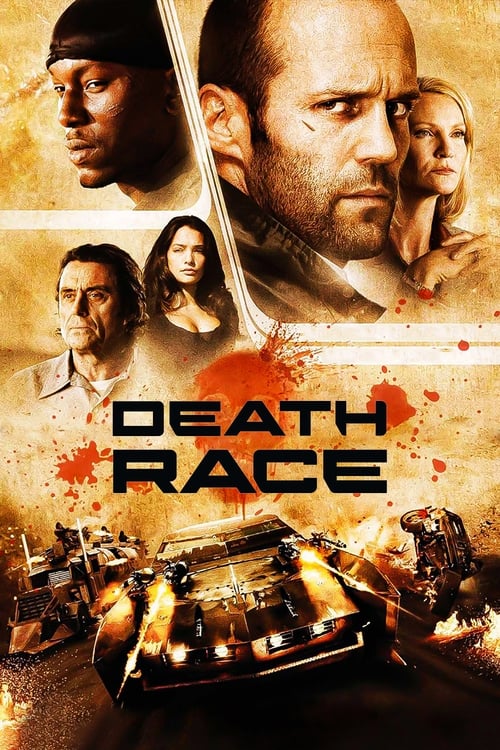
Death Race (2008)
Directed by Paul W. S. Anderson
No — Death Race is not especially woke, scoring 21 out of 100 on our wokeness meter.
Death Race arrives as a dystopian action film from 2008, directed by Paul W. S. Anderson, a remake or prequel depending on whom we ask.
Consciousness Markers
The core premise is a privatized prison run by the Weyland Corporation that monetizes inmates through a televised bloodsport for ratings and profit, a genuine if blunt critique of corporate prison profiteering and reality-TV exploitation.
The cast is notably multiracial for a 2008 action film, with Tyrese Gibson as a co-lead rival, Natalie Martinez as the navigator Case, and Joan Allen as the female warden, but these are natural genre-casting choices rather than a stated representational agenda.
Joan Allen's Warden Hennessey is a coldly competent female authority figure and Case is a capable mechanic/navigator, but the film is a hyper-masculine car-combat spectacle with no feminist argument.
The film gestures at a 'comment on society and reality television' per its producers, but it is a loud, unpretentious action romp that never stops to preach.
The multiracial cast exists without any commentary on race, and the film engages no racial themes whatsoever.
No LGBTQ+ characters, themes, or subtext appear anywhere in the film.
No environmental or climate themes are present; the dystopia is economic and carceral, not ecological.
No body-positivity themes; the film trades entirely in conventional action-star physicality.
No neurodivergent characters or themes are depicted.
The film is set in a fictional near-future and makes no historical claims to revise.
Why it received this score
Death Race arrives as a dystopian action film from 2008, directed by Paul W. S. Anderson, a remake or prequel depending on whom we ask. Terminal Island, privatized prison, Weyland Corporation monetizes inmates via pay-per-view carnage. Jason Statham as Jensen Ames, framed, coerced. The film's politics are blunt: corporate prison profiteering and reality television's appetite for suffering. This is its most legible modern anxiety. It earns a modest anti-capitalist pulse. But it never builds a coherent argument. It simply places a corporation in the villain's chair and lets cars explode.
Casting is more varied than the genre standard. Tyrese Gibson as Machine Gun Joe, Natalie Martinez as Case, Joan Allen as Warden Hennessey. These are natural action-movie choices, not a stated representational program. Race is present but unexamined. No line of dialogue asks us to consider it. Joan Allen gives the film a cold female authority figure, and Case is competent with engines and weapons. That is not a feminist thesis. The camera remains devoted to muscle, chrome, and gasoline. No LGBTQ themes, no climate concerns, no body positivity, no neurodivergence. The dystopia is economic and carceral. The environment is not on trial. The body is not a site of acceptance. The mind is not a subject of inquiry.
The film gestures toward commentary on society and reality television, according to its producers. On screen, it is a loud, unpretentious romp. It never stops for a sermon. The message, such as it is, can be absorbed while watching a tanker truck named Dreadnought get tricked into a trap. Critics called it mindless, violent, and lightning-paced. They were largely correct. It is not a work of historical revision. It makes no claims about the past. It is a product of its moment, a B-movie with a budget and a sour little idea about who profits when people are locked up. The result is neither righteous nor radical. It is greasy, nasty, and mostly interested in the next crash.
Analysis generated by our Consciousness Algorithm
Part of


Synopsis
Terminal Island, New York: 2020. Overcrowding in the US penal system has reached a breaking point. Prisons have been turned over to a monolithic Weyland Corporation, which sees jails full of thugs as an opportunity for televised sport. Adrenalized inmates, a global audience hungry for violence and a spectacular, enclosed arena come together to form the 'Death Race', the biggest, most brutal event.
Questions about Death Race
Is Death Race woke?
No — Death Race is not especially woke, scoring 21 out of 100 on our wokeness meter. That earns it a verdict of Based.
Does Death Race have any woke elements?
2 of the 10 markers register at 30 or above, led by Eat the Rich (45) and Representation Casting (35). On Eat the Rich: The core premise is a privatized prison run by the Weyland Corporation that monetizes inmates through a televised bloodsport for ratings and profit, a genuine if blunt critique of corporate prison profiteering and reality-TV exploitation.
How does Death Race compare to other 2008 movies?
It ranks #36 of the 212 films from 2008 we've scored; their average is 12. The wokest is Milk (68).
Is Death Race the most woke Death Race (2008) movie?
Yes. It scores highest of the 3 Death Race (2008) films we've scored.