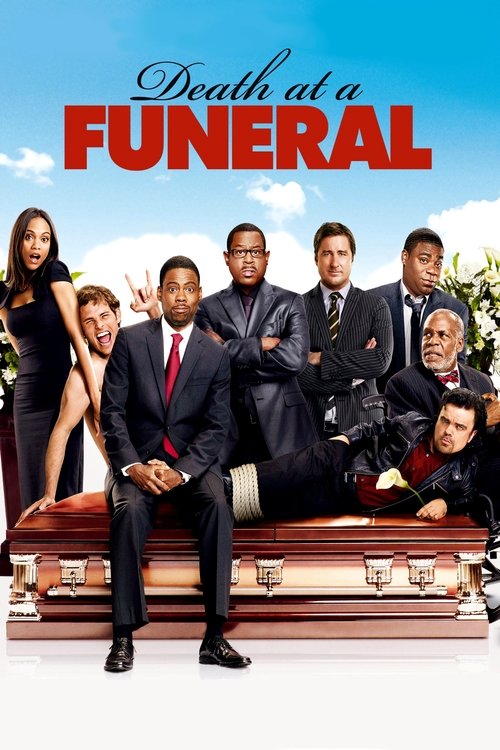
Death at a Funeral (2010)
Directed by Neil LaBute
No — Death at a Funeral is not especially woke, scoring 31 out of 100 on our wokeness meter.
Neil LaBute's 2010 remake of Dean Craig's own 2007 British farce relocates the Barnes family from the English home counties to an African-American household, and that shift is the most consequential decision in the picture.
Consciousness Markers
The film reimagines the original British white ensemble as an African-American family, with a predominantly Black cast led by Chris Rock, Martin Lawrence, and Tracy Morgan.
The plot hinges on the deceased father's secret male lover, Frank, who attempts to blackmail the family; the gay relationship is central, though played for comedy.
Female characters are present as wives, fiancées, and mothers, but the film advances no feminist themes or critiques.
Despite the Black-led cast, the film never engages with race, racism, or racial identity.
No environmental themes or commentary.
Financial anxieties are plot devices, not a critique of capitalism.
No body positivity themes.
No exploration of neurodivergence; drug-induced hallucinations are purely comedic.
A remake of a contemporary comedy, not a historical revision.
The film is a farcical comedy and delivers no preachy moral lessons.
Why it received this score
Neil LaBute's 2010 remake of Dean Craig's own 2007 British farce relocates the Barnes family from the English home counties to an African-American household, and that shift is the most consequential decision in the picture. Chris Rock, Martin Lawrence, Tracy Morgan, Regina Hall, Danny Glover and Loretta Devine fill out an ensemble the original had staffed with pale Britons, and the film treats the change as unremarkable, which is to say it never pauses to explain itself. The result is a comedy that looks different from its source without ever announcing that it does. A rare instance of representation arriving without a press release attached.
The plot's engine is a dead man's secret. Frank Lovett, played by Peter Dinklage in the only role carried over from the earlier version, arrives at the service with photographs and a demand for thirty thousand dollars, having been the deceased's lover for years. The revelation is central, unavoidable, and handled entirely as farce: blackmail, a wrestling match, a dose of hallucinogens, a man stuffed into a coffin. Here is a mainstream studio comedy in which a gay relationship drives the entire narrative, and nobody delivers a speech about tolerance. Whether that constitutes progress or merely good plotting is a question the film declines to entertain.
The picture's omissions are instructive. It offers no thesis on race, no critique of money, no sermon on how we ought to live. Female characters marry, worry, and get pregnant, and the screenplay asks nothing more of them. What it sets out to do is make an audience laugh at a corpse, a naked man on a roof, and a father's double life. It succeeds often enough. Ebert preferred it to the original, a minority position, and the aggregate scores sit stubbornly in the middle. A farce, competently assembled, with no ambitions beyond the next punchline.
Analysis generated by our Consciousness Algorithm


Synopsis
Aaron's father's funeral is today at the family home, and everything goes wrong: the funeral home delivers the wrong body, his cousin accidentally drugs her fiancé, and Aaron's successful younger brother, Ryan, flies in from New York, broke but arrogant. To top it all off, a mysterious stranger wants a word with Aaron.
Questions about Death at a Funeral
Is Death at a Funeral woke?
No — Death at a Funeral is not especially woke, scoring 31 out of 100 on our wokeness meter. That earns it a verdict of Based.
Does Death at a Funeral have any woke elements?
2 of the 10 markers register at 30 or above, led by Representation Casting (70) and LGBTQ+ Themes (55). On Representation Casting: The film reimagines the original British white ensemble as an African-American family, with a predominantly Black cast led by Chris Rock, Martin Lawrence, and Tracy Morgan.
How does Death at a Funeral compare to other 2010 movies?
It ranks #16 of the 238 films from 2010 we've scored; their average is 11. The wokest is My Name Is Khan (84).
How is the Woke Score calculated?
An AI-assisted process researches the film and its reception, scores it 0–100 on ten markers, then combines those into one 0–100 Woke Score. It measures a specific set of 2020s cultural themes, not film quality.