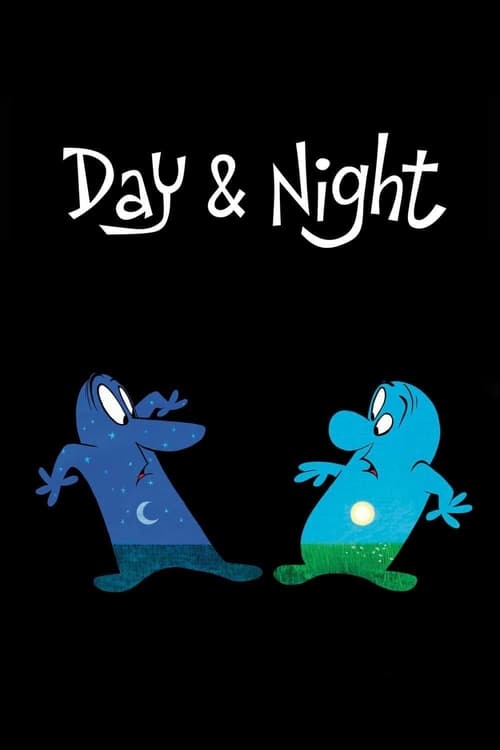
Day & Night (2010)
Directed by Teddy Newton
No — Day & Night is not woke, scoring 0 out of 100 on our wokeness meter.
We approached 'Day & Night' as a cinematic exercise in conceptual duality.
Consciousness Markers
A sampled Wayne Dyer lecture voiceover explicitly spells out the moral that the unknown is mysterious and beautiful rather than frightening, giving the short a gently didactic, message-forward tone.
The two leads are abstract anthropomorphic personifications of Day and Night, with no human casting or demographic representation to speak of.
No LGBTQ+ characters, themes, or subtext appear in this wordless Pixar short.
The film has no gendered characters or feminist themes; it is a fable about two abstract entities.
The story is a general humanist parable about fearing the unfamiliar, not a commentary on race or racial identity.
No environmental or climate themes are present; the day/night cycle is used purely as a visual conceit.
No economic critique or anti-capitalist messaging appears in the short.
No body image or body positivity themes are present.
No neurodivergence themes or characters are depicted.
The film engages no historical subject matter to revise.
Why it received this score
We approached 'Day & Night' as a cinematic exercise in conceptual duality. It presents a stark dichotomy between a bright, sun-drenched entity and a brooding, lunar counterpart. While the animation technique, blending 2D outlines with 3D internal landscapes, is technically ambitious, the narrative itself is a foundational parable about the human discomfort with the unknown. The short refuses to engage with the specific cultural markers of modern progressive sensibilities. There is no specific social commentary, no explicit focus on systemic injustice, and certainly no attempt to represent specific demographics. We are left with a charming, if somewhat simplistic, fable about overcoming initial suspicion.
The film achieves its minimal cultural resonance through a single, gently delivered voiceover. This sampled address by a known public intellectual provides the film's primary, and perhaps only, progressive sensibility. This spoken message insists that the mysterious nature of things should be embraced rather than feared. It functions as a foundational piece of instruction, providing the viewer with a gentle philosophical primer rather than demanding they actively participate in a social critique. The piece is highly instructive, which is its defining characteristic.
Ultimately, 'Day & Night' is a piece of highly stylized, pleasant escapism. It does not perform the heavy lifting of modern social consciousness. It does not push boundaries; it simply presents two opposing states and asks the audience to find peace between them. It is a pleasant visual experience, certainly, but in the context of contemporary cultural discourse, it remains fundamentally a meditation on cyclical nature, lacking the necessary sharp edges of modern ideological engagement.
Analysis generated by our Consciousness Algorithm
Part of

Synopsis
When Day, a sunny fellow, encounters Night, a stranger of distinctly darker moods, sparks fly! Day and Night are frightened and suspicious of each other at first, and quickly get off on the wrong foot. But as they discover each other's unique qualities--and come to realize that each of them offers a different window onto the same world-the friendship helps both to gain a new perspective.
Questions about Day & Night
Is Day & Night woke?
No — Day & Night is not woke, scoring 0 out of 100 on our wokeness meter. That earns it a verdict of Ultra Based.
Does Day & Night have any woke elements?
Very few. None of the 10 markers reaches 30, the level where a marker counts as present; the highest is Lecture Energy at 20.
How does Day & Night compare to other 2010 movies?
It ranks #204 of the 238 films from 2010 we've scored; their average is 11. The wokest is My Name Is Khan (84).
How is the Woke Score calculated?
An AI-assisted process researches the film and its reception, scores it 0–100 on ten markers, then combines those into one 0–100 Woke Score. It measures a specific set of 2020s cultural themes, not film quality.