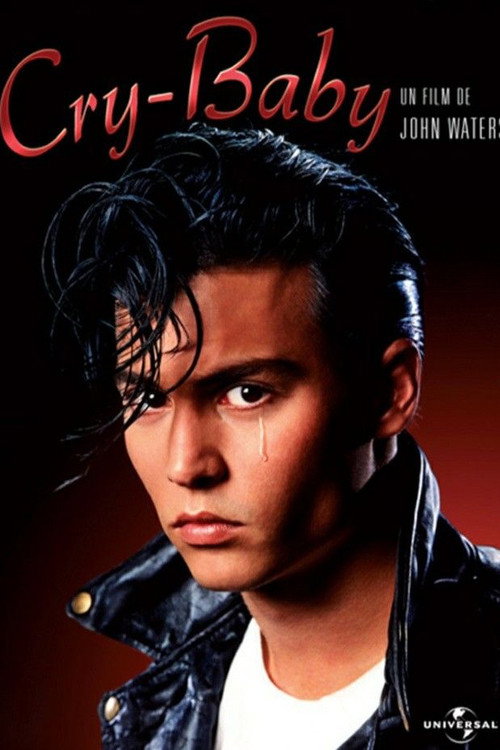
Cry-Baby (1990)
Directed by John Waters
No — Cry-Baby is not woke, scoring 12 out of 100 on our wokeness meter.
John Waters returned in 1990 with a grease-slicked parody of the teen rebel picture, setting his drapes and squares loose on a stylized 1954 Baltimore.
Consciousness Markers
Female characters like Hatchet-Face, Pepper, and Wanda are given agency and comic prominence, and Allison drives her own rebellion against her grandmother's propriety, though the film is a parody rather than a feminist statement.
Hatchet-Face, a facially disfigured woman, is presented as desirable and romantically fulfilled, and the film celebrates unconventional appearances over square conformity, though this is played for camp rather than as a body-positivity message.
The cast is overwhelmingly white, though Waters' ensemble includes a range of unconventional performers and body types. No meaningful racial or ethnic representation is foregrounded.
No explicit LGBTQ+ characters or plotlines, but the film's gleeful camp aesthetic and its director's queer sensibility give it a faintly queer-inflected tone rather than any stated themes.
The film is a broad musical comedy with no preachy or didactic messaging; its social observations are delivered as jokes rather than lessons.
The film engages class and subculture conflict between 'drapes' and 'squares' but has essentially no racial dimension or commentary.
The film lightly mocks suburban propriety and conformity but offers no economic critique or eat-the-rich sentiment.
No environmental or climate themes whatsoever.
No neurodivergent characters or themes are present.
The 1950s setting is a stylized parody of teen-rebel genre tropes, not a revisionist reframing of actual historical events.
Why it received this score
John Waters returned in 1990 with a grease-slicked parody of the teen rebel picture, setting his drapes and squares loose on a stylized 1954 Baltimore. The film is a musical, a romance, and a costume party, and it knows it. The casting is almost entirely white, a reflection of the milieu Waters grew up around and chose to lampoon, and no racial dimension enters the frame. The ensemble does offer a parade of unconventional faces and bodies, deployed for camp effect. The director's sensibility lends the proceedings a faintly queer undertow, though no character states a sexuality and no plotline turns on it.
The women here carry real comic weight. Hatchet-Face, facially disfigured and happily desired, gets a devoted boyfriend and a place at the center of the frame. Pepper raises two children without apology. Wanda embarrasses her square parents with visible relish. Allison engineers her own rebellion against her grandmother's propriety, and the grandmother, to the film's credit, comes around on her own terms. These are gestures toward female agency, though the engine is parody, not argument. The drapes and squares divide along class lines, and the film has little to say about money beyond mocking suburban conformity. It never reaches for an economic critique.
There is no environmental concern anywhere in the picture, no neurodivergent character, no reworking of the historical record. The fifties here are a genre playground, not a document. The social observations arrive as punchlines, and the film trusts the audience to catch them without a lecture. Three decades on, it remains a curious artifact: a mainstream studio musical built on subcultural affection, cheerfully indifferent to the causes that would later organize Hollywood's conscience. The tears fall from both eyes, and nobody learns a lesson. That is the joke, and it lands.
Analysis generated by our Consciousness Algorithm
Part of


Synopsis
A prim and proper schoolgirl goes against her society grandmother's wishes when she dates a motorcycle-riding juvenile delinquent.
Questions about Cry-Baby
Is Cry-Baby woke?
No — Cry-Baby is not woke, scoring 12 out of 100 on our wokeness meter. That earns it a verdict of Ultra Based.
Does Cry-Baby have any woke elements?
Very few. None of the 10 markers reaches 30, the level where a marker counts as present; the highest is Body Positivity at 25.
How does Cry-Baby compare to other 1990 movies?
It ranks #15 of the 68 films from 1990 we've scored; their average is 9. The wokest is Nightbreed (60).
How is the Woke Score calculated?
An AI-assisted process researches the film and its reception, scores it 0–100 on ten markers, then combines those into one 0–100 Woke Score. It measures a specific set of 2020s cultural themes, not film quality.