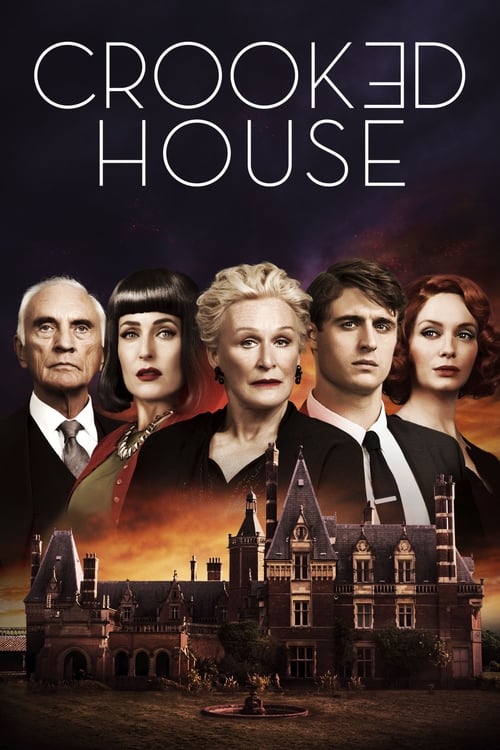
Crooked House (2017)
Directed by Gilles Paquet-Brenner
No — Crooked House is not woke, scoring 5 out of 100 on our wokeness meter.
Crooked House arrives as a 2017 adaptation of Agatha Christie's 1949 novel, a period whodunit set in the mid-1950s among an aristocratic English family.
Consciousness Markers
The film features several forceful women (Josephine, Edith, Clemency, Magda), but they function as Christie's customary suspects and schemers rather than vehicles for any feminist argument.
The plot revolves around a wealthy family squabbling over an inheritance, but it treats this as genre furniture rather than mounting any eat-the-rich critique.
The cast is a uniformly white British ensemble playing an aristocratic English family; no deliberate diverse or color-conscious casting is present.
No LGBTQ+ characters, themes, or subtext appear anywhere in this period whodunit.
Race is entirely absent as a theme; the Greek heritage of the patriarch is a plot footnote, not a racial commentary.
A character happens to be a plant biologist with knowledge of poisons, but there is no environmental or climate messaging whatsoever.
No body-positivity themes or messaging are present.
Josephine's cold cleverness and Eustace's polio are period plot devices, not framed through any modern neurodivergence lens.
The film is a faithful 1950s-set adaptation of a 1949 novel with no historical revisionism.
This is a genteel drawing-room mystery that entertains rather than sermonizes; no preachy messaging is delivered.
Why it received this score
Crooked House arrives as a 2017 adaptation of Agatha Christie's 1949 novel, a period whodunit set in the mid-1950s among an aristocratic English family. The investigator Charles Hayward is summoned by a former flame to determine whether her wealthy Greek-born grandfather was murdered. The ensemble is uniformly white, uniformly British, and occupied entirely with money. Nothing in the film's casting, its themes, or its concerns suggests any awareness of a cultural conversation that began after the novel was published. It is a drawing room, and the door has been shut for seventy years.
The women here are forceful. Josephine, twelve years old and privy to everyone's business. Edith with her shotgun and her moles. Clemency, the plant biologist fluent in poisons. Magda, the fading actress. These are Christie's customary schemers, deployed as suspects and red herrings, not as arguments. The plot concerns an enormous fortune and a family clawing over it, yet the film treats the inheritance as furniture. It observes the greed without indicting it. An attack on wealth would require a position, and the film declines to hold one. Nobody lectures. Nobody sermonizes. The murders are solved, the guilty drive into a quarry, and the audience is left with the modest pleasure of a puzzle assembled correctly.
There is no environmental messaging, no engagement with race beyond a biographical footnote about the patriarch's birthplace, no romantic subtext beyond the conventional, no attention to the body as a political subject, and no attempt to reframe the child's cold cleverness through a modern clinical lens. The film offers craft instead: Glenn Close, Gillian Anderson, Terence Stamp, and Christina Hendricks doing competent work in handsome rooms. It knows what it is and apologizes for nothing. Such restraint is nearly extinct. We note it and move on.
Analysis generated by our Consciousness Algorithm


Synopsis
A private investigator helps a former flame solve the murder of her wealthy grandfather, who lived in a sprawling estate surrounded by his idiosyncratic family.
Questions about Crooked House
Is Crooked House woke?
No — Crooked House is not woke, scoring 5 out of 100 on our wokeness meter. That earns it a verdict of Ultra Based.
Does Crooked House have any woke elements?
Very few. None of the 10 markers reaches 30, the level where a marker counts as present; the highest is Feminist Agenda at 10.
How does Crooked House compare to other 2017 movies?
It ranks #241 of the 309 films from 2017 we've scored; their average is 19. The wokest is I Am Not Your Negro (92).
How is the Woke Score calculated?
An AI-assisted process researches the film and its reception, scores it 0–100 on ten markers, then combines those into one 0–100 Woke Score. It measures a specific set of 2020s cultural themes, not film quality.