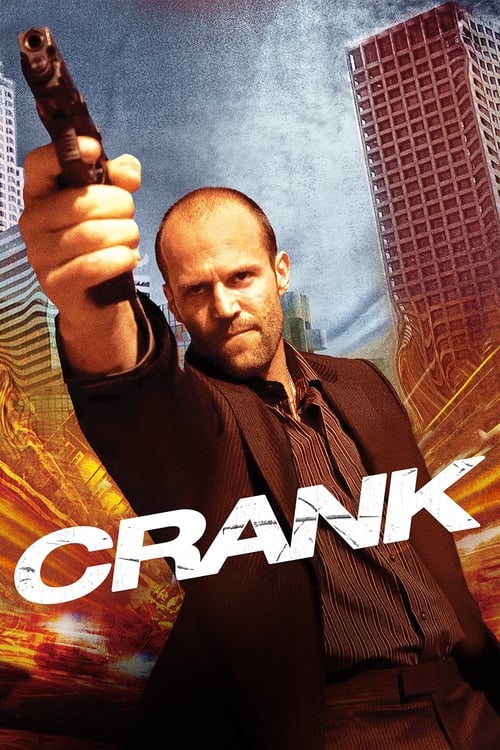
Crank (2006)
Directed by Brian Taylor
No — Crank is not woke, scoring 8 out of 100 on our wokeness meter.
Crank arrived in 2006 with a premise that reads like a dare: a Los Angeles hitman is dosed with a Chinese synthetic compound that halts his adrenaline, and he has roughly an hour to keep his heart hammering long enough to find the men who poisoned him.
Consciousness Markers
The cast is naturally multi-ethnic (Jose Pablo Cantillo, Efren Ramirez, Keone Young, Reno Wilson, Edi Gathegi) and includes a crossdressing informant, but this is organic ensemble casting rather than a deliberate representation statement.
The crossdressing informant Kaylo is a plot device, not an exploration of LGBTQ+ identity or themes; no queer content is present.
Amy Smart's Eve functions as the girlfriend/damsel who must be rescued and informed of her man's secret life; no feminist agenda whatsoever.
Triad bosses, a Korean sweatshop, and a Haitian cabbie appear as genre furniture, with no commentary on race or racial justice.
No environmental or climate themes of any kind.
A Korean sweatshop appears briefly as a set piece, but the film has no critique of capitalism or wealth; it is a pure adrenaline revenge romp.
No body positivity themes; the film trades in conventional action-star physicality.
No neurodivergence themes or characters.
A contemporary fictional crime thriller with no historical subject matter to revise.
The film is the antithesis of preachy — gleefully depraved, assaultively styled, and utterly uninterested in moral instruction.
Why it received this score
Crank arrived in 2006 with a premise that reads like a dare: a Los Angeles hitman is dosed with a Chinese synthetic compound that halts his adrenaline, and he has roughly an hour to keep his heart hammering long enough to find the men who poisoned him. Brian Taylor and Mark Neveldine shot the thing on digital videotape and cut it like a panic attack. Jason Statham sprints, brawls, steals a motorcycle, and conducts a public sex scene because his life depends on it. The film has no interest in explaining itself, and no interest in us.
The cast is naturally polyglot. Jose Pablo Cantillo, Efren Ramirez, Keone Young, Reno Wilson, and Edi Gathegi fill out the margins, and Ramirez's Kaylo, a crossdressing informant, is a memorable piece of street furniture. This is organic ensemble building, not a statement. The film never pauses to congratulate itself for it. Amy Smart's Eve exists to be the girlfriend who must be rescued and finally told the truth about her man's profession. A Korean sweatshop serves as a shootout location and nothing more. There is no argument about labor here, no argument about race, no argument about anything.
That absence is the film's defining quality. It is gleefully depraved, assaultively styled, and entirely unserious about moral instruction. Where a modern action picture might fold in a lesson about corporate greed or environmental ruin, Crank offers a helicopter fight at three thousand feet and a man who survives a fall onto a downtown intersection. It is a relic from a moment when a B-movie could simply be a B-movie, and it remains difficult to dislike for that.
Analysis generated by our Consciousness Algorithm
Part of


Synopsis
Chev Chelios, a hit man wanting to go straight, lets his latest target slip away. Then he awakes the next morning to a phone call that informs him he has been poisoned and has only an hour to live unless he keeps adrenaline coursing through his body while he searches for an antidote.
Questions about Crank
Is Crank woke?
No — Crank is not woke, scoring 8 out of 100 on our wokeness meter. That earns it a verdict of Ultra Based.
Does Crank have any woke elements?
Very few. None of the 10 markers reaches 30, the level where a marker counts as present; the highest is Representation Casting at 20.
How does Crank compare to other 2006 movies?
It ranks #89 of the 211 films from 2006 we've scored; their average is 11. The wokest is An Inconvenient Truth (92).
How is the Woke Score calculated?
An AI-assisted process researches the film and its reception, scores it 0–100 on ten markers, then combines those into one 0–100 Woke Score. It measures a specific set of 2020s cultural themes, not film quality.