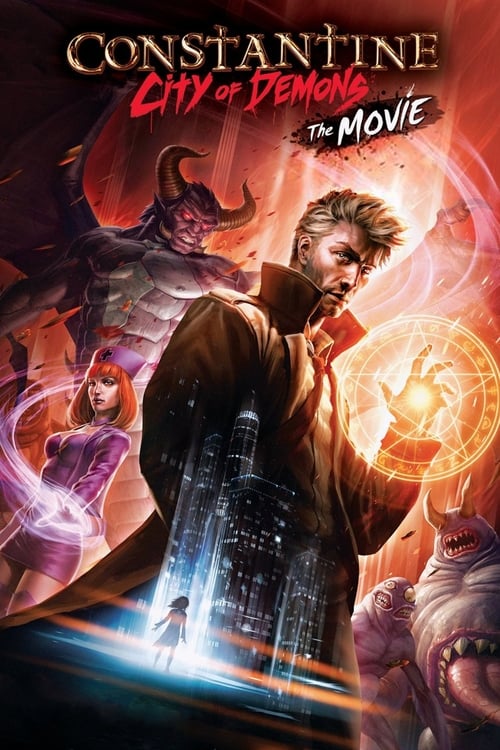
Constantine: City of Demons - The Movie (2018)
Directed by Doug Murphy
No — Constantine: City of Demons - The Movie is not woke, scoring 6 out of 100 on our wokeness meter.
Constantine: City of Demons - The Movie arrives as a feature assembled from a television series, which explains its episodic lunges and abrupt emotional pivots.
Consciousness Markers
The voice cast includes Kevin Michael Richardson, a Black actor, but the film does not foreground diversity as a theme or make it central to the story.
John Constantine is canonically bisexual in the comics, but this film contains no same-sex romance, identity exploration, or LGBTQ+ themes.
The plot revolves around saving a young girl, with female characters largely serving as victims or plot devices; no feminist agenda is present.
No exploration of race, systemic racism, or racial identity appears in the story.
No environmental or climate-related themes are present.
The film does not critique wealth, capitalism, or economic inequality.
No body-positive messaging or body-diverse representation is present.
While Constantine has trauma and addictive tendencies, the film does not frame these as neurodivergence or explore neurodiverse identity.
The film is a supernatural fantasy with no historical revisionism.
The film does not deliver preachy social or political lectures; it is a dark supernatural action story.
Why it received this score
Constantine: City of Demons - The Movie arrives as a feature assembled from a television series, which explains its episodic lunges and abrupt emotional pivots. John Constantine and Chas Chandler race to save Chas's daughter from a supernatural coma, a premise that keeps the stakes personal and the metaphysics grimy. The film is content to be a dark fantasy procedural with exorcisms, demons, and neo-noir cigarette smoke. It has no interest in instructing us on contemporary social matters. That restraint is not a virtue or a flaw. It is simply the weather of this particular production.
The voice cast includes Kevin Michael Richardson, a Black performer of great range, but the film does not foreground diversity as a theme or ask us to think about representation. John Constantine's canonical bisexuality remains on the page. Here he is too busy with possession and paternal guilt to explore identity, romance, or desire. Female characters exist mostly as victims or instruments of the plot, which means the story has no feminist argument to make. Race, climate, economic inequality, body image, and neurodivergence all go untouched. Constantine's trauma and addictive tendencies are present as character texture, not as a framework for neurodiverse identity.
This is a supernatural action story with no sermonizing impulse. It does not revise history, critique capitalism, or lecture the audience about virtue. The closest it comes to social consciousness is a stray bit of casting, and even that is not put to thematic use. The remainder is a modest, moody exercise in DC animation, edited together with the seams showing. It is the kind of film that wants to be judged by its demons, not its discourse. On those narrow terms, it succeeds enough. The classification is straightforward, and the ledger is mostly empty.
Analysis generated by our Consciousness Algorithm
Part of


Synopsis
A decade after a tragic mistake, family man Chas Chandler and occult detective John Constantine set out to cure his daughter Trish from a mysterious supernatural coma.
Questions about Constantine: City of Demons - The Movie
Is Constantine: City of Demons - The Movie woke?
No — Constantine: City of Demons - The Movie is not woke, scoring 6 out of 100 on our wokeness meter. That earns it a verdict of Ultra Based.
Does Constantine: City of Demons - The Movie have any woke elements?
Very few. None of the 10 markers reaches 30, the level where a marker counts as present; the highest is Representation Casting at 15.
How does Constantine: City of Demons - The Movie compare to other 2018 movies?
It ranks #244 of the 325 films from 2018 we've scored; their average is 20. The wokest is Return (92).
How is the Woke Score calculated?
An AI-assisted process researches the film and its reception, scores it 0–100 on ten markers, then combines those into one 0–100 Woke Score. It measures a specific set of 2020s cultural themes, not film quality.