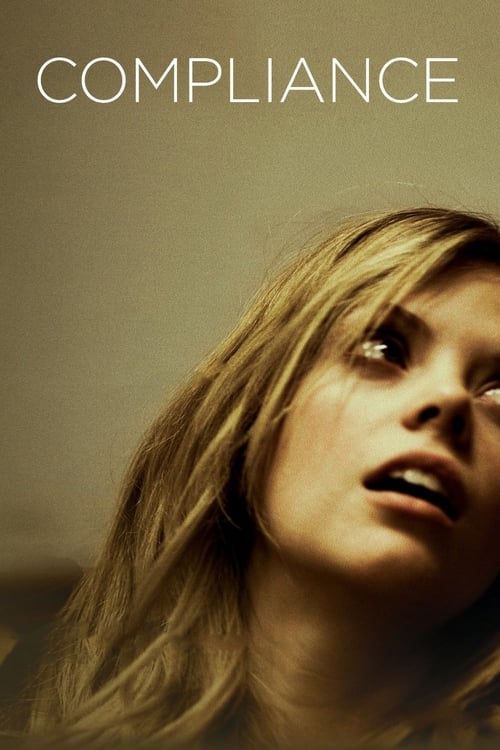
Compliance (2012)
Directed by Craig Zobel
No — Compliance is not woke, scoring 0 out of 100 on our wokeness meter.
Craig Zobel's Compliance arrives with a premise that sounds fabricated and is not.
Consciousness Markers
The film is built as a Milgram-style provocation about compliance, but its thesis is psychological rather than a modern social-justice sermon.
The cast is largely white and reflects the ordinary Ohio fast-food setting; any diversity is incidental and not framed as representation casting.
There are no LGBTQ+ characters, themes, or subtext.
The film centers on a female manager and a female victim, but it treats the events as a study in obedience to authority rather than an explicitly feminist critique.
Race is not a meaningful theme or commentary in the film.
There is no climate or environmental messaging.
The fast-food workplace provides a setting for authority dynamics, not an eat-the-rich or anti-capitalist argument.
The strip-search and humiliation scenes are the opposite of body-positivity messaging.
No neurodivergence themes or characters are present.
The film is closely based on a real incident and changes names, but it does not revise history for ideological purposes.
Why it received this score
Craig Zobel's Compliance arrives with a premise that sounds fabricated and is not. A suburban Ohio fast-food manager named Sandra takes a call from a man claiming to be a police officer, and over the next several hours she detains, strip-searches, and ultimately surrenders a teenage employee named Becky to a rotating cast of men, all of them following instructions from a voice on a phone that nobody ever verifies. The film is drawn from the strip-search phone call scams that surfaced in Mount Washington, Kentucky in 2004. Names were changed. The mechanics were not.
What the film declines to do is instructive. It declines to sermonize. There is no racial thesis here, no queer subtext, no environmental lament, no argument about capital or bodies or brains. The cast looks like the staff of an actual chicken restaurant in Ohio, because that is what it is meant to look like, and the film treats that as set dressing, not as a statement. Becky is a young woman degraded at length, and a lazier film would have made a gender essay of it. Zobel keeps his camera steady and his mouth shut. The horror is procedural.
That restraint is nearly the whole achievement. Ann Dowd plays Sandra as a woman who believes, sincerely, that she is being helpful, and the performance earned her the National Board of Review award for it. Sundance audiences walked out and shouted at the question and answer session, which is the correct response to a film that works. There is a faint whiff of the classroom in the Milgram framing, a nudge toward the lesson about authority, but it is a lesson in psychology, not a sermon about how we ought to live. The film wants us uncomfortable. It does not want us instructed. Mostly, it gets its wish.
Analysis generated by our Consciousness Algorithm


Synopsis
On a particularly busy day at a suburban Ohio fast food restaurant, manager Sandra receives a phone call from a police officer saying that an employee has stolen money from a customer.
Questions about Compliance
Is Compliance woke?
No — Compliance is not woke, scoring 0 out of 100 on our wokeness meter. That earns it a verdict of Ultra Based.
Does Compliance have any woke elements?
Very few. None of the 10 markers reaches 30, the level where a marker counts as present; the highest is Lecture Energy at 10.
How does Compliance compare to other 2012 movies?
It ranks #193 of the 230 films from 2012 we've scored; their average is 12. The wokest is Killing Them Softly (92).
How is the Woke Score calculated?
An AI-assisted process researches the film and its reception, scores it 0–100 on ten markers, then combines those into one 0–100 Woke Score. It measures a specific set of 2020s cultural themes, not film quality.