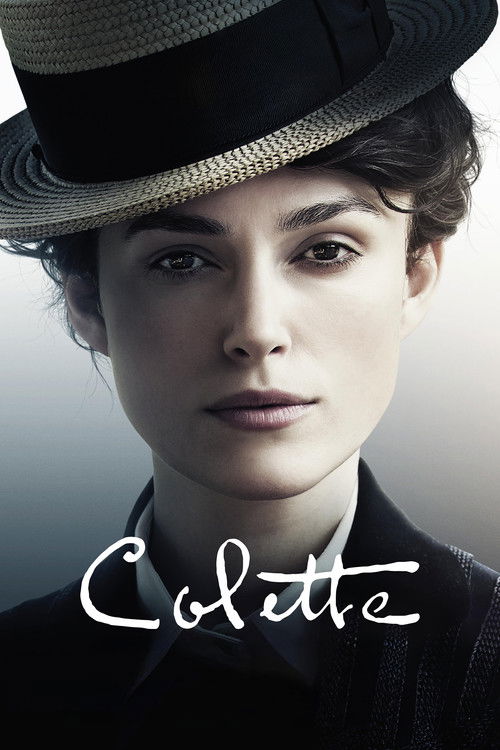
Colette (2018)
Directed by Wash Westmoreland
Partly — Colette is somewhat woke, scoring 53 out of 100 on our wokeness meter.
Colette is presented as a meticulously crafted monument to creative defiance.
Consciousness Markers
Colette's affairs with women (Georgie Raoul-Duval) and her relationship with Missy, who presents as male, are central to the narrative. The Moulin Rouge onstage kiss and its scandal are dramatized as key beats, making queer themes a major through-line.
The film is explicitly framed as a liberation story: a woman escaping a controlling, exploitative husband to claim authorship and independence. Her struggle against being erased under Willy's byline is the emotional engine of the plot.
Critics noted the film's 'timely' framing and its overt message of sexual and creative liberation, with the director explicitly aiming for a liberation story. The messaging is present but delivered through drama rather than direct address.
As a modern biopic, it foregrounds Colette's queer relationships and feminist self-assertion, reframing her legacy for contemporary sensibilities. However, these elements are historically grounded rather than invented, so revisionism is mild.
The cast is overwhelmingly white for a period piece set in France, with only marginal non-white performers (e.g., Aiysha Hart, Ray Panthaki) in supporting roles. Diversity is incidental rather than a stated aim.
Willy's role as a 'literary entrepreneur' who exploits ghostwriters and sells the Claudine rights without Colette's knowledge offers a mild critique of creative labor exploitation and commodification, though it is framed personally rather than systemically.
Race is essentially absent from the film's concerns; it is a white European literary biopic with no engagement with racial politics or structures.
No environmental or climate themes whatsoever.
No body-positivity themes; the film does not engage with body image or size acceptance.
No neurodivergent characters or themes are present.
Why it received this score
Colette is presented as a meticulously crafted monument to creative defiance. We observe Sidonie-Gabrielle Colette navigating the gilded cage of late nineteenth-century Paris, a woman whose genius is initially reduced to a function of her husband’s literary enterprise. The narrative charts her slow, deliberate migration from a provincial ghostwriter to a recognized author. This film operates less as a straightforward biography and more as a carefully calibrated statement on female autonomy within a male-dominated artistic sphere. The effort to frame her journey as an explicit liberation story is palpable, though the execution occasionally leans into a self-conscious theatricality.
The film achieves its most striking resonance in its progressive sensibilities. The central conflict is defined by Colette’s refusal to be a mere puppet, an assertion of self that extends to her personal life. Her relationships with women like Georgie Raoul-Duval and Missy are treated as crucial, defining beats of her character arc. This narrative gives substantial weight to themes of queer life and artistic independence. We see a decent critique of the exploitative dynamics between the writer and the publisher, even if the film refuses to broaden its focus to systemic issues of labor or class. The visual style is undeniably polished, a hallmark of its commitment to the aesthetic of the period.
Where the film falls short is in its thematic ambition beyond the personal. The narrative remains anchored in a singular, overwhelmingly white European milieu. We find little critical engagement with broader social structures, whether regarding race or economic inequality, which keeps the film from achieving a more comprehensive cultural commentary. It is a sophisticated study of personal agency, yet it is constrained by its historical geography and a clear, well-meaning directorial agenda. It is a capable piece of historical drama, even if it is somewhat predictable in its insistence upon its own moral clarity.
Analysis generated by our Consciousness Algorithm


Synopsis
After marrying a successful Parisian writer known commonly as Willy, Sidonie-Gabrielle Colette is transplanted from her childhood home in rural France to the intellectual and artistic splendor of Paris. Soon after, Willy convinces Colette to ghostwrite for him. She pens a semi-autobiographical novel about a witty and brazen country girl named Claudine, sparking a bestseller and a cultural sensation. After its success, Colette and Willy become the talk of Paris and their adventures inspire additional Claudine novels.
Questions about Colette
Is Colette woke?
Partly — Colette is somewhat woke, scoring 53 out of 100 on our wokeness meter. That earns it a verdict of Woke-Adjacent.
What makes Colette woke?
3 of the 10 markers register at 30 or above, led by LGBTQ+ Themes (78), Feminist Agenda (68) and Lecture Energy (40). On LGBTQ+ Themes: Colette's affairs with women (Georgie Raoul-Duval) and her relationship with Missy, who presents as male, are central to the narrative.
How does Colette compare to other 2018 movies?
It ranks #36 of the 325 films from 2018 we've scored; their average is 20. The wokest is Return (92).
How is the Woke Score calculated?
An AI-assisted process researches the film and its reception, scores it 0–100 on ten markers, then combines those into one 0–100 Woke Score. It measures a specific set of 2020s cultural themes, not film quality.