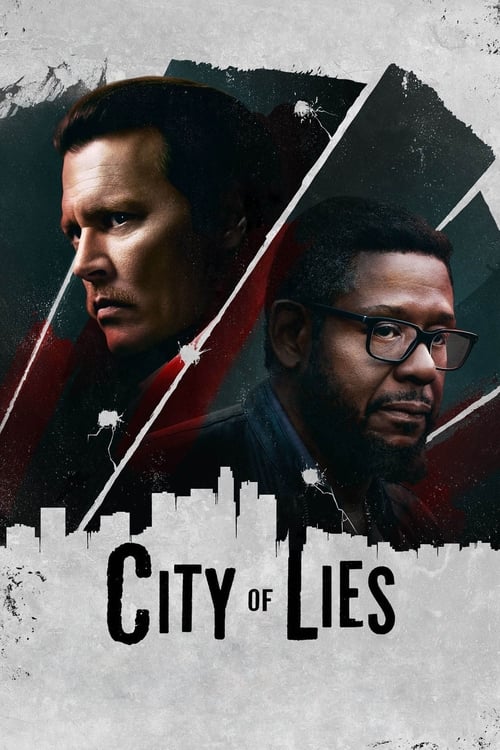
City of Lies (2018)
Directed by Brad Furman
No — City of Lies is not especially woke, scoring 26 out of 100 on our wokeness meter.
City of Lies arrives carrying the weight of a genuine American tragedy and the misfortune of a distributor that collapsed before anyone could see it.
Consciousness Markers
The cast is heavily Black (Forest Whitaker, Neil Brown Jr., Shamier Anderson, Rockmond Dunbar, Amin Joseph) because the true story centers on Black rappers and Black LAPD officers, so the diversity is largely organic to the material rather than a deliberate modern casting statement.
The narrative repeatedly invokes Rodney King, the O.J. Simpson trial, and race-related LAPD incidents, and the murders of two Black music icons sit at its center, though race is treated as context for institutional corruption rather than as an explicit social-justice thesis.
The closing act carries a moral about institutional hypocrisy and a forgotten hero, but the messaging stays within the conventions of an investigative thriller rather than preaching to the audience.
The film gestures at exploitation in the music industry (Suge Knight, Death Row) and a hypocritical system that buries truth, and Jackson resigns in disgust, but there is no sustained eat-the-rich argument.
The film dramatizes a conspiracy theory that the LAPD covered up the Biggie and Tupac murders, challenging the official account, but it does so as a true-crime procedural rather than a modern ideological rewriting of history.
Voletta Wallace appears as a grieving mother seeking justice, but the film offers no feminist framework or gender-conscious critique.
No LGBTQ+ characters, themes, or subtext appear anywhere in the film.
No environmental or climate themes are present.
No body-positivity themes or messaging appear.
No neurodivergent characters or themes are depicted.
Why it received this score
City of Lies arrives carrying the weight of a genuine American tragedy and the misfortune of a distributor that collapsed before anyone could see it. Brad Furman directs this adaptation of Randall Sullivan's LAbyrinth, following a disgraced LAPD detective and a reporter as they pick at the unsolved murders of Tupac Shakur and the Notorious B.I.G. Johnny Depp plays Russell Poole with a weary, rumpled persistence, and Forest Whitaker supplies the moral gravity as Jack Jackson. The film is a procedural, patient and gray, more interested in evidence rooms and departmental stonewalling than in the mythology of its subjects.
The racial texture here is not decorative. The killings at the center are of Black artists, the corrupt officers and the wronged ones are Black, and the screenplay keeps the Rodney King beating and the O.J. Simpson trial in the frame as ambient weather. That context is organic to the material, woven into the corruption rather than announced. The cast reflects it without ceremony. Where the film gestures toward a larger indictment, it aims at the music industry's exploitation of young talent and at an institution that buries its own sins. The critique stays narrow, more a shrug of disgust than a manifesto.
By the closing stretch, the film wants us to feel the cost of a man who told the truth and lost everything. It earns some of that. It also leans on a tidy moral about a hypocritical system and a forgotten hero, delivered with the sincerity of a network news obituary. There is no sermonizing about our present moment, no ideological refurbishment of the past. Just a sad story about two dead rappers and the people who failed them. The result is respectable, mournful, and content to leave the mystery exactly where it found it.
Verdict: a somber true-crime vintage, dry on the palate, with faint institutional notes and almost no modern cultural additives. Serve at room temperature to anyone who still believes the evidence room tells the real story. It will not convert the unconverted, and it has no interest in trying. A respectable pour for a forgettable shelf.
{"thematic_tags": ["true_story", "book_adaptation"]}
Analysis generated by our Consciousness Algorithm


Synopsis
Los Angeles Police Department detective Russell Poole has spent years trying to solve his biggest case -- the murders of The Notorious B.I.G. and Tupac Shakur -- but after two decades, the investigation remains open. Jack Jackson, a reporter desperate to save his reputation and career, is determined to find out why. In search of the truth, the two team up and unravel a growing web of institutional corruption and lies.
Questions about City of Lies
Is City of Lies woke?
No — City of Lies is not especially woke, scoring 26 out of 100 on our wokeness meter. That earns it a verdict of Based.
Does City of Lies have any woke elements?
2 of the 10 markers register at 30 or above, led by Representation Casting (45) and Racial Consciousness (40). On Representation Casting: The cast is heavily Black (Forest Whitaker, Neil Brown Jr., Shamier Anderson, Rockmond Dunbar, Amin Joseph) because the true story centers on Black rappers and Black LAPD officers, so the diversity is largely organic to the material rather than a deliberate modern casting statement.
How does City of Lies compare to other 2018 movies?
It ranks #78 of the 325 films from 2018 we've scored; their average is 20. The wokest is Return (92).
How is the Woke Score calculated?
An AI-assisted process researches the film and its reception, scores it 0–100 on ten markers, then combines those into one 0–100 Woke Score. It measures a specific set of 2020s cultural themes, not film quality.