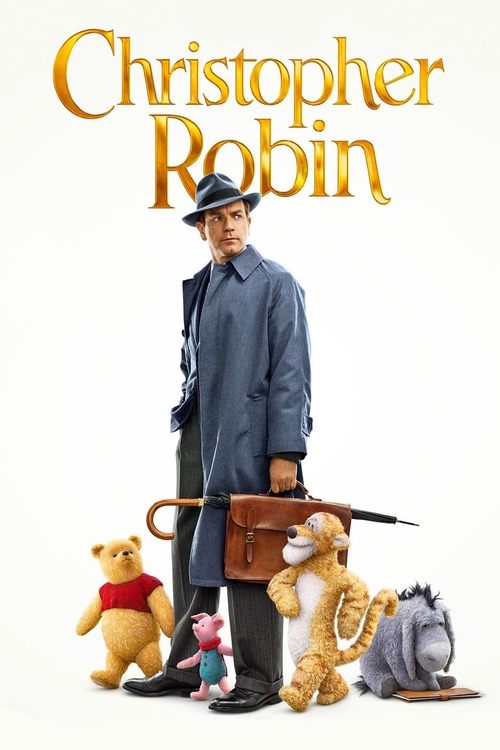
Christopher Robin (2018)
Directed by Marc Forster
No — Christopher Robin is not woke, scoring 19 out of 100 on our wokeness meter.
Christopher Robin opens on a boy saying goodbye to his toys and closes on a man apologizing to them, and in between sits a British luggage company with a staffing problem.
Consciousness Markers
The moral is stated plainly and repeatedly: work less, value your family, and remember that doing nothing is the very best something. It is gently sermonizing rather than subtle, but never strident.
Evelyn is deliberately written as a strong, self-possessed architect who refuses to play the victim, and Madeline drives the third act through her own initiative. Both are modest, character-based choices rather than an explicit agenda.
A soft anti-corporate thread: the golf-playing, do-nothing boss is the villain, and Christopher's improvised solution is cutting prices for ordinary customers and granting employees paid leave, which the elder Winslow approves. It is workplace-kindness populism, not eat-the-rich fire.
The cast is largely white British, with a handful of non-white performers in supporting and voice roles (Ronke Adekoluejo, Ken Nwosu, Sophie Okonedo) whose presence is not commented upon. Diversity is incidental rather than a stated priority.
No LGBTQ+ characters, themes, or subtext of any kind appear in the film.
Race is never engaged as a subject; the film operates in a racially unmarked English fantasia.
No environmental or climate content whatsoever.
No body positivity themes; the characters' bodies are stuffed toys and are not framed as a subject of commentary.
Pooh is affectionately called a bear of very little brain, but the film makes no neurodivergence framing or commentary around him or anyone else.
The film is a wholly fictional continuation of Milne's characters rather than a revisionist recounting of real events.
Why it received this score
Christopher Robin opens on a boy saying goodbye to his toys and closes on a man apologizing to them, and in between sits a British luggage company with a staffing problem. The adult Christopher, played by Ewan McGregor with the expression of a man who has not slept since the war, is Director of Efficiency at Winslow Luggages, which means he is the person who decides which of his colleagues get to keep eating. His boss plays golf. His daughter is nine and wants a father. A bear arrives on a train platform and says almost nothing of consequence, which is precisely the point. The film's thesis is announced early and repeated with the patience of a country vicar: work less, hold your child, and treat doing nothing as an accomplishment.
The cultural weather here is temperate. Evelyn, the wife, is an architect who stands her ground without making a speech about it; Madeline, the daughter, carries the third act on her own small shoulders. The office is integrated in the quiet manner of a film that has stopped thinking about it. The villains are corporate and the solution is a price cut for ordinary customers plus paid leave for the staff, a form of workplace kindness that the elder Winslow endorses with a warm nod. This is populism of the softest sort, aimed at quarterly reports and not at the ownership class. There is no reckoning with empire, no sermon about the environment, no announcement of anyone's pronouns.
The lecture, delivered gently and often, concerns time. Pooh's aphorisms arrive as fortune cookies from a stuffed oracle, and by the fourth one the audience understands that the message will not be complicated by nuance. The result is a curious artifact: a children's film for tired parents, assembled with craftsmanship, scored with care, and content to be exactly as soft as its characters. It is a relic of an older sentimental tradition wearing a few contemporary buttons. Nobody remarks on the diversity of the office, nobody's identity functions as a plot point, and the bear of very little brain is never diagnosed. The film asks only that we go outside. It earns some credit for that, and not much else.
Analysis generated by our Consciousness Algorithm
Part of


Synopsis
Christopher Robin, the boy who had countless adventures in the Hundred Acre Wood, has grown up and lost his way. Now it’s up to his spirited and loveable stuffed animals, Winnie The Pooh, Tigger, Piglet, and the rest of the gang, to rekindle their friendship and remind him of endless days of childlike wonder and make-believe, when doing nothing was the very best something.
Questions about Christopher Robin
Is Christopher Robin woke?
No — Christopher Robin is not woke, scoring 19 out of 100 on our wokeness meter. That earns it a verdict of Ultra Based.
Does Christopher Robin have any woke elements?
1 of the 10 markers register at 30 or above, led by Lecture Energy (30). On Lecture Energy: The moral is stated plainly and repeatedly: work less, value your family, and remember that doing nothing is the very best something.
How does Christopher Robin compare to other 2018 movies?
It ranks #112 of the 325 films from 2018 we've scored; their average is 20. The wokest is Return (92).
How is the Woke Score calculated?
An AI-assisted process researches the film and its reception, scores it 0–100 on ten markers, then combines those into one 0–100 Woke Score. It measures a specific set of 2020s cultural themes, not film quality.