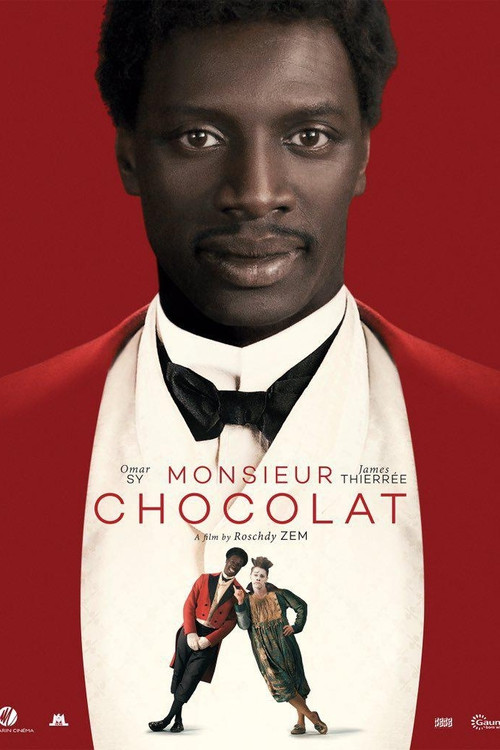
Chocolat (2016)
Directed by Roschdy Zem
Yes — Chocolat is woke, scoring 60 out of 100 on our wokeness meter.
Chocolat arrives with the weight of a forgotten life and the posture of a correction.
Consciousness Markers
The plot is built around racial caricature, police brutality, colonial hierarchy, and the line 'a negro always remains a negro'; racial consciousness is the film’s core.
Centers a black lead and a largely French ensemble in a story about the first famous black clown in France; representation is historically grounded rather than performative.
Recovers a forgotten black performer and foregrounds Belle Époque racial hypocrisy, though it is a loose biopic rather than a wholesale historical rewrite.
The film states its anti-racist thesis through blunt lines and symbolic humiliations, but mostly dramatizes rather than lectures.
Critiques the circus and show-business machine profiting from a black performer’s racial caricature, but offers no broader anti-capitalist program.
No LGBTQ+ themes or characters are present.
Women appear in supporting roles, but no feminist agenda or gendered critique is developed.
No climate or environmental theme is present.
No body-positivity theme is present.
No neurodivergence theme is present.
Why it received this score
Chocolat arrives with the weight of a forgotten life and the posture of a correction. Roschdy Zem's film follows Rafael Padilla, a former Cuban slave's son who becomes, in 1886, the first black stage performer in France, first as the cannibal Kananga in a provincial circus, then as half of a celebrated clown duo with the white performer Foottit. Omar Sy carries the role with a physical generosity that keeps the picture from collapsing into its thesis. The production is handsome, the Belle Epoque trappings are assembled with care, and the whole enterprise wears the sober air of a monument being unveiled.
The racial consciousness here is not decorative. It is the plot. The act itself is a caricature staged for laughter, a white authoritarian and a black scapegoat, and the film never lets us enjoy the joke without noticing who pays for it. The poster that renders Chocolat as a stereotype, the police who arrest and torture him, the commander's parting line that a negro always remains a negro, these are the film's true subject. The critique of an entertainment machine that profits from his humiliation is present but modest, a sour note instead of a program. There is ambition in the recovery of a lost black artist from the colonial archive, and it is performed with blunt symbolic force. The film dramatizes more than it preaches, which is its saving grace.
What the film declines to do is equally instructive. There is no feminist argument, no queer presence, no environmental sermon, no meditation on the body or the mind. Women drift through as wives and bystanders. The camera has no interest in their interiority. A serious film, then. Not a loud one. It asks us to watch a man be turned into a joke and then discarded, and it mostly trusts the audience to draw the conclusion without a lecture. That restraint is rarer than it should be, and it leaves the picture sitting quietly at the low end of the register, a historical drama that knows its subject and keeps its voice down.
Analysis generated by our Consciousness Algorithm


Synopsis
Chocolat the clown, the first black stage performer in France, goes from anonymity to fame after forming an unprecedented duo with fellow performer Footit in the very popular in Belle Epoque Paris. But easy money, gambling, and discrimination take their toll on their friendship and Chocolat's career.
Questions about Chocolat
Is Chocolat woke?
Yes — Chocolat is woke, scoring 60 out of 100 on our wokeness meter. That earns it a verdict of Woke.
What makes Chocolat woke?
4 of the 10 markers register at 30 or above, led by Racial Consciousness (90), Representation Casting (70) and Revisionist History (45). On Racial Consciousness: The plot is built around racial caricature, police brutality, colonial hierarchy, and the line 'a negro always remains a negro'; racial consciousness is the film’s core.
How does Chocolat compare to other 2016 movies?
It ranks #9 of the 285 films from 2016 we've scored; their average is 16. The wokest is 13th (92).
How is the Woke Score calculated?
An AI-assisted process researches the film and its reception, scores it 0–100 on ten markers, then combines those into one 0–100 Woke Score. It measures a specific set of 2020s cultural themes, not film quality.