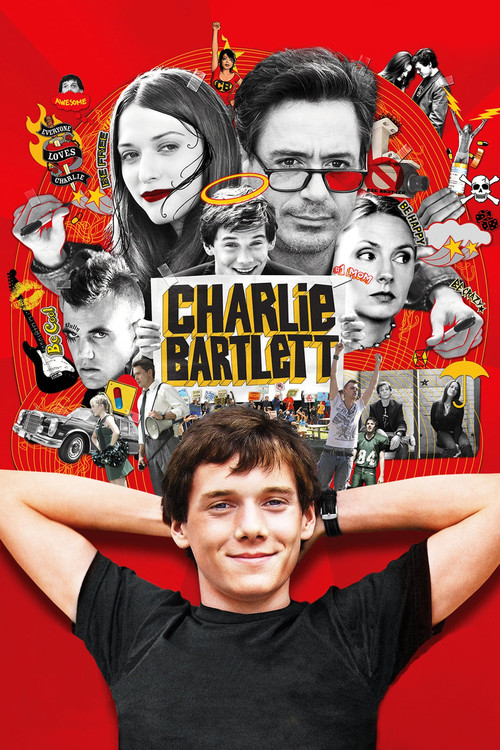
Charlie Bartlett (2008)
Directed by Jon Poll
No — Charlie Bartlett is not woke, scoring 14 out of 100 on our wokeness meter.
Charlie Bartlett arrives in 2008, a moment when a teenager selling prescription medication out of a school bathroom could still be framed as a scrappy entrepreneurial caper.
Consciousness Markers
Charlie is diagnosed with ADHD, and the film touches on depression, suicide attempts, and psychiatric medication, but it treats these as teen angst and drama rather than a neurodivergence identity or advocacy.
The film has some earnest psychobabble and a self-empowerment message, but it is not structured as a social-issue lecture.
The cast is predominantly white, with any minority actors in minor or background roles and no deliberate inclusive casting agenda or commentary on representation.
There are no LGBTQ+ characters, themes, or subtext in the film.
Female characters function mainly as romantic interests or family members, and the film does not advance a feminist critique or gender agenda.
The film does not engage with race, racism, or racial identity as themes.
There are no environmental or climate-related themes.
The film critiques adult hypocrisy and prescription drug culture, but it does not target capitalism, class inequality, or wealth redistribution.
There are no body positivity or body image themes.
The film is a contemporary fictional story with no historical revisionism.
Why it received this score
Charlie Bartlett arrives in 2008, a moment when a teenager selling prescription medication out of a school bathroom could still be framed as a scrappy entrepreneurial caper. The film follows Anton Yelchin's wealthy misfit as he ingratiates himself with the student body at a public high school, dispensing diagnoses and pills under the tutelage of a series of obliging psychiatrists. Robert Downey Jr. plays the alcoholic principal with a lived-in weariness the screenplay does not deserve. The cast is white, the romance is conventional, and the social world of the film is small and self-absorbed. There is no racial reckoning here, no gender politics, no environmental conscience, and no interest in class beyond the fact that Charlie has money and his classmates do not.
The pharmacological material is where the film comes closest to touching anything resembling an identity. Charlie receives an ADHD diagnosis, and the narrative lingers on depression, a suicide attempt, and the casual circulation of antidepressants among minors. These are treated as symptoms of adolescent malaise and as plot mechanics, not as a framework for understanding neurodivergence. The movie is interested in the pills as currency and as evidence of adult negligence. It is not interested in the people who take them.
That leaves the earnest streak, which surfaces whenever the film stops smirking. A student writes a play about adolescent pain, the principal is redeemed by his old teaching job, and the soundtrack deploys Cat Stevens to signal that everyone should simply sing out. The result is a message of self-empowerment delivered with a straight face, sitting awkwardly beside the earlier cynicism. The film wants credit for sincerity without committing to any argument. It is a mild, well-acted curiosity from a transitional moment in American teen cinema, and it asks almost nothing of the culture it depicts.
Analysis generated by our Consciousness Algorithm


Synopsis
Awkward teenager Charlie Bartlett has trouble fitting in at a new high school. Charlie needs some friends fast, and decides that the best way to find them is to appoint himself the resident psychiatrist. He becomes one of the most popular guys in school by doling out advice and, occasionally, medication, to the student body.
Questions about Charlie Bartlett
Is Charlie Bartlett woke?
No — Charlie Bartlett is not woke, scoring 14 out of 100 on our wokeness meter. That earns it a verdict of Ultra Based.
Does Charlie Bartlett have any woke elements?
Very few. None of the 10 markers reaches 30, the level where a marker counts as present; the highest is Neurodivergence at 20.
How does Charlie Bartlett compare to other 2008 movies?
It ranks #68 of the 212 films from 2008 we've scored; their average is 12. The wokest is Milk (68).
How is the Woke Score calculated?
An AI-assisted process researches the film and its reception, scores it 0–100 on ten markers, then combines those into one 0–100 Woke Score. It measures a specific set of 2020s cultural themes, not film quality.