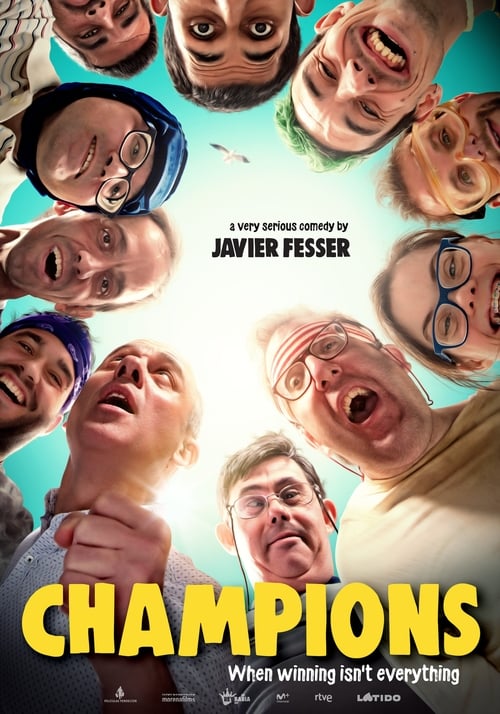
Champions (2018)
Directed by Javier Fesser
Partly — Champions is somewhat woke, scoring 40 out of 100 on our wokeness meter.
Champions arrives from Spain with a premise that could have gone wrong in a dozen ways and mostly does not.
Consciousness Markers
The film casts numerous actors with intellectual disabilities in leading and supporting roles, most notably Jesús Vidal, who won the Goya for Best New Actor. This is genuine, central representation rather than tokenism.
The entire premise revolves around a team of players with intellectual disabilities, foregrounding their dignity, individuality, and capability in a way that maps onto neurodiversity themes.
The film carries an inclusion message but delivers it through warm comedy and character beats rather than explicit sermonizing, keeping the lecturing moderate.
The female lead Sonia exists largely as a wife who wants a child and later helps the team; there is no feminist critique or gendered power analysis at work.
The film's acceptance theme centers on intellectual disability rather than body size or appearance, so it only tangentially touches body-positivity territory.
No LGBTQ+ characters or themes appear anywhere in the narrative.
The film concerns disability, not race; no racial consciousness or commentary is present.
No environmental or climate themes whatsoever.
No economic critique or anti-capitalist messaging; the story is a personal redemption arc.
No historical revisionism; the film is a contemporary sports comedy-drama.
Why it received this score
Champions arrives from Spain with a premise that could have gone wrong in a dozen ways and mostly does not. A disgraced basketball coach, Marco, is sentenced to ninety days of community service coaching Los Amigos, a team of players with intellectual disabilities. The film casts actors who actually have intellectual disabilities in nearly every role on that team, a decision that shapes the whole enterprise. Jesús Vidal took home a Goya for his work here. The result is representation that sits at the center of the frame, not in a corner, doing genuine narrative labor.
The neurodiversity material is the film's spine. Each player gets a personality, a temperament, a small stubborn humanity, and the camera treats them as people rather than symbols. The inclusion message does surface, but it arrives through jokes and locker-room warmth instead of a podium. There is some sermonizing, though a restrained amount, the kind that ends in a hug. Elsewhere the progressive ledger is thinner. Sonia, the wife, wants a baby and exists mainly to soften Marco, which is a feminist non-event. The acceptance theme grazes body image without ever committing to it.
The film's omissions are equally telling. It carries no racial argument, no environmental conscience, no economic critique, and no queer presence whatsoever. This is a redemption story with a whistle and a final buzzer. It wants us to feel better about a flawed man and a brave team, and it succeeds on those modest terms. A warm, well-made crowd-pleaser that keeps its lessons mostly in its pocket, which is its own small mercy in an era of louder instruction manuals wearing the costume of entertainment.
A note for the ledger: the picture was inspired by a real Valencian team, so it qualifies as a true story, and it remains the original work rather than any of the later remakes or the sequel that followed it. It won Spain's top honors, not the American ones, and its box-office triumph was domestic to its home country, so the relevant tags are limited and precise. The classification stands: a gentle crowd-pleaser with a genuine human core, progressive in its sympathies, modest in its messaging, and refreshingly uninterested in turning a basketball court into a seminar room.
THEMATIC TAGS: true_story, book_adaptation_absent, sequel_absent, remake_absent, oscar_winner_absent, superhero_absent, box_office_number_one_absent.
{"thematic_tags": ["true_story"]}
Analysis generated by our Consciousness Algorithm
Part of


Synopsis
A disgraced basketball coach is given the chance to coach Los Amigos, a team of players who are intellectually disabled, and soon realizes they just might have what it takes to make it to the national championships.
Questions about Champions
Is Champions woke?
Partly — Champions is somewhat woke, scoring 40 out of 100 on our wokeness meter. That earns it a verdict of Woke-Adjacent.
What makes Champions woke?
3 of the 10 markers register at 30 or above, led by Representation Casting (78), Neurodivergence (75) and Lecture Energy (35). On Representation Casting: The film casts numerous actors with intellectual disabilities in leading and supporting roles, most notably Jesús Vidal, who won the Goya for Best New Actor.
How does Champions compare to other 2018 movies?
It ranks #51 of the 325 films from 2018 we've scored; their average is 20. The wokest is Return (92).
How is the Woke Score calculated?
An AI-assisted process researches the film and its reception, scores it 0–100 on ten markers, then combines those into one 0–100 Woke Score. It measures a specific set of 2020s cultural themes, not film quality.