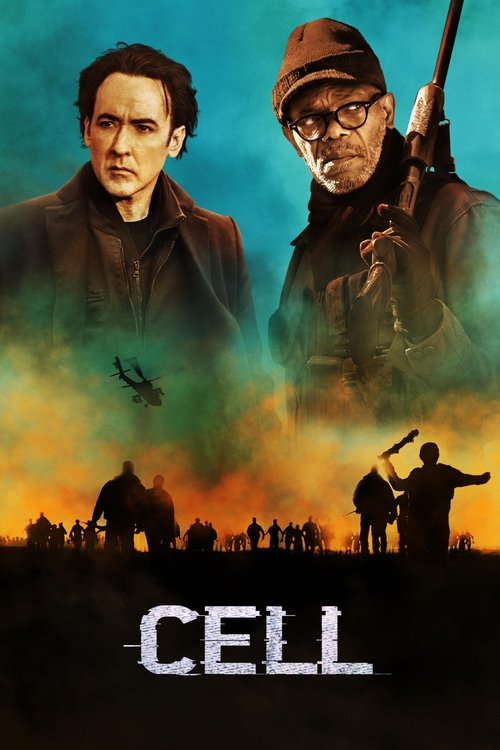
Cell (2016)
Directed by Tod Williams
No — Cell is not woke, scoring 9 out of 100 on our wokeness meter.
Cell arrives in 2016 as the second Stephen King adaptation to pair John Cusack with Samuel L. Jackson, and it carries the weary air of a project that changed hands more often than a payphone receiver.
Consciousness Markers
Samuel L. Jackson anchors the cast as Tom McCourt and the ensemble includes a few non-white performers, but this is conventional star-driven casting with no commentary on identity.
Alice Maxwell is a capable teenage survivor who kills her infected mother in self-defense, but the film offers no feminist framing or commentary.
Critics noted the film has 'no greater message'; it is a grim survival thriller that preaches nothing.
No LGBTQ+ characters, relationships, or themes appear anywhere in the film.
Race is never addressed or thematized; the apocalypse is colorblind in the most literal sense.
The catastrophe is a cell-phone signal, not an environmental one; no climate themes are present.
Despite the technology-turns-evil premise, the film makes no critique of capitalism, corporations, or consumerism.
No body-positivity themes; the infected are depicted as grotesque threats.
No neurodivergent characters or themes are present.
The film is a contemporary fictional apocalypse with no historical revisionism.
Why it received this score
Cell arrives in 2016 as the second Stephen King adaptation to pair John Cusack with Samuel L. Jackson, and it carries the weary air of a project that changed hands more often than a payphone receiver. Eli Roth walked away. The Weinsteins drifted. The version released to video on demand is a grim survival thriller: a signal broadcast through the global cellular network turns most of humanity into rabid killers, and a small band of survivors walks north through New England looking for family. The premise has aged into a period piece. Few viewers under thirty will feel any dread at the sight of a payphone.
The cast is led by Cusack and Jackson, with Isabelle Fuhrman as a teenage neighbor who kills her infected mother in self-defense and later dies from a head wound. She is capable, and the film never frames that capability as an argument about anything. Jackson's train conductor exists for star wattage and a dry line or two, which is the ordinary business of casting a movie star. Race goes unmentioned throughout. The apocalypse is colorblind in the most literal sense: it simply has no interest in the subject. The infected are grotesque, the survivors are grim, and the technology that ends the world is never tied to a corporation, a market, or a consumer habit worth indicting. The film has no message to deliver, and it delivers that message with commitment.
Critics were unkind, and reasonably so. The pacing sags, the hive-mind mythology arrives half-explained, and the ending, in which the hero's escape turns out to be an infection dream, lands with a shrug. For the purposes of classification, this is a clean specimen: a bleak, competent, thoroughly apolitical genre exercise with no designs on the viewer's conscience. It wants only to be a zombie film about phones. In that modest ambition it is at least honest, and honest things grow rarer by the season.
Analysis generated by our Consciousness Algorithm


Synopsis
When a strange signal pulsates through all cell phone networks worldwide, it starts a murderous epidemic of epic proportions when users become bloodthirsty creatures, and a group of people in New England are among the survivors to deal with the ensuing chaos after.
Questions about Cell
Is Cell woke?
No — Cell is not woke, scoring 9 out of 100 on our wokeness meter. That earns it a verdict of Ultra Based.
Does Cell have any woke elements?
Very few. None of the 10 markers reaches 30, the level where a marker counts as present; the highest is Representation Casting at 18.
How does Cell compare to other 2016 movies?
It ranks #158 of the 285 films from 2016 we've scored; their average is 16. The wokest is 13th (92).
How is the Woke Score calculated?
An AI-assisted process researches the film and its reception, scores it 0–100 on ten markers, then combines those into one 0–100 Woke Score. It measures a specific set of 2020s cultural themes, not film quality.