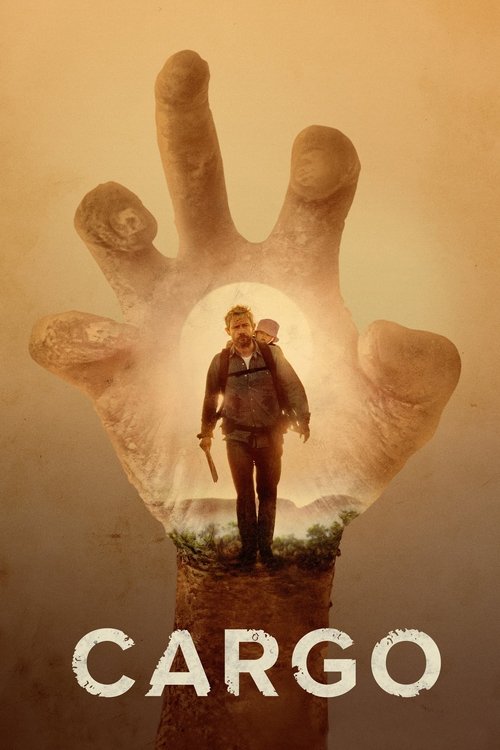
Cargo (2017)
Directed by Yolanda Ramke
No — Cargo is not especially woke, scoring 23 out of 100 on our wokeness meter.
Cargo arrives as a post-apocalyptic survival drama from Australia, which is to say it arrives with a river, a houseboat, and a father who has forty-eight hours before the virus takes him.
Consciousness Markers
The film centers Aboriginal Australian characters (Thoomi, Willie Bell, Josie, and David Gulpilil's community) as the moral and narrative heart, with substantial Indigenous casting rather than background tokens.
Aboriginal community, culture, and a return to 'the old ways' are treated as the surviving refuge, giving the film a meaningful Indigenous dimension, though it is not framed as racial-justice advocacy.
Co-directed by Yolanda Ramke and featuring capable female characters (Thoomi, Lorraine, Etta), but the film advances no explicit feminist thesis.
A quiet, character-driven survival drama that shows rather than preaches; it carries no overt ideological sermonizing.
No LGBTQ+ characters, relationships, or themes appear anywhere in the story.
The pandemic is a viral outbreak with no environmental or climate-change framing.
Vic's fortified shelter is a survivalist villain's lair, not a critique of capitalism or wealth.
No body-positivity themes or messaging are present.
No neurodivergence themes or characters are depicted.
The film is a fictional post-apocalyptic story with no historical revisionism.
Why it received this score
Cargo arrives as a post-apocalyptic survival drama from Australia, which is to say it arrives with a river, a houseboat, and a father who has forty-eight hours before the virus takes him. Martin Freeman plays Andy Rose with a weariness that suggests he has read the script and knows how this ends. The premise is familiar: a plague that turns its hosts rabid, a scattered population, a fortified shelter run by a man who is plainly worse than the disease. The film does not linger on the mechanics of collapse. It is interested in what a dying man will do for his infant daughter, and it answers that question with patience.
The film's most substantive cultural dimension is its Aboriginal cast, and here the picture is doing something real. Thoomi, played by Simone Landers, becomes the story's moral center, and David Gulpilil's presence lends the final act a gravity the genre rarely earns. The community's return to the old ways is presented as the surviving refuge, which gives the film an Indigenous texture that is not decorative. This is casting with narrative weight. It is not, however, an argument. The film observes. It does not advocate.
Elsewhere the ledger is thin, and thinness is its own kind of virtue. There is no environmental framing to the outbreak, no critique of the wealthy shelter-keeper beyond the obvious fact that he keeps people in cages, no body politics, no neurological subtext, no revisionist history. Women here are capable, and the direction is shared with Yolanda Ramke, but the film mounts no argument on their behalf. The result is a quiet, character-driven piece that trusts its audience to draw conclusions without a lecture. It is a modest achievement, delivered without a raised voice. In a genre that usually shouts, that restraint is nearly radical.
Analysis generated by our Consciousness Algorithm


Synopsis
After being infected in the wake of a violent pandemic and with only 48 hours to live, a father struggles to find a new home for his baby daughter.
Questions about Cargo
Is Cargo woke?
No — Cargo is not especially woke, scoring 23 out of 100 on our wokeness meter. That earns it a verdict of Based.
Does Cargo have any woke elements?
2 of the 10 markers register at 30 or above, led by Representation Casting (60) and Racial Consciousness (40). On Representation Casting: The film centers Aboriginal Australian characters (Thoomi, Willie Bell, Josie, and David Gulpilil's community) as the moral and narrative heart, with substantial Indigenous casting rather than background tokens.
How does Cargo compare to other 2017 movies?
It ranks #79 of the 309 films from 2017 we've scored; their average is 19. The wokest is I Am Not Your Negro (92).
How is the Woke Score calculated?
An AI-assisted process researches the film and its reception, scores it 0–100 on ten markers, then combines those into one 0–100 Woke Score. It measures a specific set of 2020s cultural themes, not film quality.