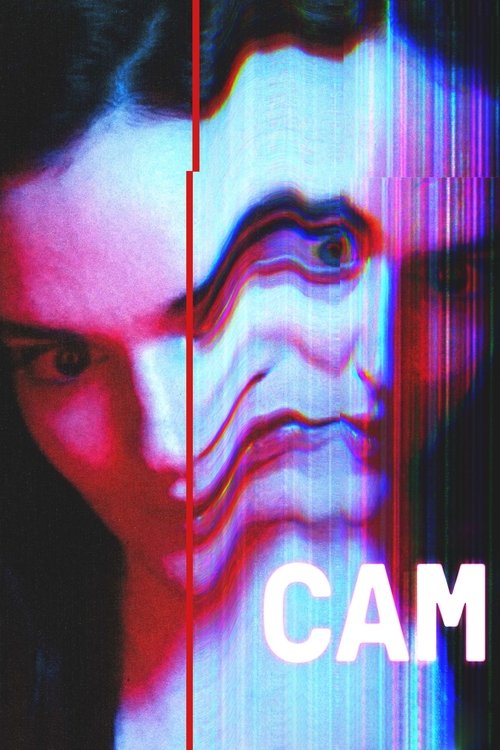
Cam (2018)
Directed by Daniel Goldhaber
No — Cam is not especially woke, scoring 28 out of 100 on our wokeness meter.
Cam arrives in 2018 as a psychological horror film about a camgirl whose online identity is hijacked by a doppelgänger, and it conducts itself with a restraint its subject matter rarely receives.
Consciousness Markers
Written by a former camgirl and co-credited as a rebuke to auteurism, the film foregrounds female sexual autonomy, sex-worker dignity, and the dismissal women face from police and platforms.
The film centers on a sex worker and features a notably diverse cast, including several women of color as fellow camgirls, giving screen time to a profession typically marginalized or moralized in cinema.
The film gestures at the exploitative platform economy and the commodification of performers via ranking systems, but this is atmospheric rather than an explicit economic critique.
The film addresses sex-worker stigma and online identity through suspense and horror rather than direct moralizing, keeping its messaging largely implicit.
The cast is diverse, but race is never a subject of commentary or thematic weight in the story.
No LGBTQ+ themes or characters are present; the narrative concerns a heterosexual-presenting protagonist and her male viewers.
No environmental or climate themes appear in the film.
No body-positivity themes or messaging are present.
No neurodivergence themes or characters are present.
The film is a contemporary fictional horror story with no historical revisionism.
Why it received this score
Cam arrives in 2018 as a psychological horror film about a camgirl whose online identity is hijacked by a doppelgänger, and it conducts itself with a restraint its subject matter rarely receives. The screenplay comes from Isa Mazzei, a former cam model, and the film carries a joint credit for her and director Daniel Goldhaber, a quiet rebuke to the cult of the lone auteur. The plot concerns Alice, who performs as Lola, watches her ranking climb, and then watches a replica of herself seize the account. The horror is procedural and calm. It is also, in its way, a workplace drama.
The film's progressive instincts are genuine but muted. Alice's profession is treated as labor, not shame, and the camera never moralizes about the women who populate the site. Her fellow performers are a diverse group, and they are granted interiority and solidarity. When Alice goes to the police, they dismiss her and leer at her, a scene lifted from the real experiences of sex workers. The platform itself is a machine of rankings and commodification, though the film lets this sit in the background instead of speechifying. Race appears in the casting and nowhere else. There is no climate anxiety here, no body-positivity sermon, no LGBTQ subplot. The story stays fixed on identity and theft.
What keeps Cam from becoming a lecture is its commitment to suspense. The messaging about sex-worker stigma and online personae is embedded in the mechanics of a chase, and the film trusts us to draw conclusions. It is cheeky, tense, and largely free of the sermonizing this material might invite. A modest achievement, and a disciplined one.
Analysis generated by our Consciousness Algorithm
Part of
Synopsis
A young camgirl discovers that she’s inexplicably been replaced on her site with an exact replica of herself.
Questions about Cam
Is Cam woke?
No — Cam is not especially woke, scoring 28 out of 100 on our wokeness meter. That earns it a verdict of Based.
Does Cam have any woke elements?
2 of the 10 markers register at 30 or above, led by Feminist Agenda (60) and Representation Casting (55). On Feminist Agenda: Written by a former camgirl and co-credited as a rebuke to auteurism, the film foregrounds female sexual autonomy, sex-worker dignity, and the dismissal women face from police and platforms.
How does Cam compare to other 2018 movies?
It ranks #71 of the 325 films from 2018 we've scored; their average is 20. The wokest is Return (92).
How is the Woke Score calculated?
An AI-assisted process researches the film and its reception, scores it 0–100 on ten markers, then combines those into one 0–100 Woke Score. It measures a specific set of 2020s cultural themes, not film quality.