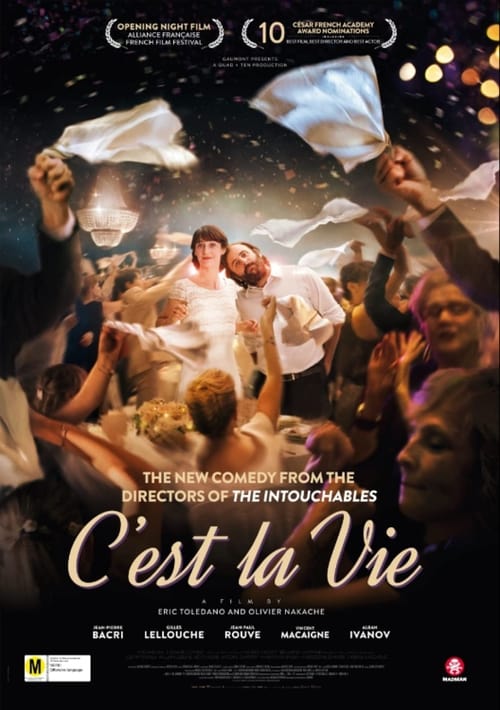
C'est la vie! (2017)
Directed by Éric Toledano
No — C'est la vie! is not woke, scoring 6 out of 100 on our wokeness meter.
Éric Toledano and Olivier Nakache have built a career on warm, frantic ensemble comedies about people doing difficult jobs badly, and this 2017 entry follows the template with a wedding planner named Max shepherding a chateau nuptial through electrical failures, a substitute DJ, and a groom who treats the evening as a personal referendum.
Consciousness Markers
The ensemble includes Eye Haïdara as Adèle, a prominent Black French actress in a substantial supporting role, but her presence is naturalistic and unremarked upon, with no commentary on representation.
The film depicts service workers laboring for a wealthy wedding party, which carries faint class friction, but it is played for farce rather than as an anti-capitalist indictment.
Female characters exist (Josiane, Adèle, the bride) but the film offers no feminist critique or gendered power analysis; the women function within a conventional comedic framework.
A broad ensemble comedy that aims to entertain rather than instruct; there is no preachy messaging or moralizing.
No LGBTQ+ characters, themes, or subtext appear anywhere in the film.
The film is set in a French context with no engagement with race as a theme or social issue.
No environmental or climate themes are present.
No body positivity themes or messaging.
No neurodivergence themes or characters.
No historical revisionism; the film is a contemporary comedy.
Why it received this score
Éric Toledano and Olivier Nakache have built a career on warm, frantic ensemble comedies about people doing difficult jobs badly, and this 2017 entry follows the template with a wedding planner named Max shepherding a chateau nuptial through electrical failures, a substitute DJ, and a groom who treats the evening as a personal referendum. The camera darts between waiters, relatives, and a singer convinced of his own James Brown lineage. It is a farce about logistics, and logistics, blessedly, have no ideology.
Our cultural instruments detect little here. Eye Haïdara appears as Adèle, a substantial supporting role filled naturally, with no accompanying commentary on what her presence signifies. That is casting, not a statement, and the distinction matters. The film does place a crew of laborers at the disposal of a wealthy party, which carries a faint whiff of class friction, though the friction is played for pratfalls instead of indictment. Female characters exist in numbers, including a bride and a coolly decisive Josiane, yet the film offers no gendered power analysis, no reckoning, no sermon. The women simply behave, badly and well, as the plot requires.
What is absent is more striking than what remains. No climate anxiety intrudes on the fireworks. No character announces a pronoun or a diagnosis. History is not revised, bodies are not celebrated, and the rich are not eaten, merely served canapés. The result is a comedy that trusts its audience to laugh without instruction, a relic of an era when a film could gather thirteen people in a chateau and ask nothing of them but timing. We classify it, we file it, and we move on to the next one.
Analysis generated by our Consciousness Algorithm
Synopsis
Max is a battle-weary veteran of the wedding-planning racket. His latest — and last — gig is a hell of a fête, involving stuffy period costumes for the caterers, a vain, hyper- sensitive singer who thinks he's a Gallic James Brown, and a morose, micromanaging groom determined to make Max's night as miserable as possible. But what makes the affair too bitter to endure is that Max's colleague and ostensible girlfriend, Joisette, seems to have written him off, coolly going about her professional duties while openly flirting with a much younger server. It's going to be a very long night… especially once the groom's aerial serenade gets underway.
Questions about C'est la vie!
Is C'est la vie! woke?
No — C'est la vie! is not woke, scoring 6 out of 100 on our wokeness meter. That earns it a verdict of Ultra Based.
Does C'est la vie! have any woke elements?
Very few. None of the 10 markers reaches 30, the level where a marker counts as present; the highest is Representation Casting at 20.
How does C'est la vie! compare to other 2017 movies?
It ranks #224 of the 309 films from 2017 we've scored; their average is 19. The wokest is I Am Not Your Negro (92).
How is the Woke Score calculated?
An AI-assisted process researches the film and its reception, scores it 0–100 on ten markers, then combines those into one 0–100 Woke Score. It measures a specific set of 2020s cultural themes, not film quality.