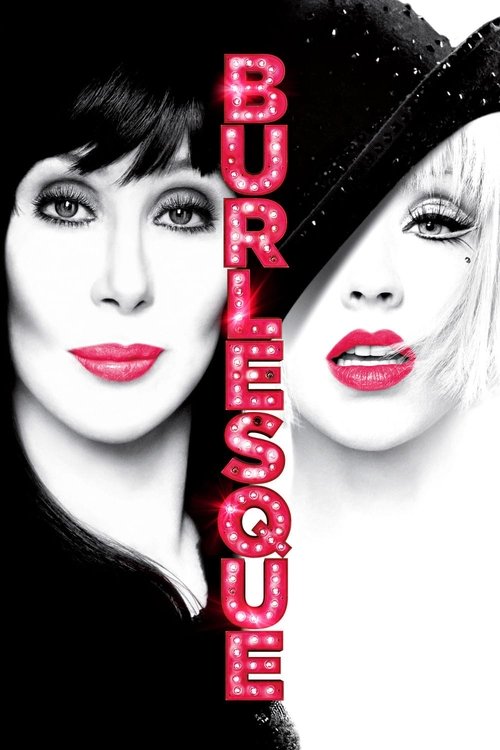
Burlesque (2010)
Directed by Steve Antin
No — Burlesque is not woke, scoring 12 out of 100 on our wokeness meter.
Burlesque arrives as a backstage musical with a female-led ensemble and a modest empowerment arc, and it is content to remain exactly that.
Consciousness Markers
The story centers on a woman pursuing her dream and a female club owner fighting to save her business, offering mild empowerment beats, but it remains a conventional backstage romance with catfights and male romantic interests.
The film features a female-led ensemble and some supporting performers of color, but there is no explicit diversity casting agenda or commentary on representation.
Stanley Tucci's character Sean is revealed to be gay, and the burlesque milieu has a camp sensibility, but LGBTQ+ identity is not a central theme or explored with any depth.
A wealthy developer wants to demolish the club for condos, providing a mild anti-gentrification beat, but the film resolves the conflict through property deals rather than systemic critique.
No racial themes, commentary, or consciousness are present; characters of color exist without the film addressing race.
There is no environmental or climate-related content whatsoever.
The film showcases conventionally attractive performers in sexy costumes and does not promote body positivity or diverse body types as a theme.
No characters are portrayed with neurodivergence or related themes.
The film is a fictional backstage musical with no historical revisionism or reimagining of past events.
Burlesque is a campy, song-and-dance entertainment with no preachy or lecture-like messaging.
Why it received this score
Burlesque arrives as a backstage musical with a female-led ensemble and a modest empowerment arc, and it is content to remain exactly that. Ali pursues her dream, Tess fights to keep her club, and the film offers a few mild beats of self-determination before settling into a conventional romance with catfights and a jealous rival. The representation is present but unremarked: women carry the film, and performers of color appear in supporting roles without the screenplay making a case for them. This is social consciousness as ambient lighting, not as a thesis.
The film's LGBTQ content is similarly incidental. Stanley Tucci's Sean is gay, a fact disclosed late and then left alone, while the burlesque milieu supplies a camp sensibility that the movie wears like a feather boa. A wealthy developer wants to demolish the lounge for condos, which gives the plot a faint anti-gentrification pulse, though the conflict is resolved through air rights and property deals instead of any systemic critique. There is no racial commentary, no environmental concern, no body positivity, no neurodivergence, and no revisionist history. The film is a fiction about a fictional club, and it has no interest in arguing with the past.
The film offers a preachy-free entertainment, which is its own kind of relief. Burlesque does not lecture. It sings, it struts, it lets Cher deliver a ballad with the gravity of a monument, and it asks nothing of our politics. The progressive touches are decorative, like sequins on a costume: visible, pleasant, and structurally unnecessary. A sommelier would call this a light-bodied vintage with a campy finish. We would call it a film that knows exactly what it is and makes no apologies for it.
Analysis generated by our Consciousness Algorithm


Synopsis
Ali leaves behind a troubled life and follows her dreams to Los Angeles, where she lands a job as a cocktail waitress at the Burlesque Lounge, a once-majestic theater that houses an inspired musical revue. Vowing to perform there, she makes the leap from bar to stage, helping restore the club's former glory.
Questions about Burlesque
Is Burlesque woke?
No — Burlesque is not woke, scoring 12 out of 100 on our wokeness meter. That earns it a verdict of Ultra Based.
Does Burlesque have any woke elements?
Very few. None of the 10 markers reaches 30, the level where a marker counts as present; the highest is Feminist Agenda at 25.
How does Burlesque compare to other 2010 movies?
It ranks #71 of the 238 films from 2010 we've scored; their average is 11. The wokest is My Name Is Khan (84).
How is the Woke Score calculated?
An AI-assisted process researches the film and its reception, scores it 0–100 on ten markers, then combines those into one 0–100 Woke Score. It measures a specific set of 2020s cultural themes, not film quality.