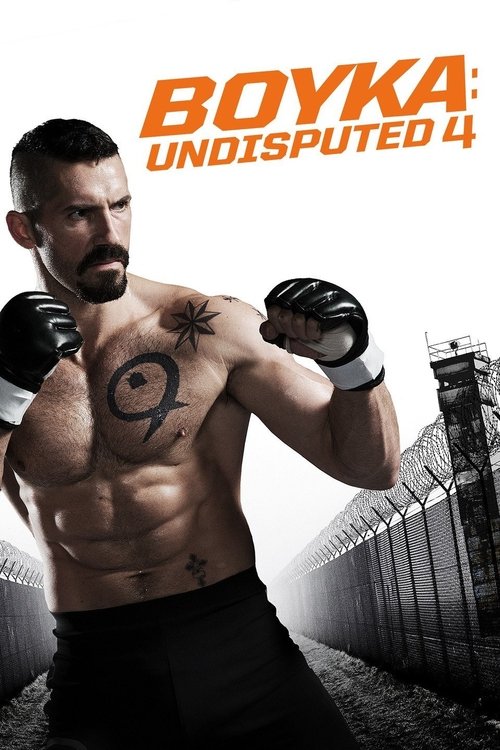
Boyka: Undisputed IV (2016)
Directed by Todor Chapkanov
No — Boyka: Undisputed IV is not woke, scoring 0 out of 100 on our wokeness meter.
Boyka: Undisputed IV arrives as the fourth entry in a franchise about a man who punches other men in unsanctioned venues, and it conducts itself with a single-mindedness that borders on the monastic.
Consciousness Markers
The cast is composed primarily of white and Eastern European actors, with no deliberate or commented-upon diversity casting.
There are no LGBTQ+ characters, themes, or subtext in the film.
The female lead is a widow in peril who motivates the protagonist, but the film does not advance a feminist agenda or critique patriarchy.
Race and racial identity are not addressed or made thematically relevant in the story.
There is no environmental or climate-related content in the film.
The villain is a crime boss exploiting fighters, but the film frames this as individual criminality rather than a systemic anti-capitalist critique.
The film does not engage with body positivity or challenge conventional physical beauty standards.
No neurodivergent characters or themes are present.
The film is a fictional martial arts story and does not revise or reinterpret historical events.
The film is an action-driven redemption story and does not pause to deliver explicit social or political lectures.
Why it received this score
Boyka: Undisputed IV arrives as the fourth entry in a franchise about a man who punches other men in unsanctioned venues, and it conducts itself with a single-mindedness that borders on the monastic. Scott Adkins returns as Yuri Boyka, a freed prisoner who accidentally kills an opponent, learns the man left a widow, and then travels to Russia to fight a crime boss's stable of brawlers in order to purchase her freedom. The plot is assembled from spare parts: guilt, debt, a community center full of at-risk children, a giant named Nightmare. The film has no interest in anything beyond the geometry of its own fight scenes. That is a relief.
We searched the runtime for the usual contemporary markers and found the shelves bare. The cast is Eastern European and white by and large, and nobody remarks upon it. The widow Alma exists to be rescued and then to forgive, which is a function, not a thesis. The villain Zourab exploits fighters for profit, and the film treats this as the behavior of one bad man, not a symptom of anything larger. There is no climate anxiety, no body positivity, no neurodivergent coding, no revisionist history, no sermonizing. When the characters pause, it is to catch their breath.
What remains is craftsmanship of a narrow kind. The fights are legible and brutal, the Bulgarian locations are gray and serviceable, and the redemption arc resolves with a prison visitation and a promise of more punching to come. It won a Best Fight award in Shanghai, which feels correct. A film can be about guilt, servitude, and the moral weight of an accidental killing without ever addressing the social questions of its own decade. This one does exactly that, and it seems untroubled by the omission.
Analysis generated by our Consciousness Algorithm
Part of


Synopsis
In the fourth installment of the fighting franchise, Boyka is shooting for the big leagues when an accidental death in the ring makes him question everything he stands for. When he finds out the wife of the man he accidentally killed is in trouble, Boyka offers to fight in a series of impossible battles to free her from a life of servitude.
Questions about Boyka: Undisputed IV
Is Boyka: Undisputed IV woke?
No — Boyka: Undisputed IV is not woke, scoring 0 out of 100 on our wokeness meter. That earns it a verdict of Ultra Based.
Does Boyka: Undisputed IV have any woke elements?
No. All 10 markers score zero.
How does Boyka: Undisputed IV compare to other 2016 movies?
It ranks #264 of the 285 films from 2016 we've scored; their average is 16. The wokest is 13th (92).
Is Boyka: Undisputed IV the most woke Undisputed movie?
No. It ranks #3 of the 4 Undisputed films we've scored; the wokest is Undisputed III: Redemption (13).