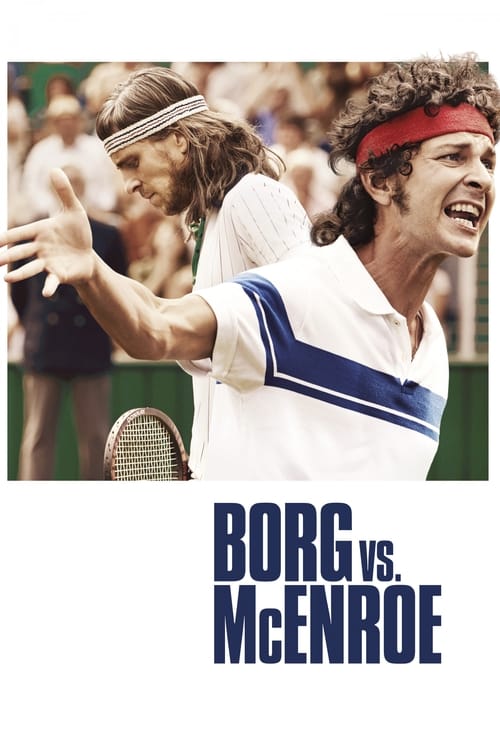
Borg vs McEnroe (2017)
Directed by Janus Metz
No — Borg vs McEnroe is not woke, scoring 6 out of 100 on our wokeness meter.
Borg vs McEnroe arrives from Sweden, Denmark and Finland with a modest proposition: two men hitting a ball across a net at Wimbledon in 1980 constitutes drama.
Consciousness Markers
Mariana Simionescu is given some interiority as a woman chafing under the loss of control over her own life due to Borg's fame, but this is a minor subplot rather than a feminist thesis.
The cast is overwhelmingly white, which is largely dictated by the true story of two white European and American tennis stars; a minor appearance by Arthur Ashe (Jason Forbes) is the only notable non-white presence.
The film is a character-driven sports drama that shows rather than preaches; there is essentially no didactic messaging.
There are no LGBTQ+ characters, themes, or subtext anywhere in the film.
The film engages no racial themes or commentary; Arthur Ashe's brief presence carries no racial framing.
No environmental or climate content of any kind.
The film critiques the personal toll of fame and celebrity pressure, but offers no economic or anti-capitalist argument.
No body-positivity themes; the film is about elite athletic performance and mental pressure.
McEnroe's and Borg's tempers are framed as psychological and emotional struggles, not as neurodivergence.
The film is a straightforward biographical dramatization of the 1980 Wimbledon rivalry, not a revisionist reframing of history.
Why it received this score
Borg vs McEnroe arrives from Sweden, Denmark and Finland with a modest proposition: two men hitting a ball across a net at Wimbledon in 1980 constitutes drama. Janus Metz directs with a steady hand, and the result is a well-reviewed sports picture with no interest in instructing its audience. The cast is overwhelmingly white, a condition imposed by the historical record and not by any editorial timidity. The subjects are a Swedish champion and an American one. Arthur Ashe drifts through briefly, a courtesy to the era, and is never asked to carry a lesson. That restraint is the film's defining habit.
The psychology on offer is the old-fashioned kind. Borg swallows his temper until it curdles. McEnroe performs his for the galleries. Stellan Skarsgård's coach frets in the wings like a man tending a furnace he cannot control. Tuva Novotny's Mariana Simionescu gets a sliver of interiority, a woman quietly losing ownership of her own life to her fiancé's fame, and the film notices her without building a case around her. The pressure of celebrity is examined at length. The economics of celebrity are not examined at all. Nobody mentions the money, the sponsors, or the machinery. The men simply suffer, elegantly, in nice hotels.
There is no sermon here. The film shows tempers and calls them tempers, not diagnoses. It shows a rivalry and calls it a rivalry, not a parable. For a contemporary sports drama, this is close to an act of abstinence. What remains is craft: the tie-break, the rain delays, the rackets tuned to a precise tension. It is a film about two men who could not explain themselves and a director wise enough not to try on their behalf. The vintage is dry. It goes down cleanly.
Analysis generated by our Consciousness Algorithm


Synopsis
The Swedish Björn Borg and the American John McEnroe, the best tennis players in the world, maintain a legendary duel during the 1980 Wimbledon tournament.
Questions about Borg vs McEnroe
Is Borg vs McEnroe woke?
No — Borg vs McEnroe is not woke, scoring 6 out of 100 on our wokeness meter. That earns it a verdict of Ultra Based.
Does Borg vs McEnroe have any woke elements?
Very few. None of the 10 markers reaches 30, the level where a marker counts as present; the highest is Feminist Agenda at 12.
How does Borg vs McEnroe compare to other 2017 movies?
It ranks #224 of the 309 films from 2017 we've scored; their average is 19. The wokest is I Am Not Your Negro (92).
How is the Woke Score calculated?
An AI-assisted process researches the film and its reception, scores it 0–100 on ten markers, then combines those into one 0–100 Woke Score. It measures a specific set of 2020s cultural themes, not film quality.