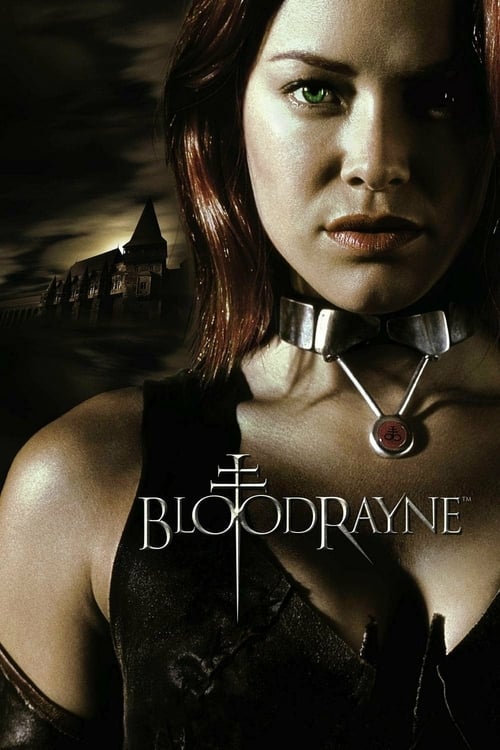
BloodRayne (2006)
Directed by Uwe Boll
No — BloodRayne is not woke, scoring 9 out of 100 on our wokeness meter.
BloodRayne arrives from 2005, a Uwe Boll adaptation of a video game in which a dhampir named Rayne hunts the vampire king who happens to be her father.
Consciousness Markers
The heroine Rayne is a capable fighter, but the film offsets this with gratuitous nudity, sexual violence against women, and a catfight-tinged rivalry; no feminist thesis is advanced.
A female action lead and Michelle Rodriguez as a fellow warrior give the cast some demographic variety, but this is standard video-game-genre casting, not a deliberate representation initiative.
No LGBTQ+ characters, themes, or subtext appear in the film.
No engagement with race or racial politics whatsoever.
No environmental themes.
The villain is a vampire king with thralls, not a capitalist allegory; no economic critique exists.
The only body-diverse figure, a deformed monk, is a monster to be slain; no body-positive messaging.
No neurodivergent characters or themes.
Set in a fantastical 18th-century Romania against a video-game lore backdrop, with no revisionist reframing of real history.
A schlocky vampire action romp with zero didactic social messaging.
Why it received this score
BloodRayne arrives from 2005, a Uwe Boll adaptation of a video game in which a dhampir named Rayne hunts the vampire king who happens to be her father. It is set in a fantasy Romania and it is, by the consensus of everyone who has seen it, a bad film. It is also, for our purposes, a nearly blank specimen. The picture has no social program to advance, no lesson to impart, and no interest in the moral improvement of its audience. It simply wishes to move from one swordfight to the next, and it does so with a graceless plod.
The needle stirs in exactly one place, and only faintly. Kristanna Loken's Rayne is a capable swordswoman, and Michelle Rodriguez supplies a second woman who can fight, which grants the cast a measure of demographic variety. That variety comes free with the genre, not from any deliberate design. Whatever credit accrues is spent within minutes. The camera leers, the backstory hinges on sexual violence, and the women's rivalry carries the temperature of a catfight. No thesis about women is offered, feminist or otherwise. The film is not interested in women. It is interested in women's bodies, which is a separate department entirely.
Everything else sits at zero, and not out of spite. There is no racial politics, no climate anxiety, no critique of wealth (Kagan is a vampire king with thralls, not a hedge fund), no body positivity (the one deformed figure is a monster to be killed with a hammer), no neurodivergence, and no reframing of real history. The setting is borrowed from game lore. Best of all, the film lectures no one. It has no message, only a plot, and the plot lurches. In an age when even the cheapest product arrives with a moral stapled to it, there is something restful about a picture this devoid of instruction. The wigs are fake, the swordfights incoherent, and the conscience absent.
Analysis generated by our Consciousness Algorithm


Synopsis
In 18th-century Romania, after spending much of her life in a traveling circus, human-vampire hybrid Rayne escapes and plots to take down her father, Kagan, the evil vampire king. When she's discovered by three vampire hunters, she manages to convince them to spare her life and join her cause. But slaying a vampire as powerful as Kagan will be no easy task.
Questions about BloodRayne
Is BloodRayne woke?
No — BloodRayne is not woke, scoring 9 out of 100 on our wokeness meter. That earns it a verdict of Ultra Based.
Does BloodRayne have any woke elements?
Very few. None of the 10 markers reaches 30, the level where a marker counts as present; the highest is Feminist Agenda at 20.
How does BloodRayne compare to other 2006 movies?
It ranks #75 of the 211 films from 2006 we've scored; their average is 11. The wokest is An Inconvenient Truth (92).
How is the Woke Score calculated?
An AI-assisted process researches the film and its reception, scores it 0–100 on ten markers, then combines those into one 0–100 Woke Score. It measures a specific set of 2020s cultural themes, not film quality.