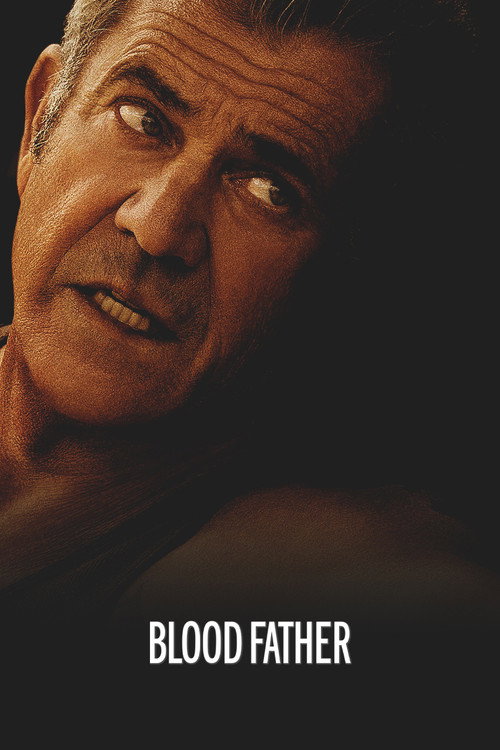
Blood Father (2016)
Directed by Jean-François Richet
No — Blood Father is not woke, scoring 6 out of 100 on our wokeness meter.
Blood Father arrives with an unlikely pedigree: a French production, directed by Jean-François Richet, adapted by Peter Craig from his own 2005 novel, premiered at Cannes, and shot in Albuquerque on what appears to be a modest budget.
Consciousness Markers
The cast includes several Latino actors (Diego Luna, Miguel Sandoval, Richard Cabral, Raoul Trujillo) in cartel and gang roles, but this is conventional casting for a borderland crime thriller rather than a deliberate representational statement.
Lydia is a survivor with an arc toward sobriety, but the film is squarely a father-redemption story and she functions largely as the object of rescue rather than a vehicle for any feminist thesis.
Mexican cartel and gang dynamics are plot machinery, not social commentary; the film makes no effort to interrogate race or structural injustice.
The film gestures mildly at addiction and recovery in its AA scenes, but it never stops the action to deliver a moral lesson.
No LGBTQ+ characters or themes appear anywhere in the film.
No environmental or climate content whatsoever.
No critique of wealth, capital, or class appears; the villains are criminals motivated by money, not the system.
No body-positivity themes or messaging.
No neurodivergent characters or themes are present.
The film is a contemporary fictional crime story with no historical subject to revise.
Why it received this score
Blood Father arrives with an unlikely pedigree: a French production, directed by Jean-François Richet, adapted by Peter Craig from his own 2005 novel, premiered at Cannes, and shot in Albuquerque on what appears to be a modest budget. It stars Mel Gibson as John Link, a paroled ex-convict and recovering alcoholic living in a trailer, whose estranged daughter Lydia surfaces with a dead boyfriend, a stolen pile of cartel money, and a gang of armed men behind her. The remainder is a chase, punctuated by gunfire, a landmine, and a motorcycle. The film knows exactly what it is and does not apologize for it.
The cast places several Latino performers in cartel and gang roles, among them Diego Luna, Miguel Sandoval, Richard Cabral, and Raoul Trujillo. This is the standard furniture of the borderland crime picture, inhabited competently and without commentary. The film has no interest in interrogating the structures that produce its villains. There is no LGBTQ content, no environmental concern, no body positivity, no neurodivergent character, and no critique of capital. The criminals want money because they are criminals. Lydia survives, gets sober, and speaks at a support group one year later, but her function is to be rescued by a father seeking redemption, and the film never pretends otherwise.
The recovery material, confined to a handful of Alcoholics Anonymous exchanges and a closing testimonial, brushes against a moral without delivering one. Nobody stops the action to explain the lesson. For a 2016 release, this is a notably unadorned specimen, and the classification is correspondingly lean. We assign it low marks across the board and move on to the next screening. There is something almost restful about a film this indifferent to the cultural currents of its moment, though restful is not the same as commendable. It is simply a man on a motorcycle, a daughter in peril, and a desert. Our work here is done, and it was brief work indeed. We note the runtime, log the scores, and reach for the next screener with the weary diligence that this calling demands of us, week after week, without complaint and without end. The ledger closes. The trailer door shuts. Somewhere, a support group meets in a church basement, and nobody in it is thinking about representation at all, which is, in its own small way, a kind of honesty. We mark it down and move along. The next film awaits, and it will almost certainly have opinions.
{"thematic_tags": ["book_adaptation"]}
Analysis generated by our Consciousness Algorithm


Synopsis
An ex-con reconnects with his estranged teenage daughter while fighting to keep her alive after she becomes a target of violent drug dealers.
Questions about Blood Father
Is Blood Father woke?
No — Blood Father is not woke, scoring 6 out of 100 on our wokeness meter. That earns it a verdict of Ultra Based.
Does Blood Father have any woke elements?
Very few. None of the 10 markers reaches 30, the level where a marker counts as present; the highest is Representation Casting at 18.
How does Blood Father compare to other 2016 movies?
It ranks #202 of the 285 films from 2016 we've scored; their average is 16. The wokest is 13th (92).
How is the Woke Score calculated?
An AI-assisted process researches the film and its reception, scores it 0–100 on ten markers, then combines those into one 0–100 Woke Score. It measures a specific set of 2020s cultural themes, not film quality.