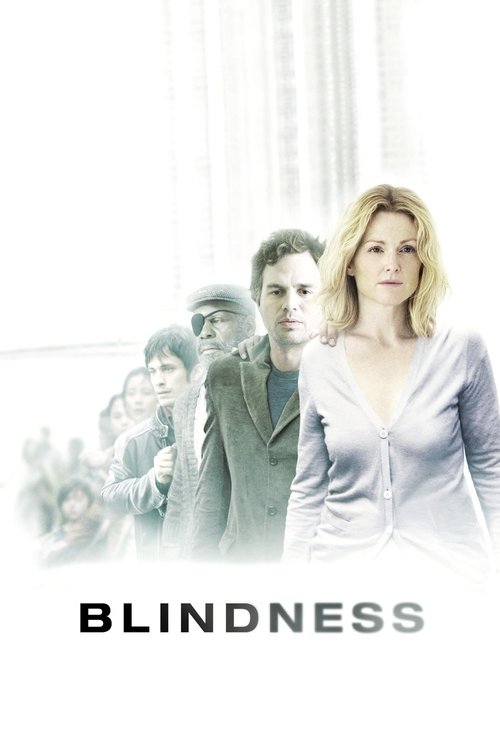
Blindness (2008)
Directed by Fernando Meirelles
No — Blindness is not especially woke, scoring 30 out of 100 on our wokeness meter.
Fernando Meirelles takes Jose Saramago's 1995 novel and strips it down to an allegory of civic collapse.
Consciousness Markers
The film deliberately assembled an international cast to represent a microcosm of humanity, including Black, Asian, Latino, and white actors in a global ensemble. However, the leads remain white and the diversity is not tied to identity politics.
Julianne Moore's doctor's wife is the only sighted person, becomes the moral and practical leader, and kills the tyrannical 'king' after women are sexually exploited. The narrative centers on female agency and retaliation against male sexual violence, though without explicit feminist lecturing.
The film carries a philosophical allegory about civilization's fragility and moral responsibility, but the screenwriter deliberately cut the novel's most heavy-handed line to avoid preachiness.
No LGBTQ+ characters, themes, or subtext are present in the film.
Race is not a thematic concern; characters are defined by their actions and blindness rather than racial identity, and no racial commentary is made.
The epidemic is a mysterious 'white sickness,' not an environmental or climate-related catastrophe.
The film critiques authoritarian control and human desperation in a quarantine, but it does not advance an anti-capitalist or eat-the-rich message.
No body positivity themes or body-image commentary are present.
Blindness is a physical/sensory disability in the film, not a neurodivergence such as autism or ADHD, and no neurodivergent themes are explored.
The film is a fictional allegory set in an unnamed contemporary city, not a historical revision or reimagining.
Why it received this score
Fernando Meirelles takes Jose Saramago's 1995 novel and strips it down to an allegory of civic collapse. A white sickness spreads through an unnamed city. The government herds the afflicted into a derelict asylum and then forgets them. The result is a study of what people do when the structures holding them upright are removed. Meirelles cast internationally, drawing on Brazilian, Canadian, Japanese, and American performers, so the quarantine ward reads as a small model of the species. This was a deliberate choice by the producers, who wanted the film to represent all of humanity. It is an ensemble gesture, not a political argument, and the leads remain Julianne Moore and Mark Ruffalo.
Moore's doctor's wife is the only person who can still see, and the film hands her the whole moral weight of the story. She hides her sight, feeds her ward, leads the survivors out of the burning building, and eventually drives a pair of medical scissors into the neck of the man who declared himself king and traded food for women's bodies. The narrative is built on her authority and on her retaliation against sexual violence. Nobody stands around explaining what this means. The camera simply watches her decide, and the audience is left to keep up.
The restraint extends to the ideas. McKellar cut the novel's closing line about being blind while seeing, believing the symbolism had already landed. He was right. The film has a thesis about responsibility, but it declines to announce it from a pulpit, which keeps the sermonizing to a minimum. The film itself is a grim, well-acted descent with almost none of the cultural markers that define the current moment. Race goes unremarked. The plague is not ecological. There is no economic critique, no body-image discourse, no neurodivergent framing. It is a film about blindness that resists the urge to lecture us about everything else, and that restraint, in this climate, reads almost as a novelty."}Wait, I made an error: I wrote
Analysis generated by our Consciousness Algorithm


Synopsis
When a sudden plague of blindness devastates a city, a small group of the afflicted band together to triumphantly overcome the horrific conditions of their imposed quarantine.
Questions about Blindness
Is Blindness woke?
No — Blindness is not especially woke, scoring 30 out of 100 on our wokeness meter. That earns it a verdict of Based.
Does Blindness have any woke elements?
2 of the 10 markers register at 30 or above, led by Representation Casting (45) and Feminist Agenda (40). On Representation Casting: The film deliberately assembled an international cast to represent a microcosm of humanity, including Black, Asian, Latino, and white actors in a global ensemble.
How does Blindness compare to other 2008 movies?
It ranks #13 of the 212 films from 2008 we've scored; their average is 12. The wokest is Milk (68).
How is the Woke Score calculated?
An AI-assisted process researches the film and its reception, scores it 0–100 on ten markers, then combines those into one 0–100 Woke Score. It measures a specific set of 2020s cultural themes, not film quality.