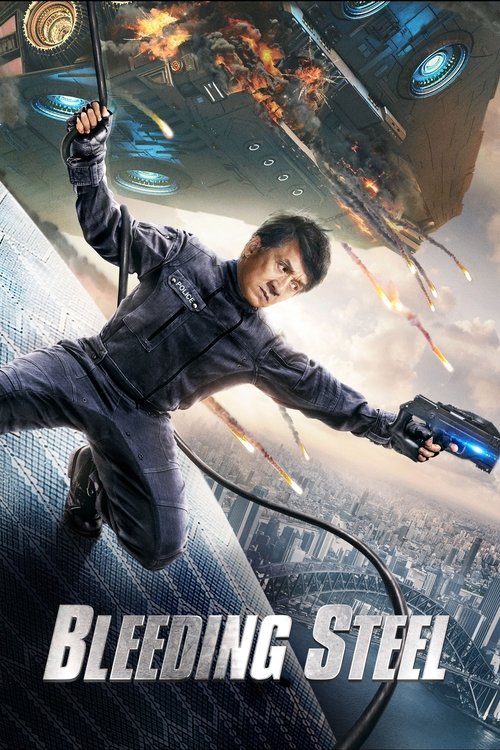
Bleeding Steel (2017)
Directed by Leo Zhang
No — Bleeding Steel is not woke, scoring 6 out of 100 on our wokeness meter.
Bleeding Steel arrives as a Chinese-Australian co-production directed by Leo Zhang, in which Jackie Chan plays Lin Dong, a Hong Kong agent who spends thirteen years guarding a daughter he believes is dead.
Consciousness Markers
A Chinese-Australian co-production with a predominantly Asian lead cast and Australian supporting players, but this reflects the natural casting needs of a Hong Kong/Sydney-set story rather than a deliberate diversity initiative.
Ouyang Nana's Nancy/Xixi and Tess Haubrich's Woman in Black are capable combatants, but they function as standard action archetypes (damsel and henchwoman) with no feminist thesis.
A Korean arms dealer seeks to steal Dr. James' research 'for profit,' a faintly villainous profit motive, but the film offers no systemic critique of capitalism.
The film is a corny action pastiche that preaches nothing; any messaging is incidental to the explosions and cybernetics.
No LGBTQ+ themes. Li Sen's cross-dressing as a prostitute is a spy-movie disguise gag, not queer representation.
No engagement with race, racism, or racial identity as a theme; the international cast is simply a product of the film's globe-trotting plot.
No environmental or climate content whatsoever.
No body-positivity themes; the film's focus on genetic perfection and regeneration runs in the opposite direction.
No neurodivergent characters or themes.
A wholly fictional cyberpunk story with no historical revisionism.
Why it received this score
Bleeding Steel arrives as a Chinese-Australian co-production directed by Leo Zhang, in which Jackie Chan plays Lin Dong, a Hong Kong agent who spends thirteen years guarding a daughter he believes is dead. The daughter, it turns out, was resurrected through a biogenetic blood substitute and a mechanical heart, which is the sort of premise a film can either honor or squander. This one squanders it, though not on ideology. It squanders it on a cyborg in an airship and a great deal of noise.
On the matter of social consciousness, the film is nearly inert. Its Asian lead cast and Australian supporting players reflect the practical demands of a story set between Hong Kong and Sydney, not a casting initiative, and the globe-trotting plot leaves no room for commentary on race or identity. The women, played by Ouyang Nana and Tess Haubrich, can throw a punch, but they occupy the familiar stations of damsel and henchwoman, which is a genre inheritance, not a thesis. A Korean arms dealer wants Dr. James' research for profit, a motive the film treats as villainy without ever suggesting the system that produced him is the problem. There is no environmental content, no body-positivity, no neurodivergence, no queerness, and no history to revise, since the whole affair is invented from scratch.
The film preaches nothing. It is a corny cyberpunk pastiche that would rather show a man rip a heart from a chest than deliver a message, and Variety's assessment that it appeals exclusively to children is difficult to dispute. We are left with a low classification, not out of disapproval, but because there is simply nothing here to classify. The explosions, at least, are sincere.
Analysis generated by our Consciousness Algorithm
Part of


Synopsis
A hardened special forces agent fights to protect a young woman from a sinister criminal gang. At the same time, he feels a special connection to the young woman, like they have met in a different life.
Questions about Bleeding Steel
Is Bleeding Steel woke?
No — Bleeding Steel is not woke, scoring 6 out of 100 on our wokeness meter. That earns it a verdict of Ultra Based.
Does Bleeding Steel have any woke elements?
Very few. None of the 10 markers reaches 30, the level where a marker counts as present; the highest is Representation Casting at 15.
How does Bleeding Steel compare to other 2017 movies?
It ranks #224 of the 309 films from 2017 we've scored; their average is 19. The wokest is I Am Not Your Negro (92).
How is the Woke Score calculated?
An AI-assisted process researches the film and its reception, scores it 0–100 on ten markers, then combines those into one 0–100 Woke Score. It measures a specific set of 2020s cultural themes, not film quality.