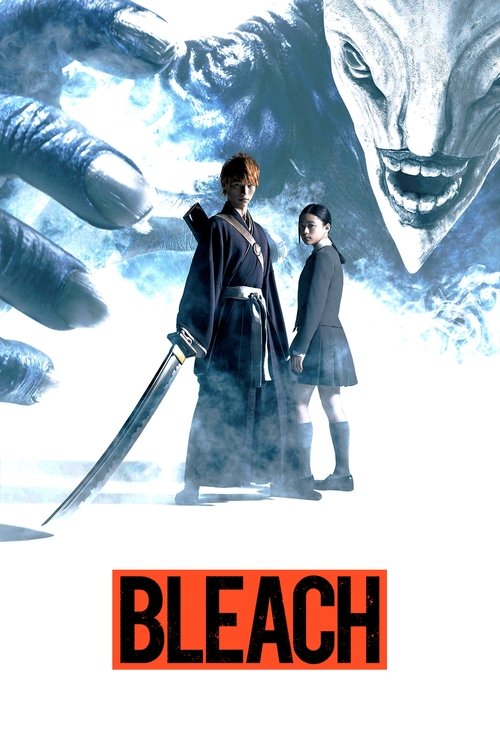
Bleach (2018)
Directed by Shinsuke Sato
No — Bleach is not woke, scoring 0 out of 100 on our wokeness meter.
The 2018 live-action adaptation of Tite Kubo's manga arrives with a katana, a grim reaper, and a great deal of solemnity about the afterlife.
Consciousness Markers
The cast is entirely Japanese, consistent with the source manga's setting; there is no deliberate inclusive or race-swapped casting agenda.
No LGBTQ+ characters, relationships, or themes appear in the film.
Rukia has agency early on, but the narrative ultimately sidelines her to serve Ichigo's arc; there is no feminist critique or agenda.
The film does not engage with racial identity, racism, or racial justice themes.
No environmental or climate-change themes are present.
The story is a supernatural action fantasy with no critique of capitalism or wealth inequality.
No body-positivity themes or diverse body representation are present.
No neurodivergent characters or themes are present.
The film is fantasy set in contemporary Japan, not a historical revision or reimagining.
The film delivers action and mythology rather than modern social or political lecturing.
Why it received this score
The 2018 live-action adaptation of Tite Kubo's manga arrives with a katana, a grim reaper, and a great deal of solemnity about the afterlife. Ichigo Kurosaki sees ghosts, meets Rukia Kuchiki, and inherits the duties of a Soul Reaper, which involve purifying monstrous Hollows and discovering that the bureaucracy of death keeps meticulous rules. Director Shinsuke Sato keeps the machinery humming. The mythology is outlined clearly, perhaps too clearly, for anyone who wandered in without having read a single panel.
We searched for signs of contemporary social consciousness and found the cupboards bare. The cast is uniformly Japanese, which is faithful to the source and offers no commentary on anything. Rukia has genuine agency in the opening act before the plot politely ushers her aside so Ichigo can have his arc, a structural habit that several critics noted without the film ever arguing a point about it. There are no LGBTQ themes, no climate anxiety, no takedowns of wealth, no celebration of bodies in all their forms, no neurodivergent protagonists. The villain is a Hollow who killed a mother. That is the whole of the moral universe on offer here.
What remains is action, swords, and a young man shouting at the sky. The film has no interest in lecturing us about our society, and for that we can be quietly grateful. It is a faithful adaptation of a shonen manga, which is to say it concerns power, duty, and punching ghosts. The classification is unambiguous. We assign it no social score to speak of, and we do so without complaint. Sometimes a katana is just a katana.
Analysis generated by our Consciousness Algorithm


Synopsis
High school student Ichigo Kurosaki lives an ordinary life, besides being able to see ghosts and the blurry memories of his mother's death under strange circumstances when he was a kid. His peaceful world suddenly breaks as he meets Rukia Kuchiki, a God of Death.
Questions about Bleach
Is Bleach woke?
No — Bleach is not woke, scoring 0 out of 100 on our wokeness meter. That earns it a verdict of Ultra Based.
Does Bleach have any woke elements?
No. All 10 markers score zero.
How does Bleach compare to other 2018 movies?
It ranks #291 of the 325 films from 2018 we've scored; their average is 20. The wokest is Return (92).
How is the Woke Score calculated?
An AI-assisted process researches the film and its reception, scores it 0–100 on ten markers, then combines those into one 0–100 Woke Score. It measures a specific set of 2020s cultural themes, not film quality.