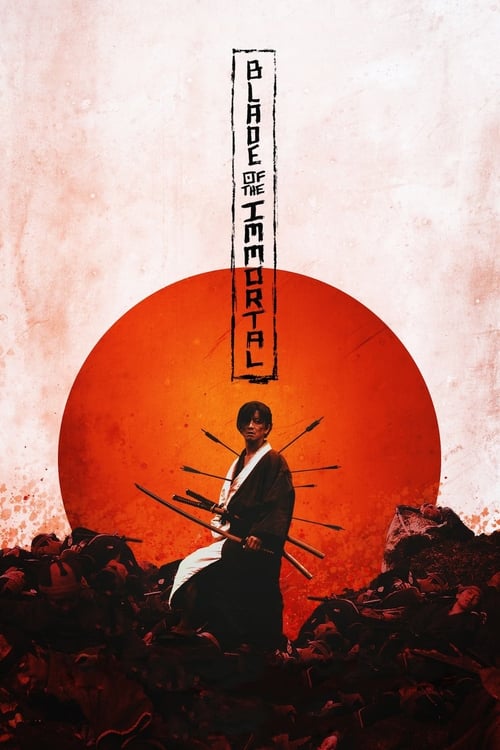
Blade of the Immortal (2017)
Directed by Takashi Miike
No — Blade of the Immortal is not woke, scoring 3 out of 100 on our wokeness meter.
Blade of the Immortal arrives as Takashi Miike's hundredth feature, a milestone he reportedly greeted with the shrug of a man who had simply been too busy to count.
Consciousness Markers
Rin and Makie are capable female characters, but they exist within a conventional chanbara revenge framework with no feminist thesis or commentary on patriarchy.
A wholly Japanese production with a Japanese cast playing Japanese characters; there is no diversity-casting agenda at work, merely a domestic genre film.
No LGBTQ+ characters, themes, or subtext appear anywhere in the revenge narrative.
The film is set in feudal Japan and concerns samurai factions; it engages no racial consciousness or identity politics.
No environmental themes or climate messaging of any kind.
The conflict is between samurai schools and the shogunate, not economic classes; no anti-capitalist critique is present.
No body-positivity themes; the film is a hyperviolent action piece with no interest in body image discourse.
No neurodivergence is depicted or discussed; Manji's sister's madness is a plot device, not a neurodiversity statement.
A fictional manga adaptation set in the Tokugawa era; it makes no revisionist claims about actual history.
Miike delivers kinetic swordplay and gore rather than moral instruction; there is no preachy messaging or audience lecturing.
Why it received this score
Blade of the Immortal arrives as Takashi Miike's hundredth feature, a milestone he reportedly greeted with the shrug of a man who had simply been too busy to count. The film adapts Hiroaki Samura's long-running manga about Manji, an immortal swordsman bound to avenge a murdered sister, and Rin, the orphan girl who recruits him. The film then devotes two hours and twenty minutes to dismemberment, double-pronged swords and chain-blades, executed with the choreographic care of a master craftsman. It is a chanbara picture, plain and simple, and it has no interest in being anything else.
The cast is entirely Japanese, playing Japanese characters in feudal Japan, so the question of representation never surfaces. The narrative concerns samurai factions and a shogunate contract, not economic classes, and the film offers no critique of capital because it has no interest in capital. Rin and Makie are capable women with swords, and Makie's wavering loyalty gives her a flicker of interiority, but the framework is the traditional revenge plot, and no thesis about patriarchy is advanced. Manji's sister Machi is mad in the way that nineteenth-century fiction uses madness, as a wound to motivate the hero. Nobody in the production appears to have consulted a discourse.
Miike stages his carnage with the enthusiasm of a man who has read his 300 and knows what sells. The film lectures no one. It has no environmental conscience, no body-image commentary, no revisionist claims about the Tokugawa era, and no LGBTQ subtext hiding in the dojo. There is blood, and there is a great deal of it. The result is a genre object from an older tradition, made for a domestic audience that wanted swordplay and received it. Judged against the cultural sensibilities of the present decade, it registers as almost perfectly inert. The sommelier may set down the glass. There is nothing in it.
Analysis generated by our Consciousness Algorithm


Synopsis
Manji, a highly skilled samurai, becomes cursed with immortality after a legendary battle. Haunted by the brutal murder of his sister, Manji knows that only fighting evil will regain his soul. He promises to help a young girl named Rin avenge her parents, who were killed by a group of master swordsmen led by ruthless warrior Anotsu. The mission will change Manji in ways he could never imagine.
Questions about Blade of the Immortal
Is Blade of the Immortal woke?
No — Blade of the Immortal is not woke, scoring 3 out of 100 on our wokeness meter. That earns it a verdict of Ultra Based.
Does Blade of the Immortal have any woke elements?
Very few. None of the 10 markers reaches 30, the level where a marker counts as present; the highest is Feminist Agenda at 5.
How does Blade of the Immortal compare to other 2017 movies?
It ranks #272 of the 309 films from 2017 we've scored; their average is 19. The wokest is I Am Not Your Negro (92).
How is the Woke Score calculated?
An AI-assisted process researches the film and its reception, scores it 0–100 on ten markers, then combines those into one 0–100 Woke Score. It measures a specific set of 2020s cultural themes, not film quality.