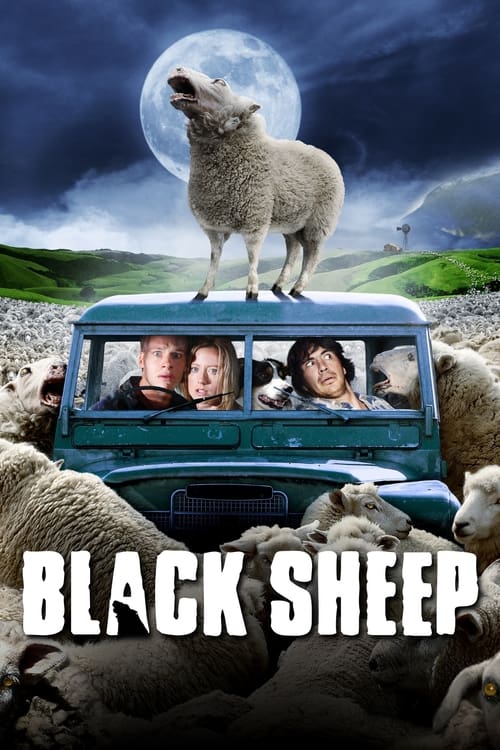
Black Sheep (2006)
Directed by Jonathan King
No — Black Sheep is not woke, scoring 6 out of 100 on our wokeness meter.
Black Sheep arrives from New Zealand in 2006 with a premise that any reasonable person would call unfilmable: a genetic experiment turns the nation's most placid livestock into carnivorous, infectious predators.
Consciousness Markers
Angus's genetically engineered sheep are pitched to international businesspersons who are promptly slaughtered, offering a faint anti-corporate jab, but the film has no economic thesis.
Environmental activists infiltrate the lab and genetic tampering drives the plot, but this is a horror-comedy device rather than an ecological sermon.
Experience is a capable female environmentalist who takes action, but the film makes no feminist argument or commentary on gender.
The film plays its outrageous premise entirely straight for laughs and never pauses to deliver a moral lesson.
The cast is almost entirely white New Zealand performers with no deliberate diversity casting or commentary on representation.
No LGBTQ+ characters, themes, or subtext appear anywhere in the film.
No engagement with race, racism, or racial identity whatsoever.
No body-positive themes or messaging present.
Henry's sheep phobia is a trauma-driven gag, not a depiction of neurodivergence.
No historical revisionism; the film is a contemporary genre romp.
Why it received this score
Black Sheep arrives from New Zealand in 2006 with a premise that any reasonable person would call unfilmable: a genetic experiment turns the nation's most placid livestock into carnivorous, infectious predators. Jonathan King directs it without a wink. The result is a film that understands something the genre often forgets, which is that absurdity lands hardest when nobody on screen acknowledges it. Weta Workshop supplies the viscera. The hills are green. The sheep are not. It premiered at Toronto's Midnight Madness, which tells you the intended audience and the intended hour.
For those of us who catalogue progressive sensibilities, the pickings here are thin, and I record that without complaint. Danielle Mason's environmentalist, Experience, infiltrates the laboratory and drives much of the action, though the screenplay never pauses to argue anything about gender. Her activism is a plot mechanism, a convenient way to get a stranger inside the building. Angus peddles his engineered flock to a room of international businesspersons who are promptly devoured, a glancing anti-corporate gesture and nothing more. The climax detonates the flock with captured methane, which smells faintly of an ecological point until you notice it is also a fart joke. Race, queerness, body image, neurodivergence: absent. Henry's ovine phobia is childhood trauma played for comedy, not a case study in anything.
Craft carries the remainder. The film is brisk, gruesome, and genuinely funny, and its refusal to sermonize reads now as a period artifact. No lesson is delivered. No audience is scolded. The final image, a sheep dog bleating like its charges, suggests the filmmakers cared about one subject, and that subject was sheep. I respect the discipline.
Analysis generated by our Consciousness Algorithm


Synopsis
After a childhood prank by his brother Angus causes Henry to develop a phobia of sheep, he must step up to the onslaught of a genetically-mutated man-eating flock with the help of his friend and a young environmentalist.
Questions about Black Sheep
Is Black Sheep woke?
No — Black Sheep is not woke, scoring 6 out of 100 on our wokeness meter. That earns it a verdict of Ultra Based.
Does Black Sheep have any woke elements?
Very few. None of the 10 markers reaches 30, the level where a marker counts as present; the highest is Eat the Rich at 15.
How does Black Sheep compare to other 2006 movies?
It ranks #121 of the 211 films from 2006 we've scored; their average is 11. The wokest is An Inconvenient Truth (92).
How is the Woke Score calculated?
An AI-assisted process researches the film and its reception, scores it 0–100 on ten markers, then combines those into one 0–100 Woke Score. It measures a specific set of 2020s cultural themes, not film quality.