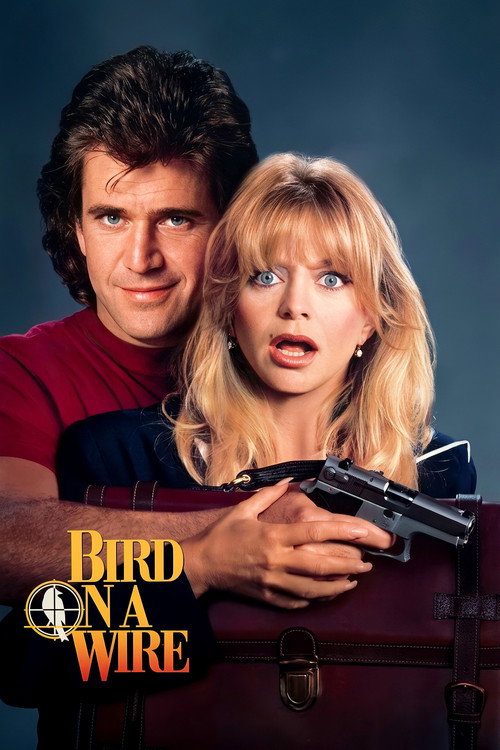
Bird on a Wire (1990)
Directed by John Badham
No — Bird on a Wire is not woke, scoring 0 out of 100 on our wokeness meter.
Bird on a Wire arrived in 1990 with two enormous stars, a Hans Zimmer score, and a title borrowed from a Leonard Cohen song, performed here by Aaron Neville.
Consciousness Markers
The cast includes Bill Duke and Clyde Kusatsu in supporting roles, but this is incidental 1990s casting rather than a deliberate modern representation-casting agenda.
No LGBTQ+ themes, characters, or subtext are present.
Goldie Hawn plays a professional woman, but the film treats her primarily as a romantic lead and damsel in distress, with no feminist agenda.
No racial themes, commentary, or consciousness are present.
No environmental or climate-related themes appear.
No critique of capitalism, wealth, or class structures is present.
The film includes cheesecake and beefcake shots, but no body-positivity messaging.
A character has dementia, but this is portrayed as a plot obstacle rather than neurodivergence representation.
No historical revisionism or reimagining of real events is present.
The film is a lightweight action-comedy with no preachy or lecture-like messaging.
Why it received this score
Bird on a Wire arrived in 1990 with two enormous stars, a Hans Zimmer score, and a title borrowed from a Leonard Cohen song, performed here by Aaron Neville. The film assembles these assets into a road movie about a man in witness protection who is recognized by an old flame, after which everyone runs, drives, and occasionally flies. The reviews were brutal and largely correct. One critic suggested the picture should have been sold in a plain white package labeled simply Movie. It opened at number one and grossed over $138 million against a $20 million budget, which settles the question of what it was for.
The social ledger is blank. Goldie Hawn plays an attorney with a career, and the screenplay converts her within twenty minutes into a hostage who screams on cue. Mel Gibson trades her watch for a car. Nobody in the production regards this as a problem, and the film offers no framework for doing so. Bill Duke and Clyde Kusatsu appear in supporting roles, incidental casting with no commentary attached. A character with dementia functions as an obstacle, a man who cannot remember the protagonist and therefore cannot help him, which is a plot mechanism and nothing more. The camera lingers on the stars' bodies in the manner of a swimwear catalog, which is exploitation and not empowerment, and the film knows the difference well enough to keep its tongue in its cheek.
The final act releases zoo animals, kills a man with a tiger, drowns another in a piranha pool, and electrocutes the villain on a collapsing bridge. This is the film's entire value system: escalation, spectacle, and a yacht at the end. The villain is a drug-dealing former DEA agent, a crime story convention and not a critique of anything. No argument is being made about money, power, identity, or the planet. It is a 1990 studio vehicle that has aged into a document of what studios used to buy, and it leaves the classifier with nothing to record.
{"thematic_tags": ["box_office_number_one"]}
Analysis generated by our Consciousness Algorithm
Part of


Synopsis
An FBI informant has kept his new identity secret for 15 years. Now an old flame has recognised him, and the bad guys are back for revenge.
Questions about Bird on a Wire
Is Bird on a Wire woke?
No — Bird on a Wire is not woke, scoring 0 out of 100 on our wokeness meter. That earns it a verdict of Ultra Based.
Does Bird on a Wire have any woke elements?
No. All 10 markers score zero.
How does Bird on a Wire compare to other 1990 movies?
It ranks #54 of the 68 films from 1990 we've scored; their average is 9. The wokest is Nightbreed (60).
How is the Woke Score calculated?
An AI-assisted process researches the film and its reception, scores it 0–100 on ten markers, then combines those into one 0–100 Woke Score. It measures a specific set of 2020s cultural themes, not film quality.