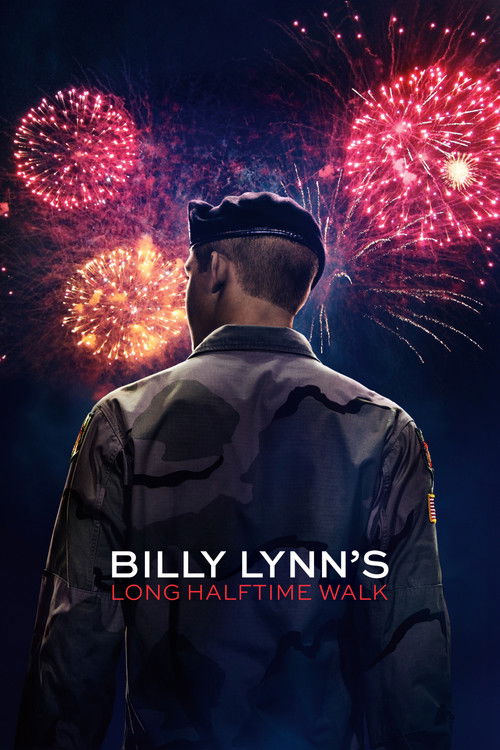
Billy Lynn's Long Halftime Walk (2016)
Directed by Ang Lee
No — Billy Lynn's Long Halftime Walk is not especially woke, scoring 27 out of 100 on our wokeness meter.
Ang Lee's adaptation of Ben Fountain's novel arrives as a technical curiosity and a dramatic shrug.
Consciousness Markers
The film's spine is a critique of the commodification of soldiers and war: Cowboys owner Norm Oglesby lowballs the squad at $5,500 apiece, the halftime spectacle turns heroism into product, and the media manufactures a narrative for profit.
The Bravo Squad is a naturally diverse ensemble (Chris Tucker, Arturo Castro, Ismael Cruz Córdova, Brian 'Astro' Bradley, Mason Lee), reflecting the real demographics of the US military without any commentary or self-congratulation.
The film carries a thematic argument about the gap between America's perception of war and its reality, but Ang Lee delivers it through impressionistic flashbacks and character rather than direct sermonizing.
Kristen Stewart's Kathryn has some agency in trying to secure her brother's discharge, and Faison the cheerleader is briefly more than a prop, but the film is squarely a male soldier's story with no feminist framework.
The squad's diversity is present but unremarked; the film's critique is of class and spectacle, not race, and it engages no racial consciousness themes.
PTSD is depicted (Sykes's violent reaction to the pyrotechnics, Billy's flashbacks), but it is framed as combat trauma rather than the modern neurodivergence-as-identity framework.
No LGBTQ+ characters, themes, or subtext appear anywhere in the film.
No environmental or climate content whatsoever.
No body positivity themes; the disfigurement of Kathryn is treated as a plot device rather than a body-image statement.
A fictional narrative based on a novel; it does not rewrite or reinterpret historical events.
Why it received this score
Ang Lee's adaptation of Ben Fountain's novel arrives as a technical curiosity and a dramatic shrug. The film follows Billy Lynn and the soldiers of Bravo Squad through a Thanksgiving halftime show, cutting between stadium spectacle and Iraqi firefights. The squad is diverse in the unforced manner of an actual military unit. Chris Tucker, Arturo Castro, and Ismael Cruz Cordova share the frame without the screenplay pausing to congratulate itself. There is no queer thread, no climate sermon, no revision of the historical record. The sister's disfigurement is a plot device, not a body-image statement. PTSD appears as combat trauma, not as an identity framework. Kristen Stewart's Kathryn has a flicker of agency. The cheerleader has a moment of personality. This remains a soldier's story, told from a male vantage. Race is not the film's organizing lens. Class and spectacle are.
Where the film does locate its argument is in the machinery of commodification. The Dallas owner offers the squad a pittance for their story. The halftime production turns heroism into a product launch. A producer circles with a movie deal. The media manufactures a narrative and sells it back to the public. This is the film's sharpest vein, and it runs deep. Ang Lee does not stop the action to deliver a lecture. He lets the critique seep through flashbacks, awkward small talk, and the dead-eyed pageantry of the stadium. The result is a social consciousness that feels earned instead of inserted. It is an argument about perception and profit, not a checklist of causes.
Billy Lynn's Long Halftime Walk is an expensive experiment that never coheres. The high frame rate makes every pore visible and every emotion strangely distant. The film's cultural awareness is real but narrow. It understands that soldiers become merchandise. It has little to say about gender, sexuality, race, or the environment. Its women are sketches. Its politics stop at the cash register. The enterprise has the air of a sommelier presenting a difficult vintage: technically accomplished, faintly medicinal, and hard to recommend without a caveat. We respect the ambition. We do not enjoy the pour.
Analysis generated by our Consciousness Algorithm


Synopsis
19-year-old Billy Lynn is brought home for a victory tour after a harrowing Iraq battle. Through flashbacks the film shows what really happened to his squad – contrasting the realities of war with America's perceptions.
Questions about Billy Lynn's Long Halftime Walk
Is Billy Lynn's Long Halftime Walk woke?
No — Billy Lynn's Long Halftime Walk is not especially woke, scoring 27 out of 100 on our wokeness meter. That earns it a verdict of Based.
Does Billy Lynn's Long Halftime Walk have any woke elements?
2 of the 10 markers register at 30 or above, led by Eat the Rich (60) and Representation Casting (30). On Eat the Rich: The film's spine is a critique of the commodification of soldiers and war: Cowboys owner Norm Oglesby lowballs the squad at $5,500 apiece, the halftime spectacle turns heroism into product, and the media manufactures a narrative for profit.
How does Billy Lynn's Long Halftime Walk compare to other 2016 movies?
It ranks #50 of the 285 films from 2016 we've scored; their average is 16. The wokest is 13th (92).
How is the Woke Score calculated?
An AI-assisted process researches the film and its reception, scores it 0–100 on ten markers, then combines those into one 0–100 Woke Score. It measures a specific set of 2020s cultural themes, not film quality.