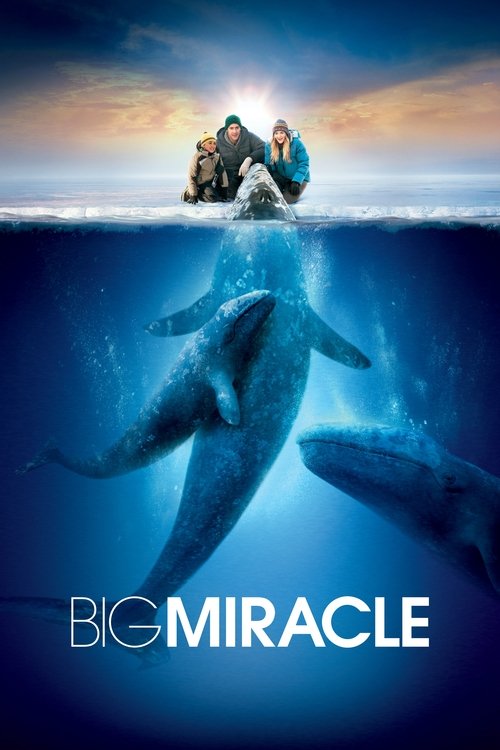
Big Miracle (2012)
Directed by Ken Kwapis
No — Big Miracle is not especially woke, scoring 25 out of 100 on our wokeness meter.
Big Miracle arrives from 2012, which in the taxonomy of these matters places it just before the cultural temperature spiked.
Consciousness Markers
Greenpeace activism, an oil executive, and a passing reference to the Exxon Valdez spill give the film a mild environmentalist streak, though the focus is animal rescue rather than climate advocacy.
The cast is overwhelmingly white, though Inupiat whale hunters appear as supporting characters in the Alaskan setting. Their presence is natural to the story rather than a casting statement.
The story includes Inupiat whale hunters and a cross-cultural rescue coalition, but race is treated as local color rather than a subject of consciousness or critique.
There is a gentle environmental and cooperation moral, but it is delivered through family-drama sentiment rather than preachy sermonizing.
Drew Barrymore's Greenpeace volunteer and Kristen Bell's ambitious reporter are capable women, but the film offers no explicit feminist thesis or gender-politics commentary.
An oil-company executive is among the factions, but the film's message is cooperative problem-solving rather than anti-capitalist indictment.
No LGBTQ+ characters or themes of any kind appear in the film.
No body-positivity themes or messaging are present.
No neurodivergent characters or themes are depicted.
The film is a fairly faithful dramatization of the 1988 Operation Breakthrough rescue, not a revisionist reframing of history.
Why it received this score
Big Miracle arrives from 2012, which in the taxonomy of these matters places it just before the cultural temperature spiked. Ken Kwapis directs the 1988 saga of three gray whales trapped beneath the Alaskan ice near Point Barrow, and the improbable coalition that assembles to free them: a Greenpeace volunteer, Inupiat whale hunters, an oil executive, the National Guard, two Minnesotan entrepreneurs with de-icing machines, and eventually a Soviet icebreaker. The film is warm, well made, and entirely sincere. It is also, for our purposes, a specimen of modest interest.
The environmental streak is real but shallow. Greenpeace gets a favorable glow, an oil man is folded into the rescue instead of villainized, and the Exxon Valdez spill earns a single mention in the closing narration. That is a mood, not a movement. The Inupiat hunters appear as supporting figures whose presence is native to the setting; the film treats their culture as texture, not as a subject for critique. Drew Barrymore's activist and Kristen Bell's climbing reporter are competent women operating inside a story that never pauses to argue about gender. Nobody lectures. The moral, when it surfaces, is that cooperation beats rivalry, delivered through family sentiment and a dead whale calf.
Which leaves us with a curious artifact: a film about environmentalism, cross-cultural rescue, and the thawing of Cold War hostility that declines to convert any of it into a thesis. It wants us to feel good, and then it wants us to go home. There is something almost quaint in that restraint, and the sommelier in me notes it with a certain wistfulness. The vintage is pleasant. It is not fortified. The whales are freed, the Soviet ship does its work, and the audience is released into the evening without having been scolded about anything at all. A gentle, decent, unremarkable bottle, best served at room temperature to a family on a Sunday afternoon, and then forgotten by Tuesday.
One notes, finally, that a movie can be about saving the planet and still possess no interest in the vocabulary we now use to discuss it. This one saves three whales and asks for nothing in return. Charming, in its way. Also, for the ledger, largely irrelevant to the matter at hand.
Analysis generated by our Consciousness Algorithm
Part of


Synopsis
A small-town news reporter and a Greenpeace volunteer enlist the help of rival superpowers to save three majestic gray whales trapped under the ice of the Arctic Circle.
Questions about Big Miracle
Is Big Miracle woke?
No — Big Miracle is not especially woke, scoring 25 out of 100 on our wokeness meter. That earns it a verdict of Based.
Does Big Miracle have any woke elements?
2 of the 10 markers register at 30 or above, led by Climate Crusade (40) and Representation Casting (35). On Climate Crusade: Greenpeace activism, an oil executive, and a passing reference to the Exxon Valdez spill give the film a mild environmentalist streak, though the focus is animal rescue rather than climate advocacy.
How does Big Miracle compare to other 2012 movies?
It ranks #32 of the 230 films from 2012 we've scored; their average is 12. The wokest is Killing Them Softly (92).
How is the Woke Score calculated?
An AI-assisted process researches the film and its reception, scores it 0–100 on ten markers, then combines those into one 0–100 Woke Score. It measures a specific set of 2020s cultural themes, not film quality.