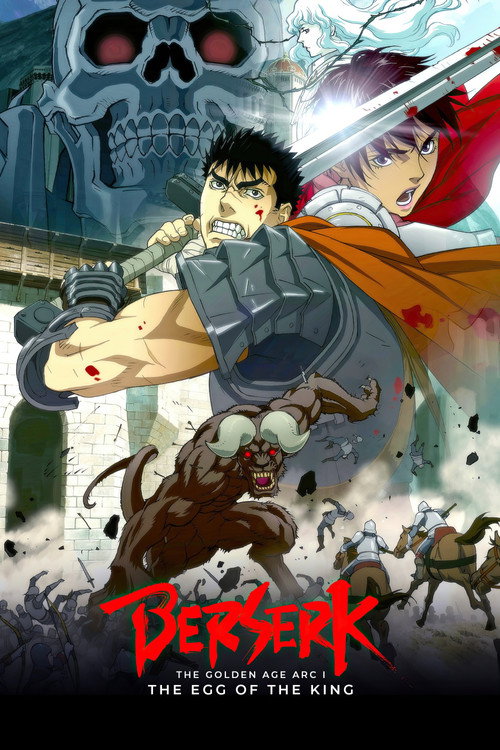
Berserk: The Golden Age Arc I - The Egg of the King (2012)
Directed by Toshiyuki Kubooka
No — Berserk: The Golden Age Arc I - The Egg of the King is not woke, scoring 4 out of 100 on our wokeness meter.
Berserk: The Golden Age Arc I - The Egg of the King is the first film in a trilogy adapting Kentaro Miura's manga, and it concerns itself with mercenary warfare, feudal politics, and the slow-burning bond between Guts and Griffith.
Consciousness Markers
The intense, famously ambiguous bond between Guts and Griffith carries homoerotic subtext, but it is presented as tragic character drama rather than an explicit LGBTQ+ social theme.
Casca is a capable swordswoman, but reviewers specifically flagged the film's 'pervasive misogyny,' and the story offers no feminist thesis or critique of patriarchy.
The cast is a standard Japanese voice ensemble and the medieval-European-coded characters (including the dark-skinned Casca) exist naturally within the source material without any modern representation commentary.
No racial themes, commentary, or consciousness appear; the setting is a fantasy medieval war with no engagement with race as a subject.
No environmental or climate themes whatsoever.
The narrative concerns mercenary warfare, ambition, and feudal politics, with no critique of capitalism or wealth.
No body-positivity themes; the film is defined by brutal violence and idealized warrior physiques.
No neurodivergence themes or characters are present.
The film is pure dark fantasy with no historical revisionism.
This is a violent action-drama with no preachy or didactic messaging; it delivers spectacle and tragedy, not sermons.
Why it received this score
Berserk: The Golden Age Arc I - The Egg of the King is the first film in a trilogy adapting Kentaro Miura's manga, and it concerns itself with mercenary warfare, feudal politics, and the slow-burning bond between Guts and Griffith. The voice cast is a standard Japanese ensemble, and characters such as the dark-skinned Casca exist naturally within the medieval-European-coded setting without any modern representation commentary. The intense, famously ambiguous relationship between the two male leads carries homoerotic subtext, but the film presents it as tragic character drama, not as an explicit LGBTQ+ social theme. That subtext earns a modest nod, though it is never the point.
Casca is a capable swordswoman, yet the film offers no feminist thesis and no critique of patriarchy. Reviewers have flagged pervasive misogyny, and the story treats her primarily as a foil for the men. The film is defined by brutal violence and idealized warrior physiques, with no body-positivity themes. There is no racial consciousness, no climate crusade, no eat-the-rich sentiment, no neurodivergence, no revisionist history, and no lecture energy. The narrative concerns mercenary ambition and feudal power struggles, not capitalism or wealth critique. It is pure dark fantasy, and it makes no apologies for that.
What we have here is a violent action-drama that delivers spectacle and tragedy, not sermons. The film has no interest in preaching to its audience about contemporary social issues. It is a grim, bloody medieval war story with demons and ambition, and its cultural awareness is minimal. The experience is one of rousing battle sequences and emotionally scarred characters, and the film remains committed to that grim spectacle throughout. For those seeking modern progressive sensibilities, this is a barren field. For those seeking a well-animated dark fantasy, it is adequate.
Analysis generated by our Consciousness Algorithm
Synopsis
Guts, an immensely strong sword-for-hire, has little direction in his life, simply fighting one battle after the next. However, this all changes suddenly when he meets and is bested by Griffith, a beautiful and charismatic young man who leads the Band of the Hawk mercenary army. After Guts joins the Band and the relationship between the two men begins to blossom, Casca, the tough, lone swordswoman in the Band of the Hawk, struggles to accept Guts and the influence he has on the world around her. While the two men begin to fight together, Griffith continues to rise to power, all seemingly in order to reach his mysterious, prophesied goals. What lengths will Guts and Griffith go to in order to reach these goals, and where will fate take the two men?
Questions about Berserk: The Golden Age Arc I - The Egg of the King
Is Berserk: The Golden Age Arc I - The Egg of the King woke?
No — Berserk: The Golden Age Arc I - The Egg of the King is not woke, scoring 4 out of 100 on our wokeness meter. That earns it a verdict of Ultra Based.
Does Berserk: The Golden Age Arc I - The Egg of the King have any woke elements?
Very few. None of the 10 markers reaches 30, the level where a marker counts as present; the highest is LGBTQ+ Themes at 10.
How does Berserk: The Golden Age Arc I - The Egg of the King compare to other 2012 movies?
It ranks #152 of the 230 films from 2012 we've scored; their average is 12. The wokest is Killing Them Softly (92).
How is the Woke Score calculated?
An AI-assisted process researches the film and its reception, scores it 0–100 on ten markers, then combines those into one 0–100 Woke Score. It measures a specific set of 2020s cultural themes, not film quality.