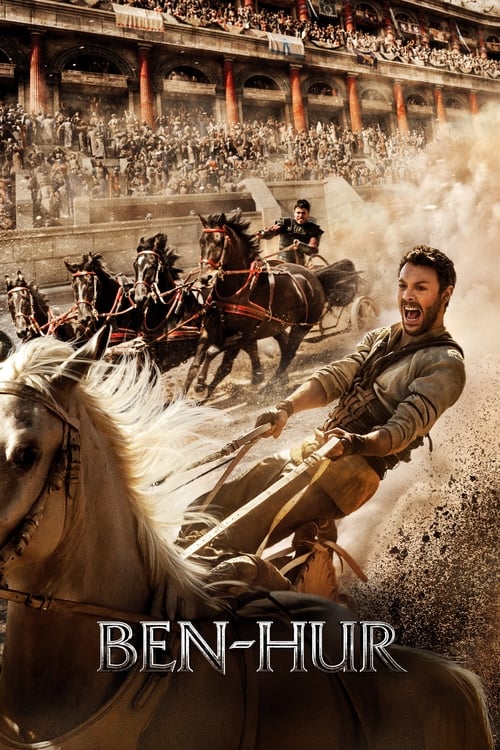
Ben-Hur (2016)
Directed by Timur Bekmambetov
No — Ben-Hur is not especially woke, scoring 34 out of 100 on our wokeness meter.
The 2016 Ben-Hur is the fifth film adaptation of Lew Wallace's novel, a re-adaptation with a script polished by John Ridley and directed by Timur Bekmambetov.
Consciousness Markers
The film is explicitly a 'new interpretation' of the source material, altering the focus from pure revenge to themes of forgiveness and giving Jesus a prominent role.
The narrative heavily features the themes of Roman colonization and the brutal reality of slavery, which was a key focus of the script's revision.
The character of Esther is specifically noted in the research as being portrayed as 'strong-willed and independent,' representing a modern revision of a traditionally passive female role.
The film features an international cast and diverse roles, such as the Nubian Sheik, which is a step up from previous versions, but the core setting remains traditional for the genre.
While the film critiques Roman imperial oppression and slavery, it is a massive, high-budget studio blockbuster, meaning its structural critique is limited to the thematic level.
The film is driven by action and character conflict rather than modern, didactic social commentary or philosophical lectures.
There are no discernible LGBTQ+ themes, characters, or subtext present in the narrative or character development.
The film focuses entirely on ancient political and religious drama and contains no commentary on environmental issues or climate change.
There is no focus on body image, diverse body types, or the celebration of physical forms within the film's narrative.
No characters are depicted with neurodivergent traits or conditions.
Why it received this score
The 2016 Ben-Hur is the fifth film adaptation of Lew Wallace's novel, a re-adaptation with a script polished by John Ridley and directed by Timur Bekmambetov. It offers an international cast and places Morgan Freeman's Nubian sheik in a position of real power, which gives the production a modest representational pulse. The film does not spend time on modern identity categories. There is no LGBTQ subtext, no body-image discourse, no neurodivergent arc, and no environmental sermon. Its social awareness is ancient, theological, and imperial, which keeps several contemporary markers at zero without any apparent struggle.
The stronger currents are historical and racial. Ridley came to the project after 12 Years a Slave, and the script returns to Roman colonization, slavery, and the brutal machinery of empire. Judah's years in the galley and his family's suffering give the film a genuine weight. Esther is expanded into a strong-willed and independent figure, a mild feminist revision of a traditionally passive role. Jesus is given a prominent place, and the story tilts from vengeance toward forgiveness. That makes the film a new interpretation of familiar material, though the anti-capitalist charge stays safely on the screen. It can indict Rome. It cannot indict the $100 million apparatus that produced it.
The lecture energy is low. This is a chariot race and a passion play, not a seminar. The film wants to entertain and evangelize, and it does so with expensive earnestness. The result is a curious artifact: too traditional to satisfy the more strident cultural demands of its moment, too polished to be dismissed as mere noise. The chariot race still has horsepower. The rest often feels like a museum exhibit with better visual effects. As a study in social consciousness, it registers as a faint pulse, mostly biblical, mildly progressive, and entirely uninterested in the modern sermon.
Analysis generated by our Consciousness Algorithm
Part of


Synopsis
A falsely accused nobleman survives years of slavery to take vengeance on his best friend who betrayed him.
Questions about Ben-Hur
Is Ben-Hur woke?
No — Ben-Hur is not especially woke, scoring 34 out of 100 on our wokeness meter. That earns it a verdict of Based.
Does Ben-Hur have any woke elements?
4 of the 10 markers register at 30 or above, led by Revisionist History (60), Racial Consciousness (55) and Feminist Agenda (45). On Revisionist History: The film is explicitly a 'new interpretation' of the source material, altering the focus from pure revenge to themes of forgiveness and giving Jesus a prominent role.
How does Ben-Hur compare to other 2016 movies?
It ranks #32 of the 285 films from 2016 we've scored; their average is 16. The wokest is 13th (92).
How is the Woke Score calculated?
An AI-assisted process researches the film and its reception, scores it 0–100 on ten markers, then combines those into one 0–100 Woke Score. It measures a specific set of 2020s cultural themes, not film quality.