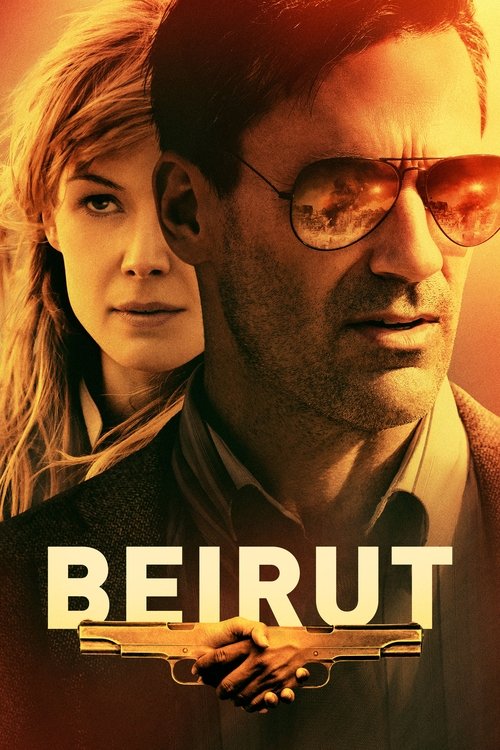
Beirut (2018)
Directed by Brad Anderson
No — Beirut is not woke, scoring 11 out of 100 on our wokeness meter.
For a genre picture assembled from a screenplay that sat dormant since 1991, Beirut arrives with an agreeable mustiness.
Consciousness Markers
Rosamund Pike's Sandy Crowder is a competent CIA operative who steals funds, leads an assault, and applies for station chief, giving the film a modestly capable female presence. It is not, however, a film organized around a feminist thesis.
The film engages the Palestinian-Israeli conflict and Lebanese Civil War, but its dominant critical reception faulted it for orientalist stereotyping and dehumanizing Arabs rather than advancing racial consciousness. Engagement with the region is not the same as progressive racial awareness.
The film is a conventional espionage thriller that largely avoids preaching, though the closing newsreel montage gestures at a message about American entanglement in the Middle East.
The film was widely criticized for casting no Lebanese actors and centering a white American savior (Jon Hamm) in a Middle Eastern setting, with the cast dominated by Western leads. This is a failure of authentic representation rather than an example of it.
The film weaves a fictional thriller into real events (the Munich massacre, the 1982 Israeli invasion, the 1983 bombings), and its trailer was criticized for distorting Lebanese history as '2,000 years of revenge.' This is historical distortion, but not the progressive reframing that defines the marker.
No LGBTQ+ characters, themes, or subtext appear anywhere in the film.
No environmental or climate themes are present.
A subplot involves a CIA officer embezzling embassy funds, but this is a corruption plot device, not a critique of capitalism or wealth inequality.
No body positivity themes or body-diverse representation are present.
No neurodivergent characters or themes are depicted.
Why it received this score
For a genre picture assembled from a screenplay that sat dormant since 1991, Beirut arrives with an agreeable mustiness. Brad Anderson directs Jon Hamm as Mason Skiles, a broken American diplomat pulled back to 1982 Lebanon to negotiate for a kidnapped CIA friend. The plotting is tight, the atmosphere is thick, and the whole enterprise carries the leather-bound smell of an older, less anxious tradition in espionage cinema. Nobody involved seems to be reaching for a thesis.
The cultural ledger here is thin, and mostly negative. Lebanon serves as a backdrop and a hazard, not a population; the cast is a wall of Western faces, and the Lebanese exist largely as scenery or threat. Rosamund Pike's Sandy Crowder is the exception worth a nod, a competent operative who embezzles four million dollars from her own station, leads an armed snatch, and then applies for the vacant station chief post. That is a respectable piece of business, though the film is not built around her or around any argument about her. On race, the movie touches the Palestinian-Israeli conflict and the civil war without arriving at much awareness; the marketing's promise of "2,000 years of revenge" did the damage, and the critical consensus about orientalist framing has followed it since.
The remaining columns sit empty. No queer presence, no environmental concern, no celebration of body diversity, no neurodivergent characters, no serious quarrel with capital (an embassy embezzlement subplot is a mechanism, not a critique). A closing newsreel montage of the 1982 invasion and the 1983 bombings reaches for a lesson about American entanglement, and that is the extent of the sermonizing. Mostly this is a professional thriller that keeps its politics in the background, which in 2018 counts as a kind of restraint.
Analysis generated by our Consciousness Algorithm


Synopsis
In 1980s Beirut, Mason Skiles is a former U.S. diplomat who is called back into service to save a colleague from the group that is possibly responsible for his own family's death. Meanwhile, a CIA field agent who is working under cover at the American embassy is tasked with keeping Mason alive and ensuring that the mission is a success.
Questions about Beirut
Is Beirut woke?
No — Beirut is not woke, scoring 11 out of 100 on our wokeness meter. That earns it a verdict of Ultra Based.
Does Beirut have any woke elements?
Very few. None of the 10 markers reaches 30, the level where a marker counts as present; the highest is Feminist Agenda at 22.
How does Beirut compare to other 2018 movies?
It ranks #184 of the 325 films from 2018 we've scored; their average is 20. The wokest is Return (92).
How is the Woke Score calculated?
An AI-assisted process researches the film and its reception, scores it 0–100 on ten markers, then combines those into one 0–100 Woke Score. It measures a specific set of 2020s cultural themes, not film quality.