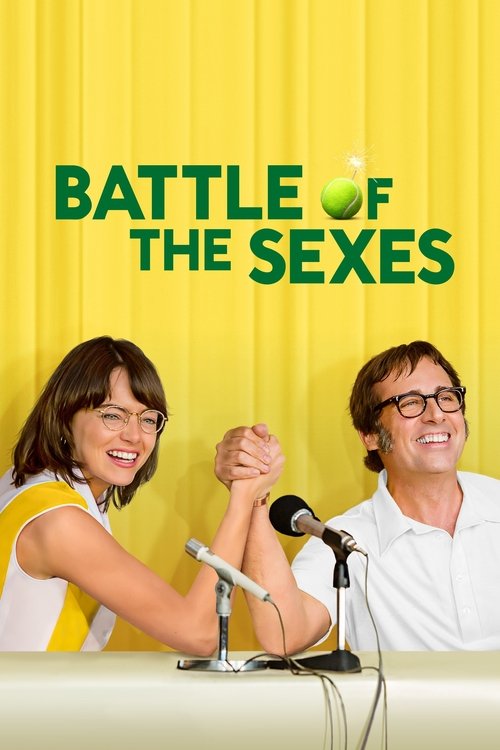
Battle of the Sexes (2017)
Directed by Jonathan Dayton
Yes — Battle of the Sexes is woke, scoring 63 out of 100 on our wokeness meter.
Battle of the Sexes arrives with the confident gait of a film that knows precisely which buttons it intends to press.
Consciousness Markers
The entire plot is a dramatization of the fight for equal prize money and the founding of the WTA, with Kramer's chauvinism as the explicit villain of the piece.
Billie Jean King's affair with hairdresser Marilyn Barnett is a central, sympathetic subplot, and the epilogue explicitly notes her long-term same-sex relationship.
The film is built around a female ensemble (Stone, Silverman, Riseborough, Shue, Morales) and foregrounds women athletes, though the cast remains predominantly white.
Critics noted the film 'smartly serves up a volley of present-day parallels,' giving it a mild but persistent message-forward tone beneath its dramedy surface.
There is grumbling about unequal pay and exploitative promoters, but the critique is framed as gender fairness within the sports business rather than a systemic anti-capitalist argument.
The film is a loose, crowd-pleasing adaptation of real events, but it does not substantially rewrite history for ideological ends.
The narrative is almost exclusively concerned with gender equity; race is essentially absent from the film's thematic concerns.
No environmental or climate content whatsoever.
No body-positivity themes are present.
No neurodivergence content; Riggs's gambling is framed as addiction, not neurodivergence.
Why it received this score
Battle of the Sexes arrives with the confident gait of a film that knows precisely which buttons it intends to press. It reconstructs the 1973 exhibition match between Billie Jean King and Bobby Riggs, and it does so with the tidy craftsmanship of a prestige dramedy: warm lighting, sharp costumes, a Nicholas Britell score humming with import. Simon Beaufoy's script treats the fight for equal prize money as the spine of the story, and Jack Kramer's sneering contempt for women's tennis supplies a villain we can point at without ambiguity. The Original Nine sign their names, the tour is born, and the audience is invited to applaud. Competent. Agreeable. Entirely pleased with its own positions.
Emma Stone plays King with a tight, wary intelligence, and the film grants her a private life that a lesser production would have filed under trivia. Her affair with the hairdresser Marilyn Barnett is handled with sympathy and genuine tenderness, and the closing text, noting her eventual long-term relationship with a woman, extends that sympathy into the present tense. On race, the picture is nearly mute; this is a story about gender, and it declines to widen the lens. Riggs's gambling is presented as addiction, not as any matter of neurology, and no character pauses to contemplate the climate, their body image, or their position on a spectrum. The economic complaint never rises above the level of a payroll dispute.
So we have a well-tailored entertainment that smuggles its 2017 parallels into a 1973 setting and trusts us to notice. The sermon is brief but sincere. The tennis is better than the thesis. It is a pleasant vintage, poured with care, and it goes down without resistance, like a sports movie that has read the room and decided the room would prefer to be flattered.
Analysis generated by our Consciousness Algorithm
Part of


Synopsis
The true story of the 1973 tennis match between world number one Billie Jean King and ex-champ and serial hustler Bobby Riggs.
Questions about Battle of the Sexes
Is Battle of the Sexes woke?
Yes — Battle of the Sexes is woke, scoring 63 out of 100 on our wokeness meter. That earns it a verdict of Woke.
What makes Battle of the Sexes woke?
4 of the 10 markers register at 30 or above, led by Feminist Agenda (82), LGBTQ+ Themes (78) and Representation Casting (55). On Feminist Agenda: The entire plot is a dramatization of the fight for equal prize money and the founding of the WTA, with Kramer's chauvinism as the explicit villain of the piece.
How does Battle of the Sexes compare to other 2017 movies?
It ranks #12 of the 309 films from 2017 we've scored; their average is 19. The wokest is I Am Not Your Negro (92).
How is the Woke Score calculated?
An AI-assisted process researches the film and its reception, scores it 0–100 on ten markers, then combines those into one 0–100 Woke Score. It measures a specific set of 2020s cultural themes, not film quality.