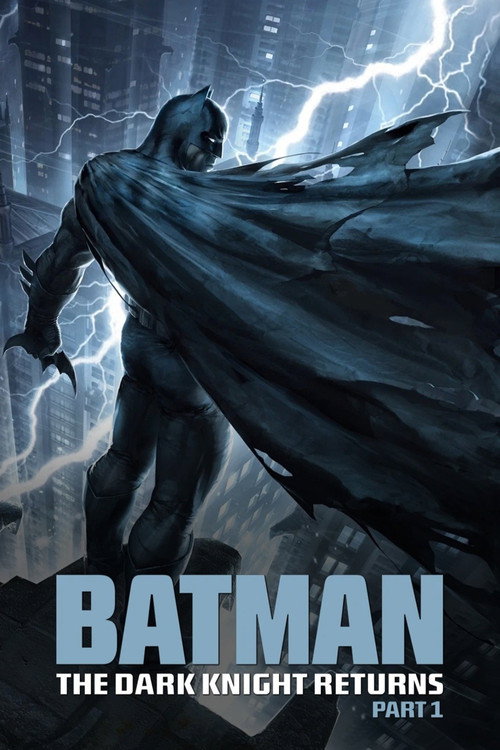
Batman: The Dark Knight Returns, Part 1 (2012)
Directed by Jay Oliva
No — Batman: The Dark Knight Returns, Part 1 is not woke, scoring 16 out of 100 on our wokeness meter.
Frank Miller's vision of an aging Bruce Wayne, adapted here into a brisk animated feature, arrives with the grim determination of a man pulling on a cape that no longer fits.
Consciousness Markers
Carrie Kelley is a proactive 13-year-old girl who becomes Robin and saves Batman, offering a notable female hero in a traditionally male role.
Features a female Robin (Carrie Kelley) and a Black voice actor for the Mutant Leader, providing some gender and racial diversity in the cast.
No LGBTQ+ themes or characters are present in this part of the story.
The story does not engage with racial themes or commentary; the Mutant gang is depicted as a multiracial group without racial focus.
No environmental or climate-related themes are present.
The film critiques media sensationalism and social decay, but does not advance an anti-capitalist or eat-the-rich message.
No body positivity themes or diverse body representations are present.
No neurodivergent characters or themes are present.
The film is a fictional superhero story and does not revise historical events.
The film delivers its themes through action and dialogue, but does not lecture the audience on social justice issues.
Why it received this score
Frank Miller's vision of an aging Bruce Wayne, adapted here into a brisk animated feature, arrives with the grim determination of a man pulling on a cape that no longer fits. Gotham has decayed. The Mutants roam the streets. Batman, ten years retired and fifty-five years old, returns to the cowl because the city demands it. The film is a study in exhaustion and violence, faithful to its source, uninterested in moral instruction. It wants to show us a broken man doing broken work, and it does so with a straight face and a great deal of rain.
The social consciousness on display is modest and largely incidental. Carrie Kelley, a thirteen-year-old girl, takes up the Robin mantle, and she is not decorative. She saves Batman, she fights, she earns her place, which grants the film a mild feminist credential that the source material arguably stumbled into. The voice cast includes Gary Anthony Williams as the Mutant Leader, a piece of color-blind casting that registers as unremarkable and is treated as such. There is no racial commentary here, no engagement with identity as theme. The Mutant gang is simply a multiracial mob, which is to say it is a mob.
Beyond that, the ledger is empty. The romantic currents, such as they are, stay conventional. No character wrestles with body image, neurodivergence, or the climate. The film's contempt is reserved for television pundits and urban decay, not for capital as such. And it never stops to explain itself. The themes arrive through fists and voiceover, not through a lecture. It is a superhero story, and it remains content to be one.
Analysis generated by our Consciousness Algorithm
Part of


Synopsis
Batman has not been seen for ten years. A new breed of criminal ravages Gotham City, forcing 55-year-old Bruce Wayne back into the cape and cowl. But, does he still have what it takes to fight crime in a new era?
Questions about Batman: The Dark Knight Returns, Part 1
Is Batman: The Dark Knight Returns, Part 1 woke?
No — Batman: The Dark Knight Returns, Part 1 is not woke, scoring 16 out of 100 on our wokeness meter. That earns it a verdict of Ultra Based.
Does Batman: The Dark Knight Returns, Part 1 have any woke elements?
1 of the 10 markers register at 30 or above, led by Feminist Agenda (30). On Feminist Agenda: Carrie Kelley is a proactive 13-year-old girl who becomes Robin and saves Batman, offering a notable female hero in a traditionally male role.
How does Batman: The Dark Knight Returns, Part 1 compare to other 2012 movies?
It ranks #54 of the 230 films from 2012 we've scored; their average is 12. The wokest is Killing Them Softly (92).
How is the Woke Score calculated?
An AI-assisted process researches the film and its reception, scores it 0–100 on ten markers, then combines those into one 0–100 Woke Score. It measures a specific set of 2020s cultural themes, not film quality.